
‘It was senseless violence and destruction’
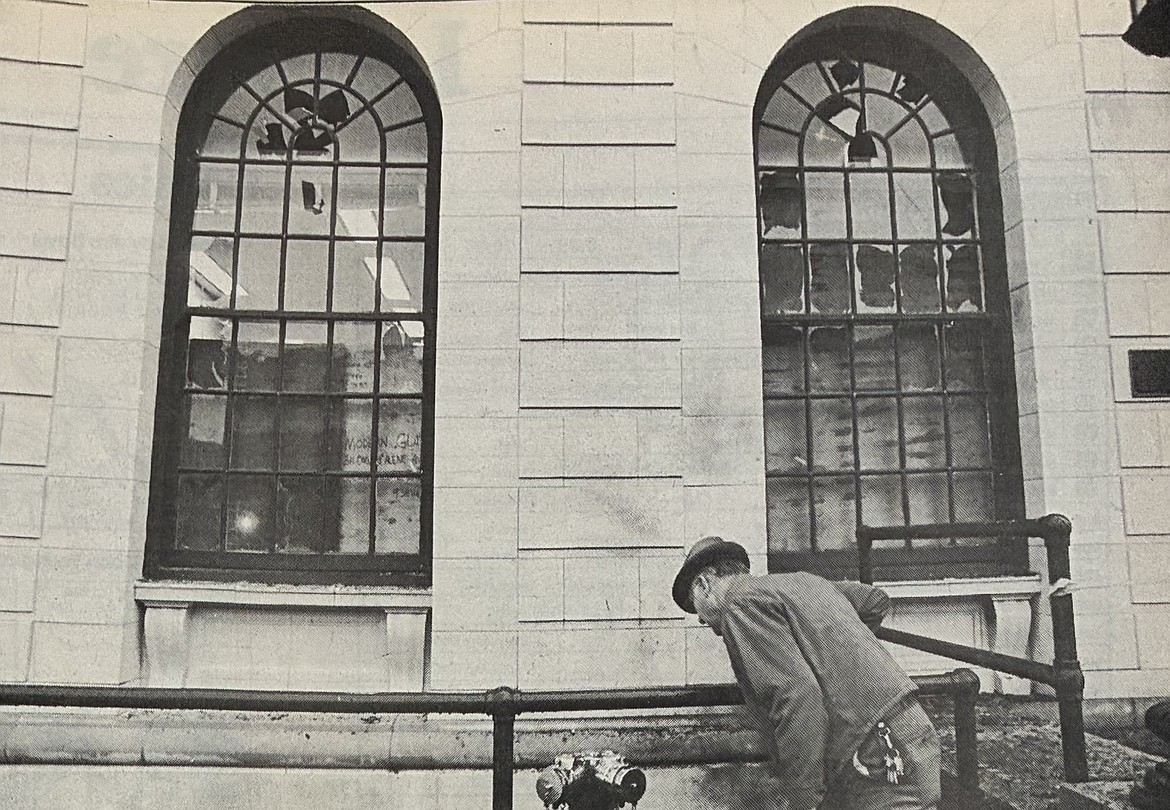
In 1986, a Federal Building maintenance worker searched for damage after windows in the structure were shredded by a bomb blast.
Coeur d'Alene Press Archive
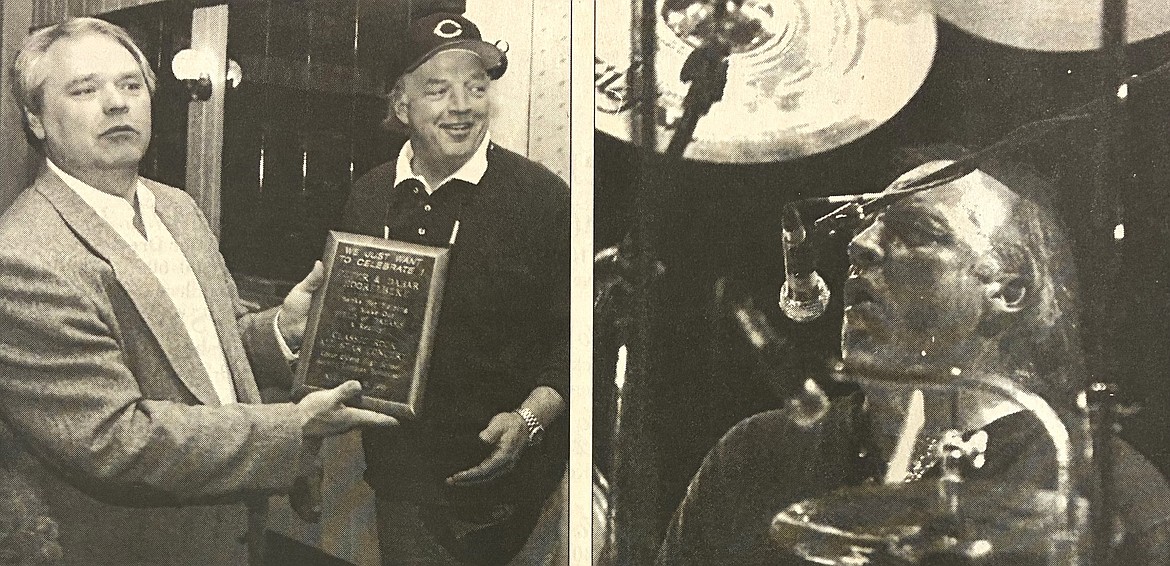
In 2001, Coeur d’Alene High athletic director Larry Schwenke (left photo) awarded Peter Hoorelbeke with a plaque in recognition of a benefit concert by Pete’s Classic Rock All-Stars. The band attracted 1,200 fans to North Idaho College and raised $15,000 for a CHS activities complex. Pete played the drums and sang.
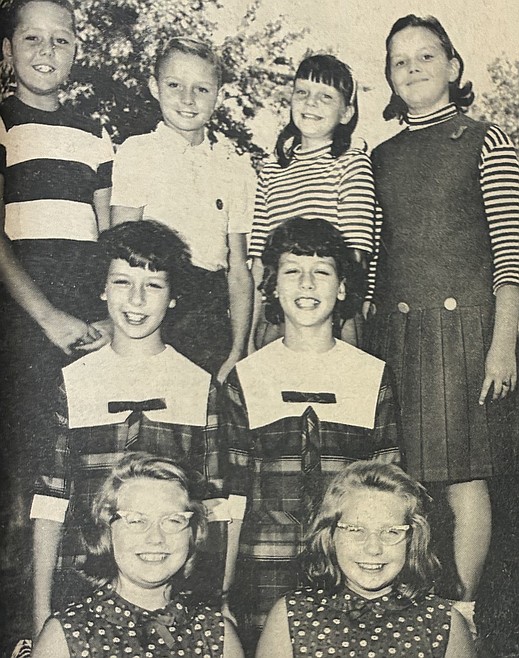
In 1966, the four sets of fifth-grade twins at Central School were (bottom to top, from left): Jeanine and Jarine Steele, Mikelyn and Michele Lunceford, Marlin and Marvin Tisdall, and Kathryn and Julie McCullough.
Coeur d'Alene Press Archive
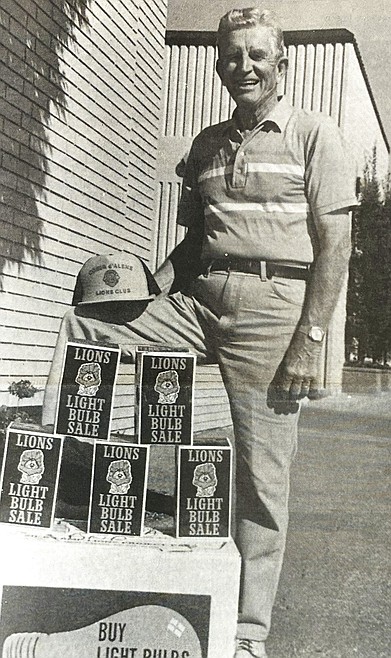
In 1991, Gil Yates, president of the Coeur d’Alene Lions Club, displayed light bulbs that his group sold door-to-door.
Coeur d'Alene Press Archive
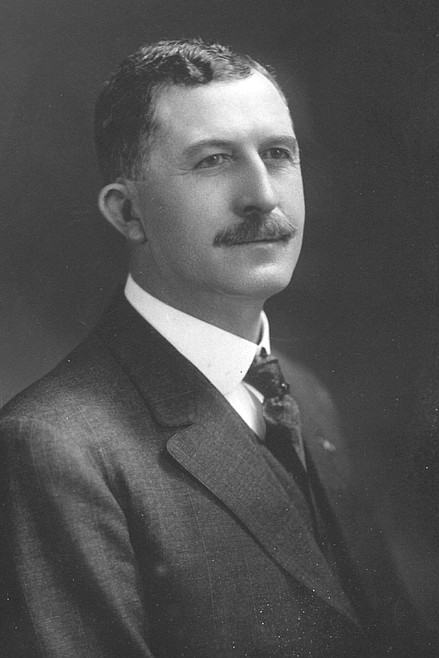
J.C. White
Courtesy photo
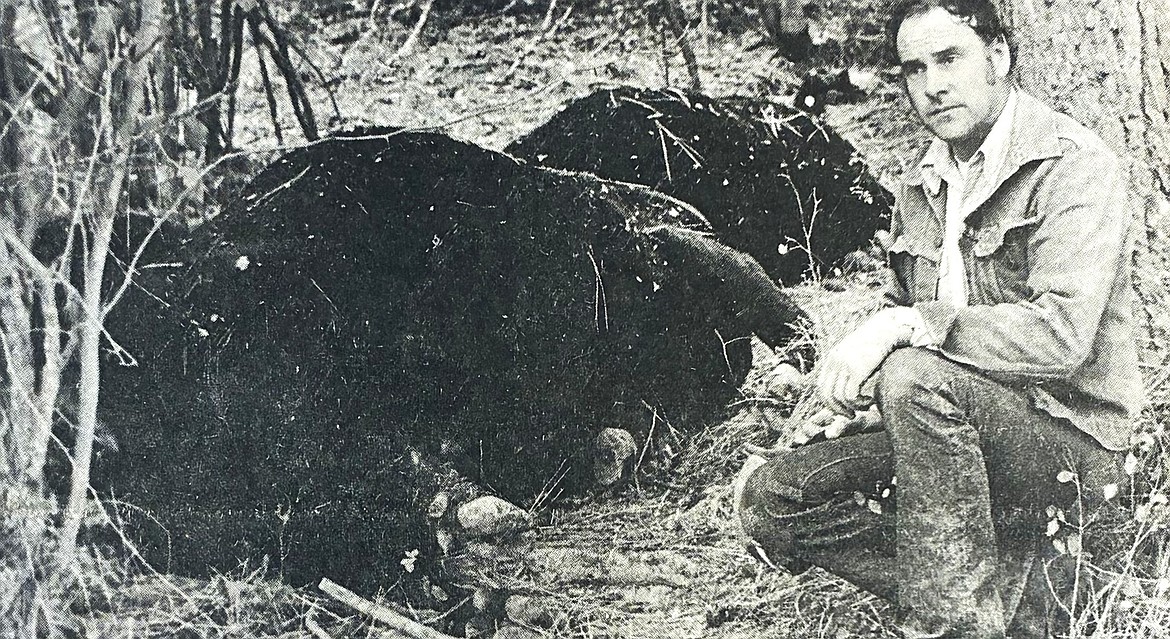
In 1981, farmer Ken Renner of Carlin Bay is shown with the carcasses of Black Angus cows that were killed by lightning.
Coeur d'Alene Press Archive
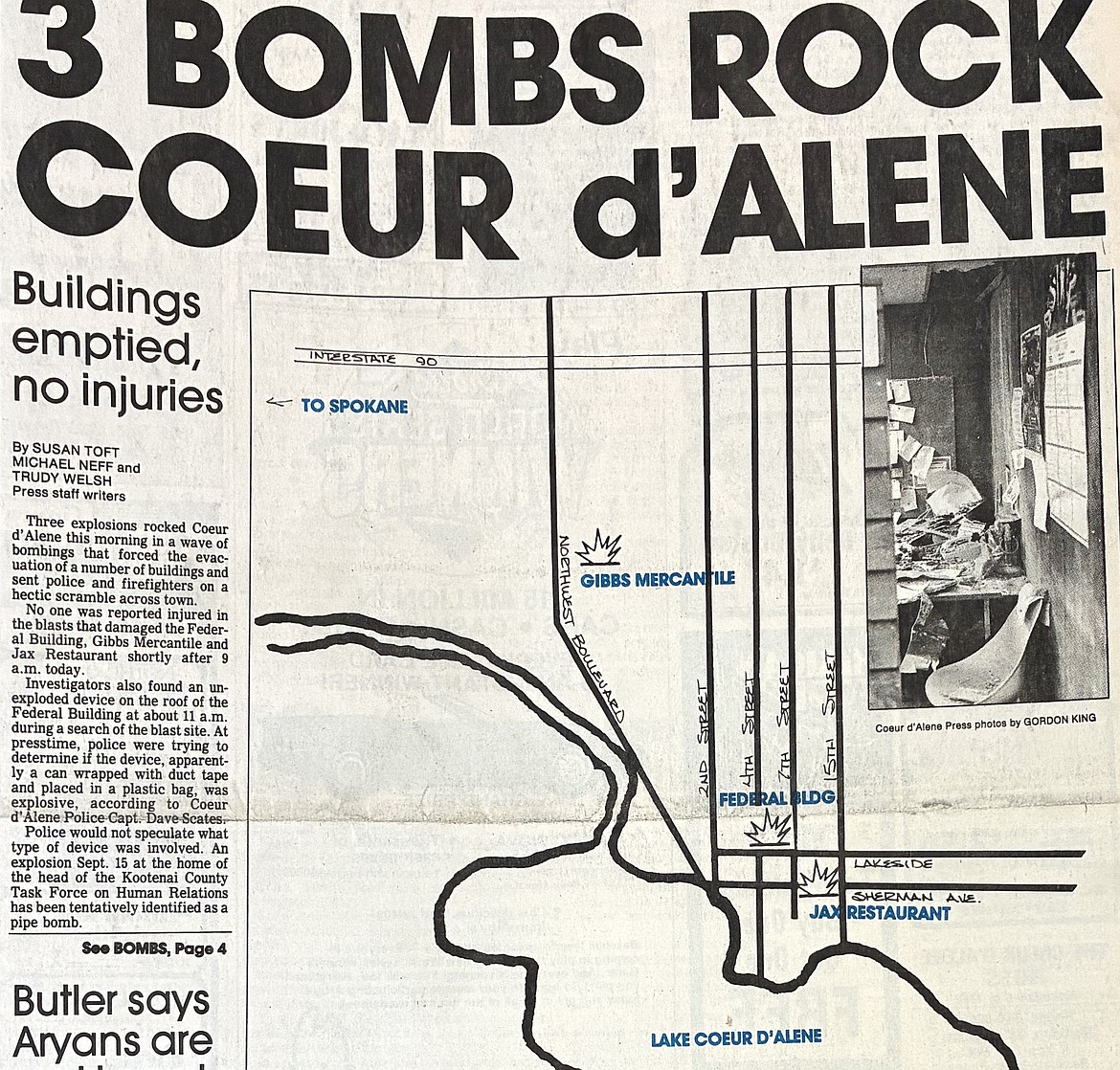
On Sept. 29, 1986, in a same-day story, the Coeur d’Alene Press reported on the Coeur d’Alene bombings.
Coeur d'Alene Press Archive
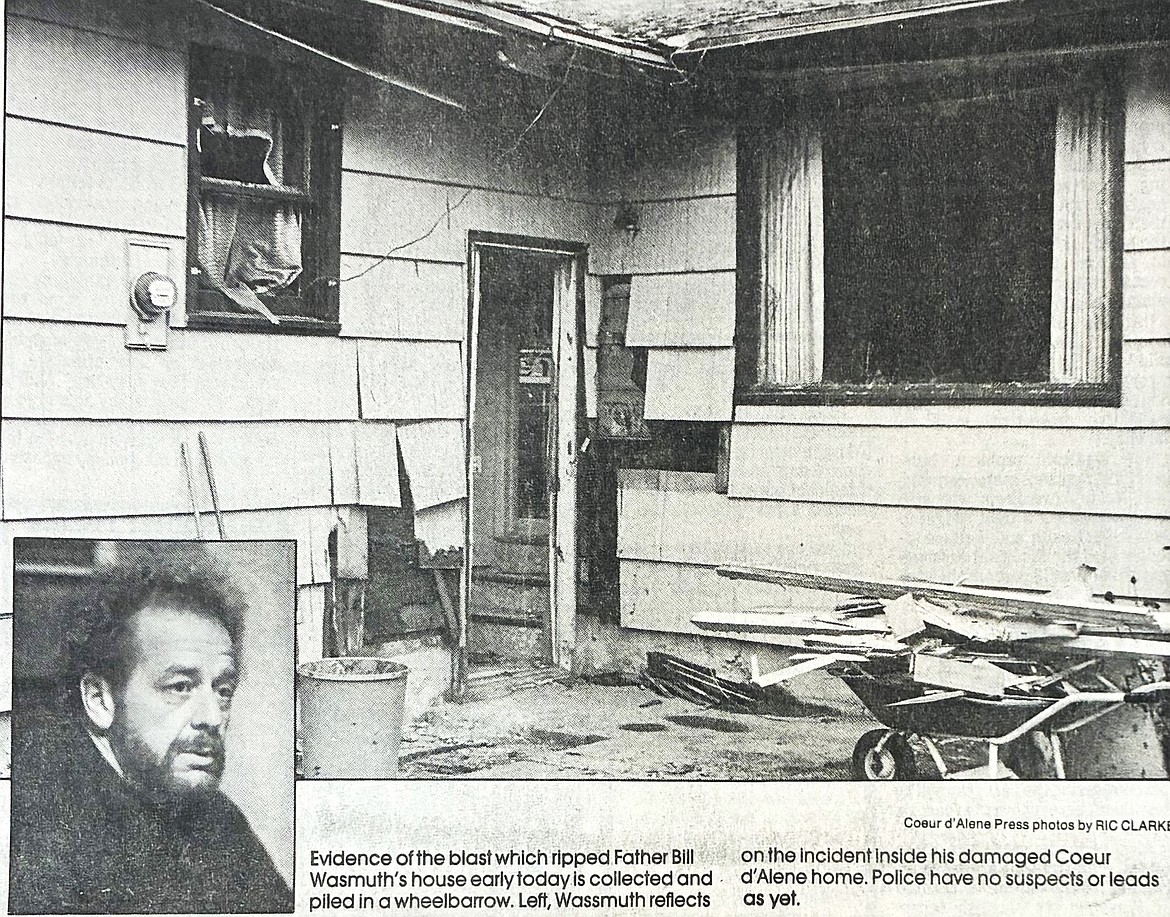
In 1986, a pipe bomb, planted by white supremacists, shattered the back wall of “Father Bill” Wassmuth’s (inset) parsonage.
Coeur d'Alene Press Archive
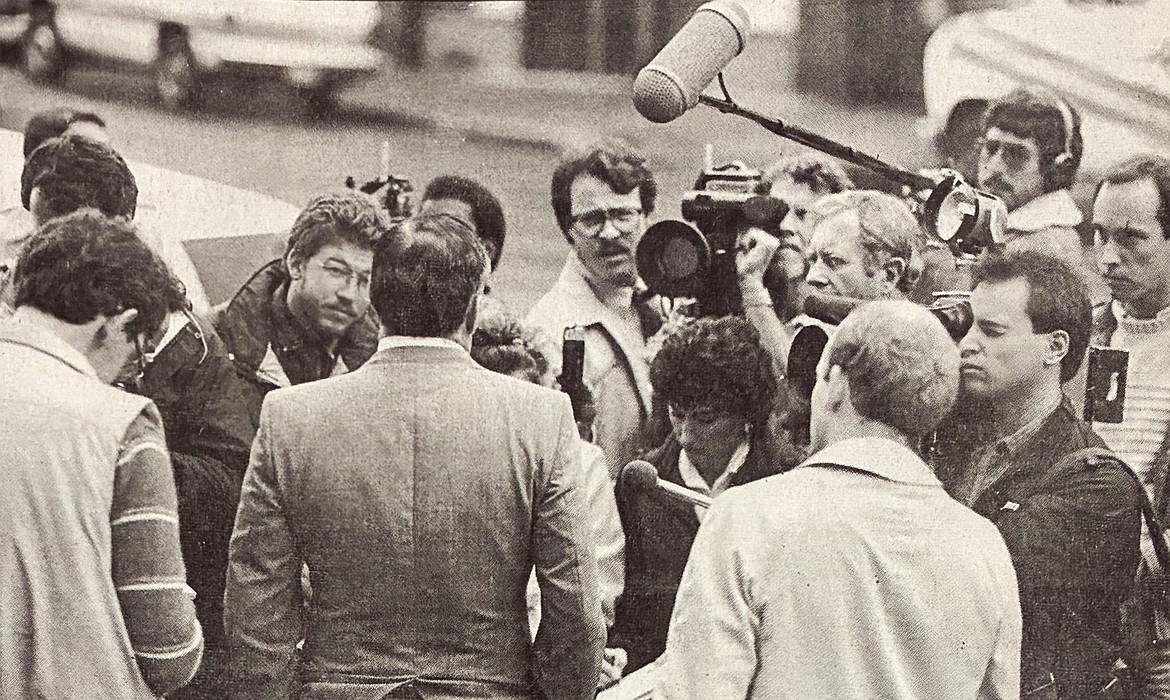
In 1986, Coeur d’Alene Police Chief Frank Premo addressed local and national media after the bombings.
Coeur d'Alene Press Archive
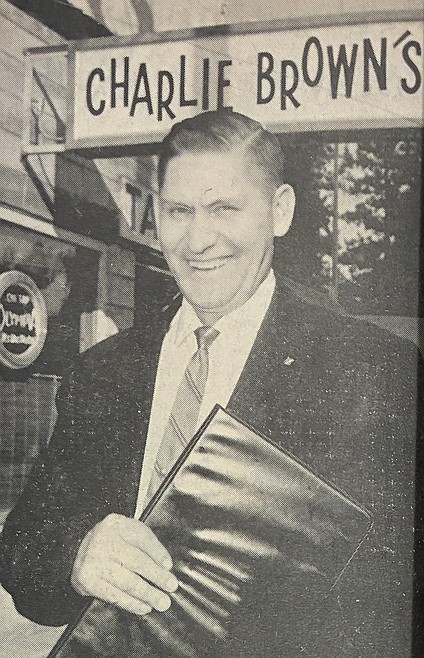
In 1966, Charles “Charlie Brown” Miller is shown outside his bar in the Fort Grounds.
“Father Bill” Wassmuth was on the phone with a friend when the bomb went off.
On Sept. 15, 1986, shortly before midnight, white supremacists placed a pipe bomb, rigged with shrapnel, in a trash can near the back door of Bill’s parsonage.
The blast shredded siding on the Roman Catholic priest’s home, blew out windows, crumpled a screen door, and launched shrapnel through a metal garage door of a neighboring house. A man two blocks away thought a plane had crashed.
When I arrived on the scene the next morning, Bill was dazed and exhausted. He had slept an hour. Local police and the federal Bureau of Alcohol, Tobacco and Firearms had combed the area and left. Bill suspected, and later was proven correct, that racists associated with the Aryan Nations compound, north of Hayden Lake, had targeted him.
Two years earlier, Bill, pastor of St. Pius X Catholic Church, agreed to lead the Kootenai County Task Force on Human Relations, a volunteer group that opposed the Aryan Nations. He and other task force leaders received anonymous threats afterward. Insiders joked with Bill that he was picked for the post because he was single and lived in a brick house.
No one was laughing that mid-September morning.
As we surveyed the structural damage, Bill, then 45, admitted he was scared but wouldn’t be intimidated by the bungled attack. He wondered why his assailants hadn’t simply rung the doorbell. He would have been more vulnerable.
“It was senseless violence and destruction,” Bill said. “That’s frustrating — scary.”
The white supremacists struck again two weeks later.
Shortly after 9 a.m. Monday, Sept. 29, domestic terrorists set off three homemade pipe bombs in Coeur d’Alene — at the Federal Building, Gibbs Mercantile and Jax Family Dining. A fourth bomb, duct-taped in a tin can, was found undetonated atop the military recruiting office on Fourth Street, across from the Federal Building.
No one was injured in the bombings.
Later, an accomplice testified in court that the bombers sought to terrorize Coeur d’Alene residents who opposed Aryan Nations founder Richard Butler. And they wanted to distract police. Their goal was to rob banks and the National Guard Armory to finance a race war.
Four racists were quickly caught and later sentenced for the bombings and other crimes.
The bombs united the community behind Wassmuth and the task force.
On Sept. 25, between the bombings, more than 600 people attended a Gathering for Solidarity at North Idaho College to support Wassmuth. Surprisingly, racist leader Richard Butler and two of his followers attended the event that included a large police presence.
Human rights groups nationwide praised Coeur d’Alene’s swift response, including the Raoul Wallenberg Committee of the United States. In January 1987, Wassmuth, Mayor Ray Stone and Undersheriff Larry Broadbent traveled to New York City on behalf of Coeur d’Alene to accept the first community award from the prestigious Wallenberg organization.
Later, “Father Bill” quit the priesthood to marry and to direct a five-state human rights association, the Northwest Coalition Against Malicious Harassment, founded in Coeur d’Alene and headquartered in Seattle.
In August 2002, Bill was 61 when Lou Gehrig’s disease claimed his life. He lived to see a $6.3 million Kootenai County civil verdict bankrupt the Aryan Nations on Sept. 7, 2000.
Something Bill said on that fall morning of the parsonage bombing remains with me. It captures the spirit of the bowed-but-unbeaten human rights warrior.
Sifting through the damage, he paused, smiled wryly, and described the incident “as an attempt to remodel my house.”
Sorry, Charlie
Charles “Charlie Brown” Miller and his Charlie Brown Tavern in the Fort Grounds embraced the name of Charles Schulz’s lovable cartoon character.
But the outspoken bar owner wasn’t a doormat. He was a fighter, albeit for losing causes.
In 1966, Miller tried to run for governor as a third-party candidate. As his main issue, he opposed a proposed new state sales tax of 3%. “Everyone has a right to run,” the former Shoshone County bar owner and gyppo logger said.
And Charlie went a step further when he formed the People’s Choice Party, which had a goat as its mascot. He planned to award the goat to “every Idaho politician attempting to override the will of Idaho’s citizens and over-tax their means.”
The odds of a win by Charlie were long — and got longer when Attorney General Al G. Shepard ruled that he had failed to follow proper procedure to get his name on the ballot. So, Charlie called Shepard “a trained seal” and began a write-in campaign.
He received 31 write-in votes from Kootenai County and finished far behind Republican nominee Don Samuelson in the governor’s race. Adding insult to Charlie’s injury, 61% of Idaho voters approved the 3% sales tax.
Rock on
In the 1990s, Peter Hoorelbeke was happy to play second drummer, er, fiddle, to his three talented kids — Coeur d’Alene High athletes Jesse, Casey and Blake.
Hoorelbeke, who was better known by his stage name, Peter Rivera, moved his family here in about 1994 to escape Los Angeles culture.
The former drummer and lead singer of the 1970s band Rare Earth still performed in 200 concerts a year with the Classic Rock All-Stars. But he had jettisoned the rocker lifestyle for stability and security. “We’re having more fun now because we see everything in the right perspective,” Pete told Sara Leaming of The Press.
On Sept. 24, 2001, Pete and The Press discussed his new book, “Born to Wander.” It described the 1970s rock scene when Rare Earth became the first white group to sign with Motown Records — and Pete’s bond with Jimi Hendrix, Elton John, Sly and the Family Stone, and Michael Jackson.
Before the band was derailed by cocaine and internal feuding, Rare Earth produced the hits “Get Ready” (1970) and “I Just Want to Celebrate” (1971). By the time the book was published, three of the former Rare Earth band members were dead.
Of his decision to leave Rare Earth for good in 1983, Pete said: “The band just fell apart in unity. It wasn’t fun anymore.”
Huckleberries
• Poet’s Corner: They open to a width incredible / when he spies something vaguely edible; / I’d guess a hungry anaconda / might swallow whole a four-door Honda — The Bard of Sherman Avenue (“Jaws of the Anaconda”).
• Double Minted: Fifth-grade teachers at the old Central School at Seventh and Wallace were seeing double as the 1966-67 year began. Enrolled in the two fifth-grade classes were four sets of twins: Jeanine and Jarine Steele, 10; Mikelyn and Michele Lunceford, 10; Marlin and Marvin Tisdall, 11; and Kathryn and Julie McCullough, 10. Sounds perfect for an old Wrigley’s Doublemint Gum commercial.
• O Pioneer: You may know that J.C. White built the 1903 house that now serves as the Museum of North Idaho. But did you know that he was also steamboat king on Lake Coeur d’Alene until the advent of the automobile? And that he was the first chamber of commerce president (1910)? And that he was instrumental in building old Highway 10, between Coeur d’Alene and Wallace, a road we now call Interstate 90?
• Flashback: Do you remember when Coeur d’Alene Lions Club members sold light bulbs door-to-door to buy glasses for those in need? Eldon Koehler and Gordon DeFoe had the bright idea. “Why not?” the former Washington Water Power (Avista) employees said. And the Lions did. In 1991, when Gil Yates was Lions Club president, a six-pack of bulbs sold for $4 and a 12-pack for $7.
Parting shot
Contrary to an old saying, lightning can strike twice in one spot.
Farmer Ken Renner of Carlin Bay didn’t think so until his 12-year-old daughter rode home on horseback Sept. 26, 1981. He knew something was wrong when she asked if it was hard to wake up cows.
According to the Press, five of his Black Angus cows had sought shelter from rain under some trees. A single bolt killed them and singed two trees. Renner estimated that the act of God cost him $3,000. “If we could have got to them right after it happened,” Renner said, “we could have butchered beef all night.”
He wasn’t going to make a profit on the Black Angus anyway. After he bought them earlier in the year, the beef market dropped from 79 cents a pound to 54 cents.
So, Farmer Renner learned the hard way that lightning can strike twice in a place, literally and figuratively.
• • •
D.F. “Dave” Oliveria can be contacted at [email protected].
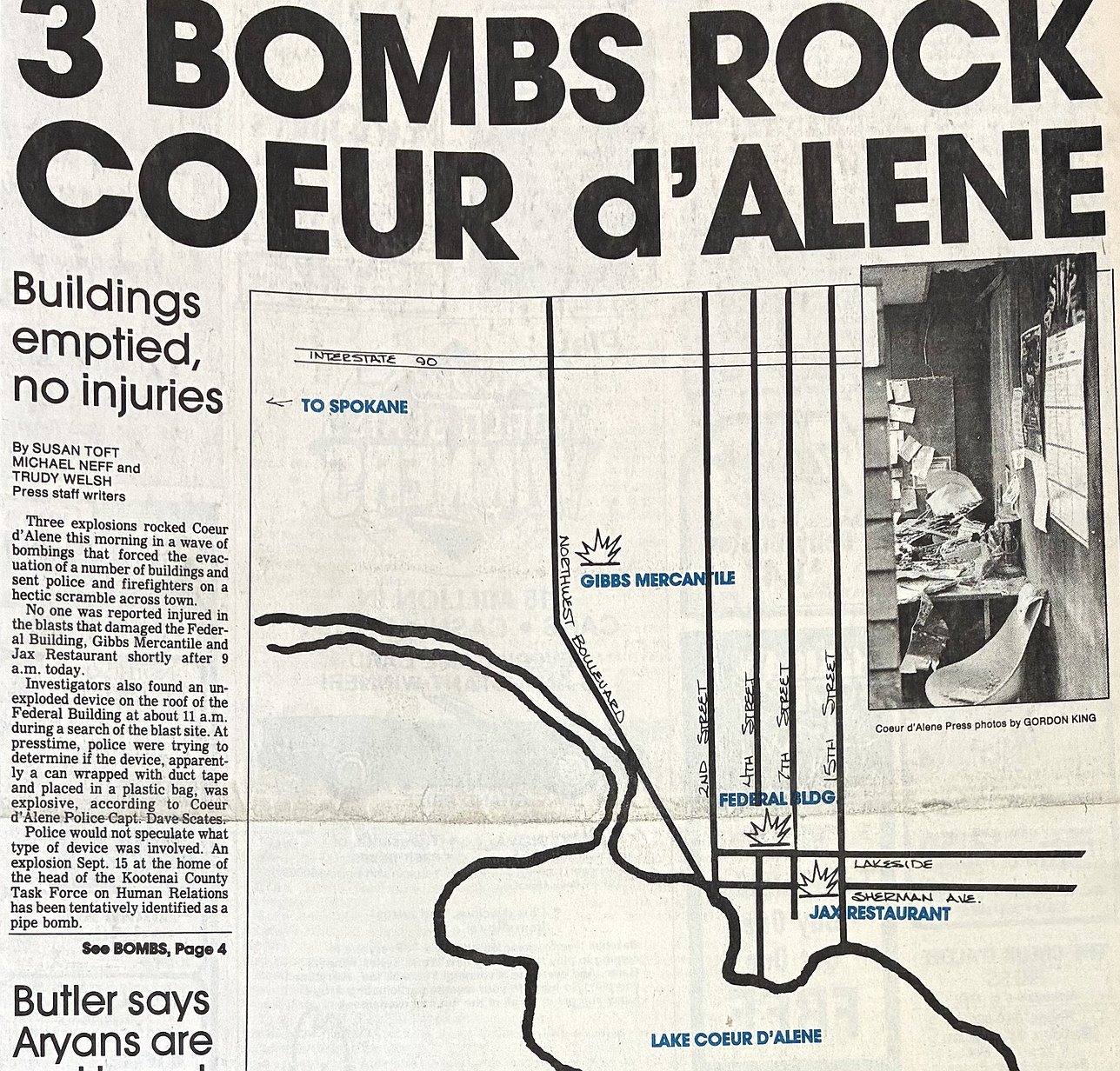 On Sept. 29, 1986, in a same-day story, the Coeur d’Alene Press reported on the Coeur d’Alene bombings.
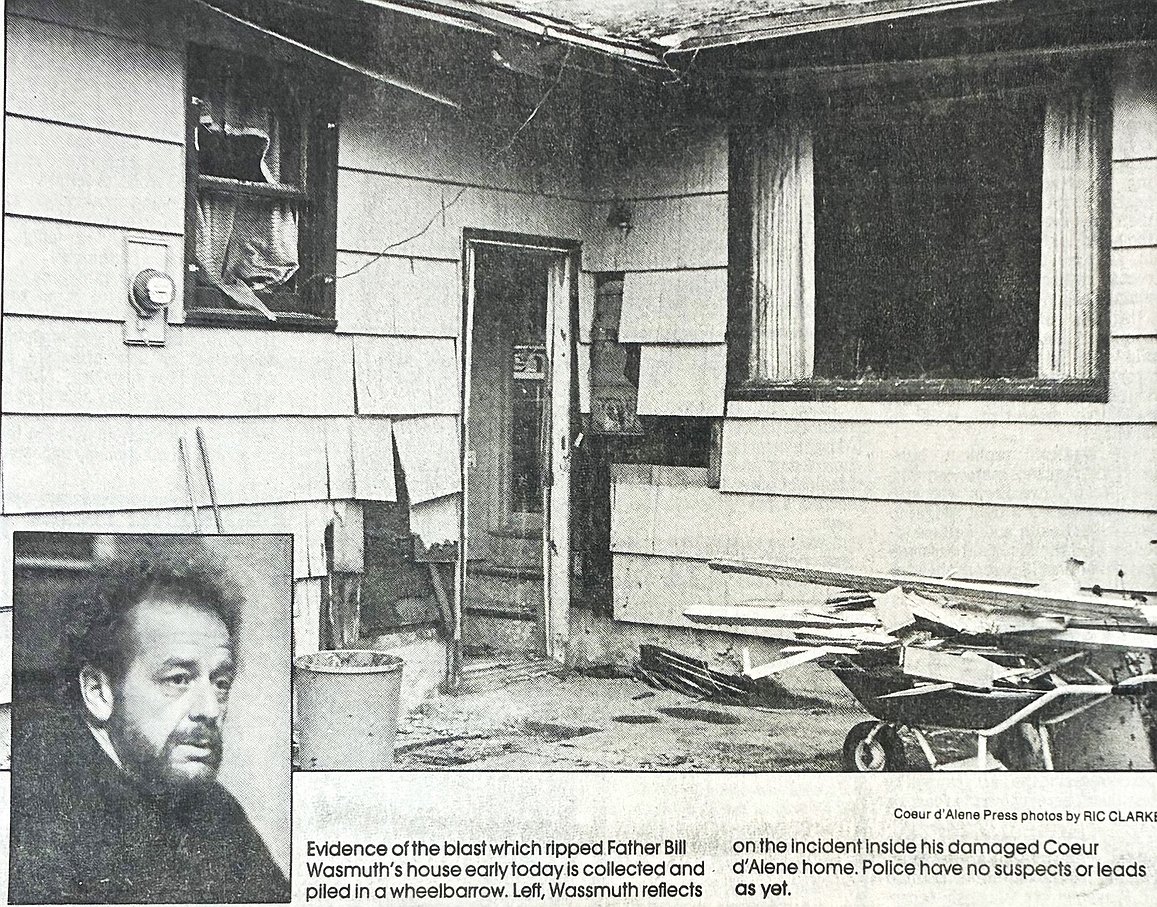 In 1986, a pipe bomb, planted by white supremacists, shattered the back wall of “Father Bill” Wassmuth’s (inset) parsonage.
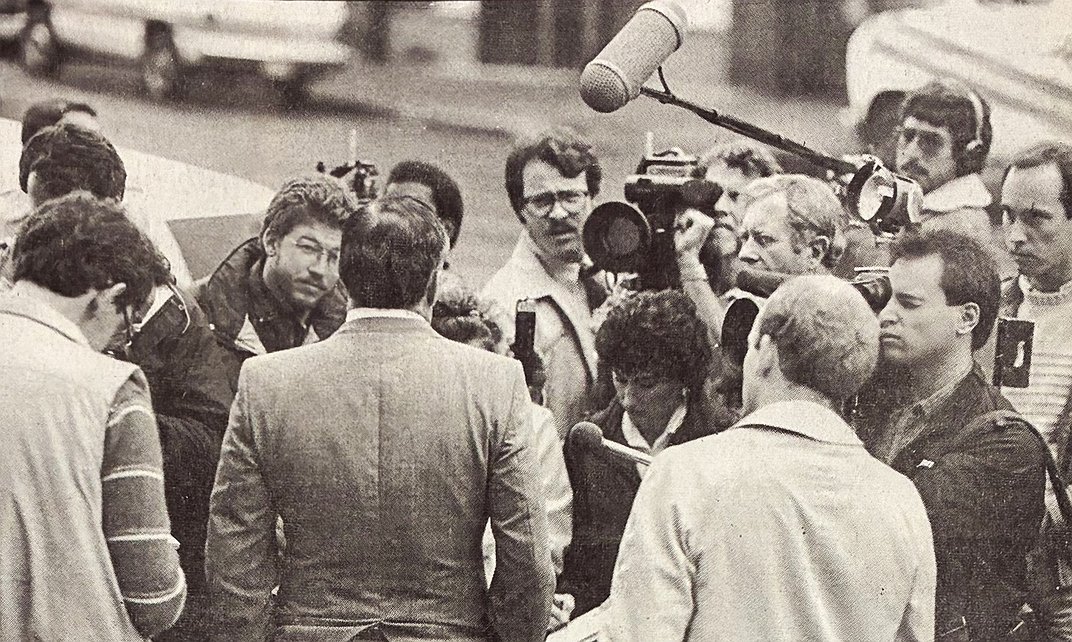 In 1986, Coeur d’Alene Police Chief Frank Premo addressed local and national media after the bombings.
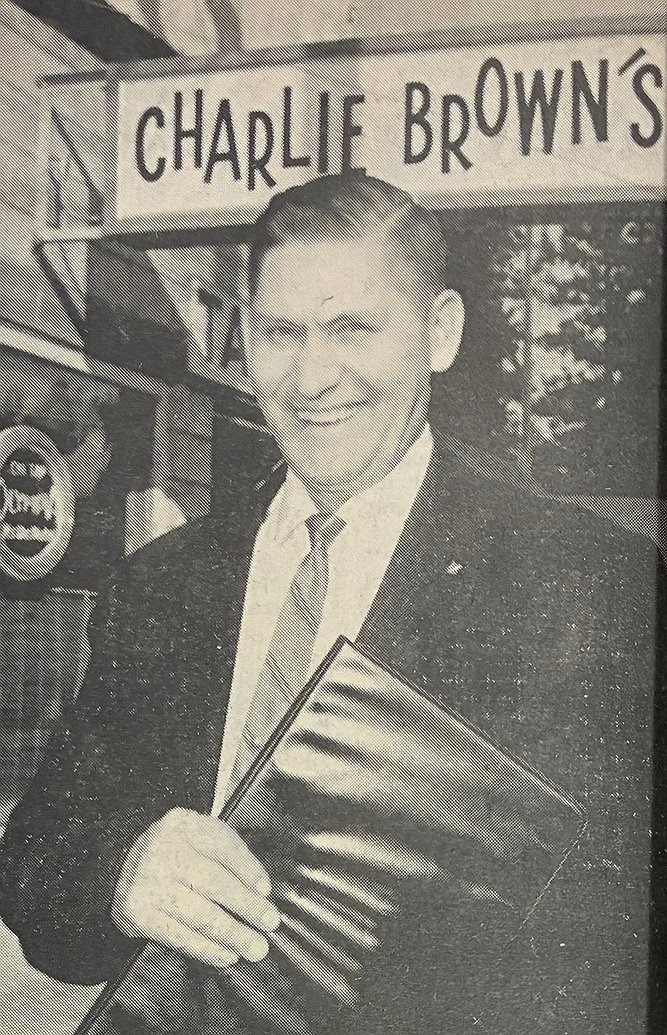 In 1966, Charles “Charlie Brown” Miller is shown outside his bar in the Fort Grounds.
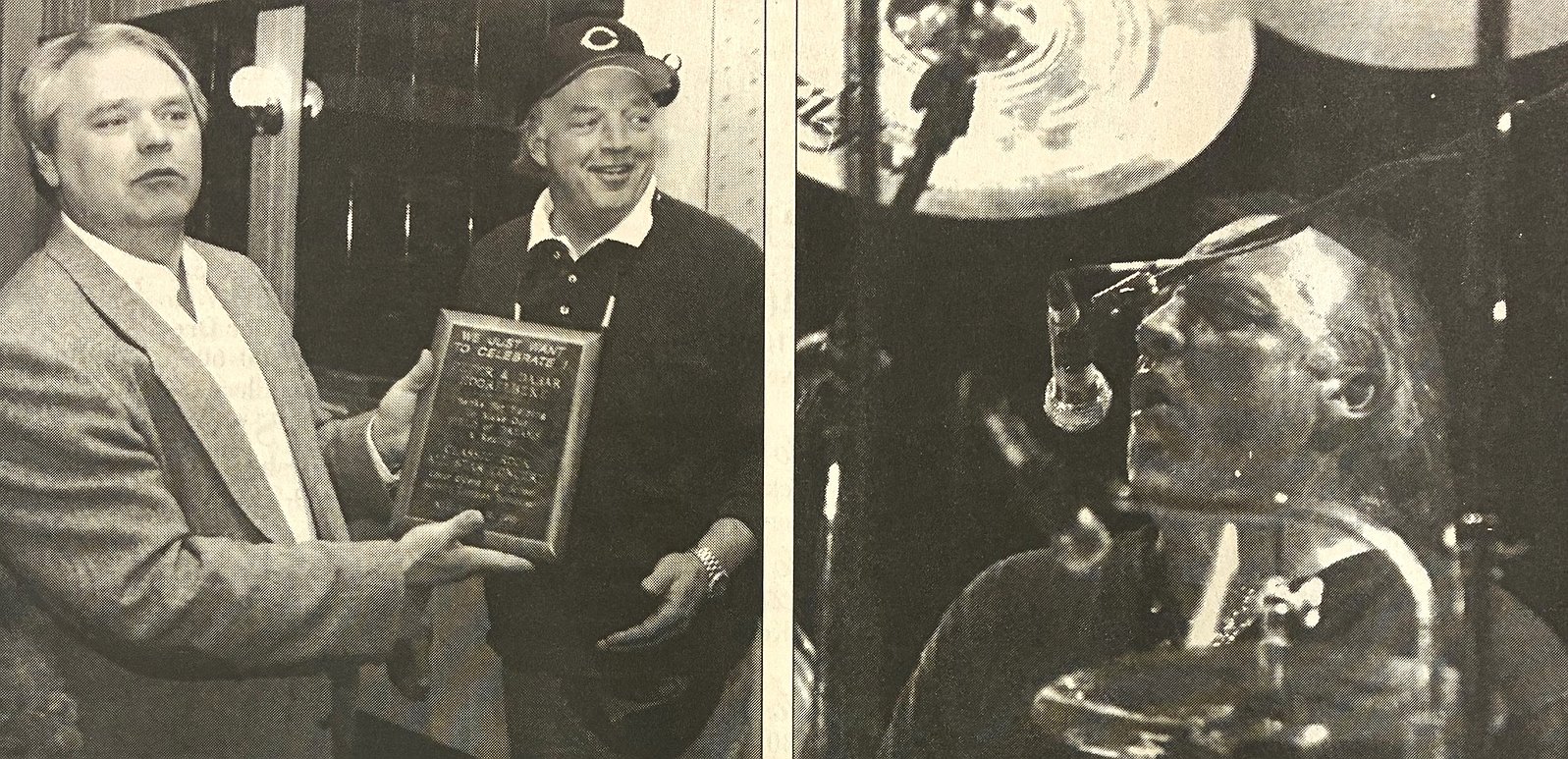 In 2001, Coeur d’Alene High athletic director Larry Schwenke (left photo) awarded Peter Hoorelbeke with a plaque in recognition of a benefit concert by Pete’s Classic Rock All-Stars. The band attracted 1,200 fans to North Idaho College and raised $15,000 for a CHS activities complex. Pete played the drums and sang.
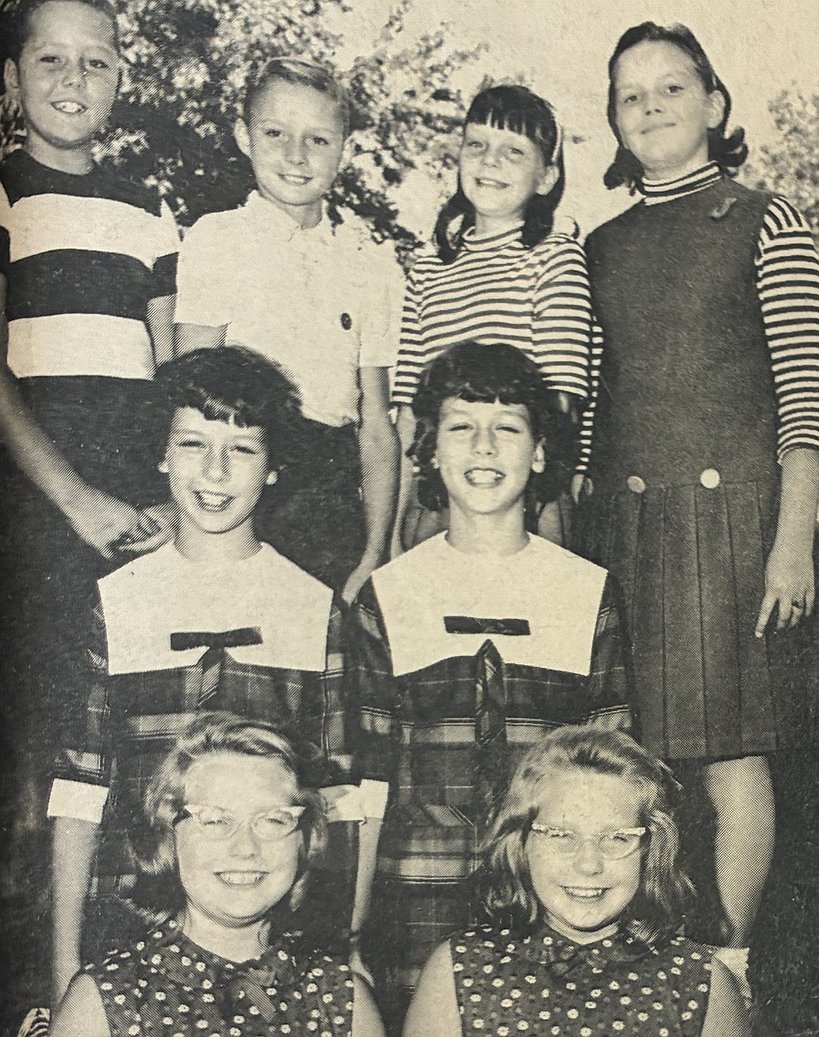 In 1966, the four sets of fifth-grade twins at Central School were (bottom to top, from left): Jeanine and Jarine Steele, Mikelyn and Michele Lunceford, Marlin and Marvin Tisdall, and Kathryn and Julie McCullough.
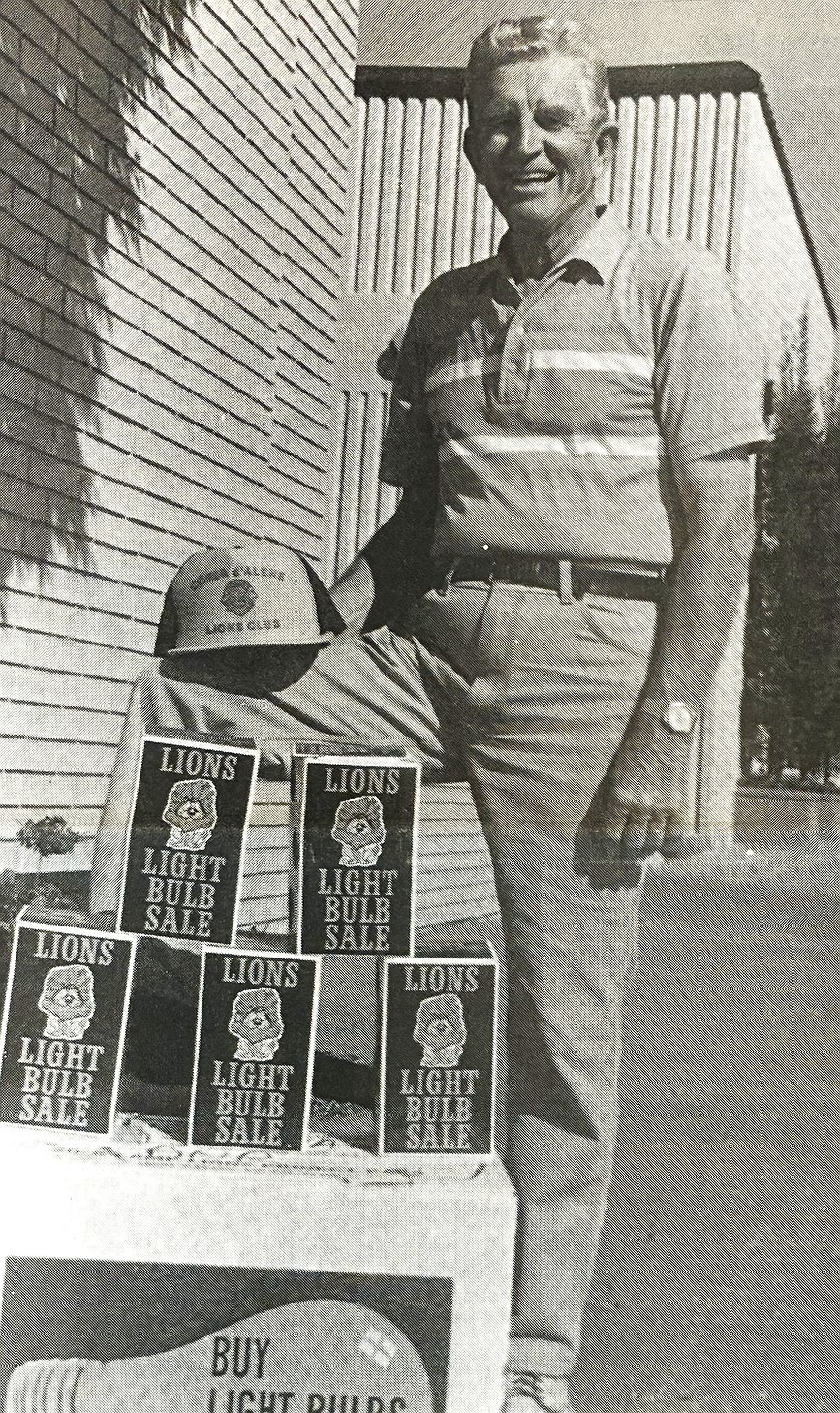 In 1991, Gil Yates, president of the Coeur d’Alene Lions Club, displayed light bulbs that his group sold door-to-door.
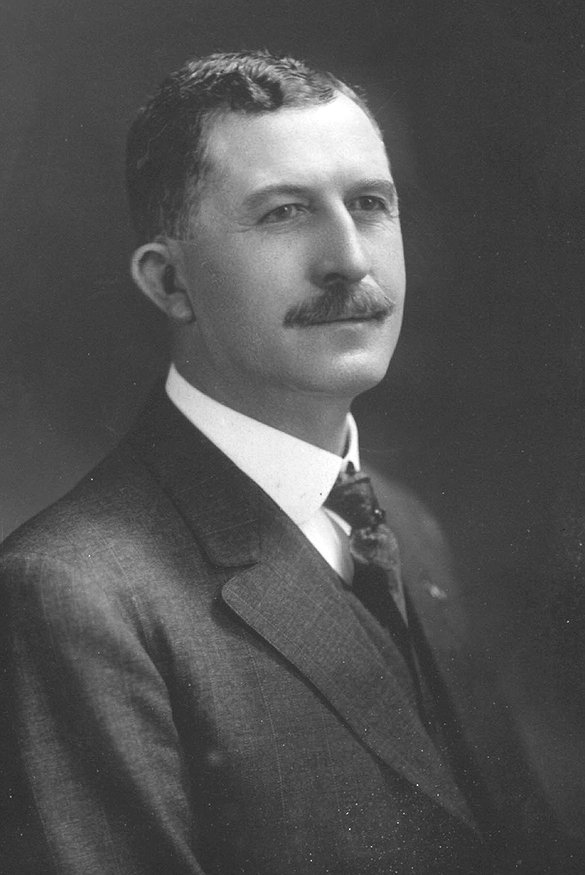 J.C. White
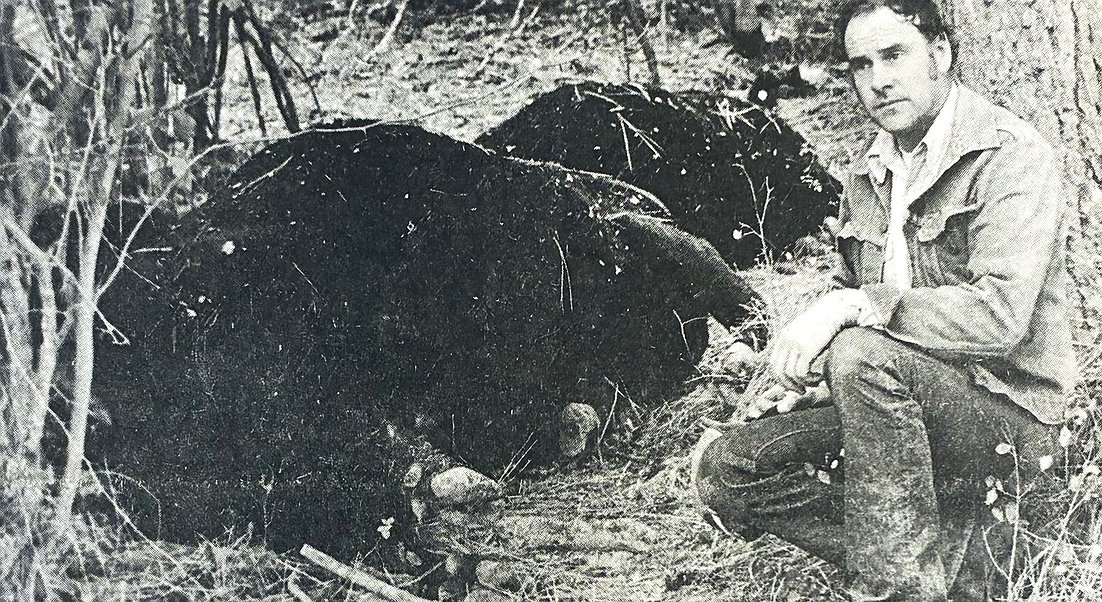 In 1981, farmer Ken Renner of Carlin Bay is shown with the carcasses of Black Angus cows that were killed by lightning.