

Record-setting 'Doctor Fish' caught in Lake Coeur d'Alene
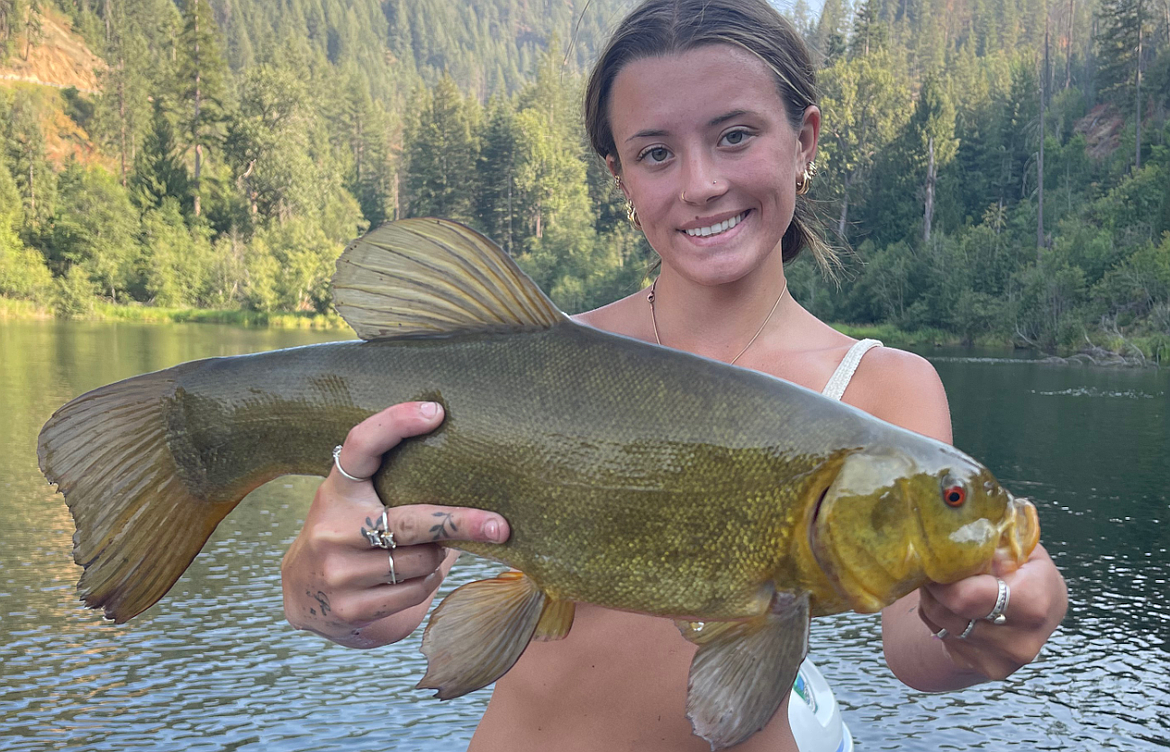
Rylee Dragon smiles while showing off her Idaho catch-and-release record setting Tench while on Lake Coeur d'Alene in August.
Courtesy of Idaho Fish and Game
In mid-August, while fishing on Lake Coeur d'Alene, Rathdrum native Rylee Dragon landed an Idaho state catch-and-release record tench measuring 20.5 inches. Dragon's catch beat the old state record, also caught on Lake Coeur d'Alene by Mike Nunemacher in 2020, by 1.5 inches.
Tench, sometimes known as a Doctor Fish, are relatively unknown to most anglers. Still, according to Idaho Fish and Game Fisheries Research Biologist Eric Geisthardt, anglers can find them in most regional fisheries.
"Most of the lakes in the Panhandle of Idaho and in eastern Washington have tench," he said.
Geisthardt said tench are not "widely distributed" elsewhere in the U.S. and are "very uncommon" in the Midwest and the East. He said a few places, like the Great Lakes Basin, have "real" tench populations.
Geisthardt said that tench can get "pretty big" and mostly eat invertebrates. They can be identified by their "real funny" carp-like appearance, olive-green to gold-colored skin, striking red eyes and small scales. He said tench are not native and originate from places in Europe, like England.
"They like warmer, shallow, weedy habitats," Geisthardt said.
Despite their carp-like appearance, Geisthardt said tench are more closely related to European minnow species than to carp. The two fish prefer the same habitat: warm, muddy water. However, according to Geisthardt, tench are not nearly as destructive to lake ecology as carp.
"You don't go into the back of a shallow bay and see clouds of mud because there is tench rooting around," he said.
Gesithardt said that tench have been in Idaho for "over 100 years" but doesn't know exactly when they were introduced. He said many of the warm-water species that came into Idaho arrived during Idaho's peak railroad days.
He said tailmen had spots along the railroad where they collected water for the train's steam engines, and they would fish these spots for food and sport along the trip.
"They used to grab fish along the way and try to stock them," he said. "They've been naturalized in most of the lakes in North Idaho for a long time."
Geisthardt said tench aren't great to eat, but there is a market for sport fishing. He said that they can "fight hard for their size" and don't have any positive or negative effects on other fish populations.
"They don't really negatively impact any of the either native or introduced warm-water fish that we have out here," he said.