
Raised by the Rainforest
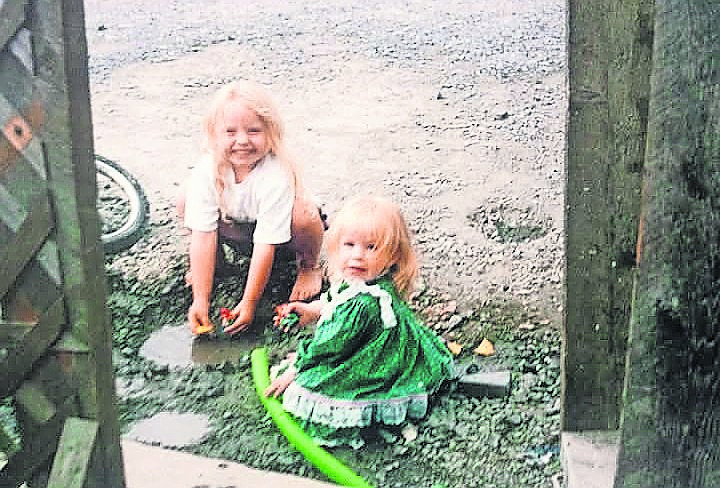
I didn't realize I was raised differently than most kids until I left Alaska and discovered that not every child grows up knowing what to do when there's a bear on the front porch.
I was raised on Prince of Wales Island in Southeast Alaska, surrounded by the Tongass National Rainforest, the Pacific Ocean and enough wildlife to make a Lower 48 kid reconsider going outside. Looking back, I'm realizing that some of the things I considered perfectly normal were, in fact, completely unhinged.
I learned to swim because my dad was the foreman of a crew building roads on the island, and my mom was the camp cook. At one point, our family lived on a float camp in the bay while my dad and his crew worked.
Since our home was literally floating in the ocean, knowing how to swim was considered a necessary life skill. So my dad and his crew taught my brother, my sister and me.
By “taught,” I mean they took us out into the open ocean, threw us overboard and told us to swim back to the boat.
No floaties. No gentle introduction to the water. No swimming instructor.
Just three kids, the open ocean, what lay beneath the us a complete mystery and apparently a very straightforward approach to survival. And somehow, I grew up thinking this was a perfectly reasonable way to learn how to swim. It wasn't until much later that I realized most people's childhood swimming lessons don't involve being thrown overboard.
But the ocean wasn't just where we learned to swim. It was our way of life, really. It was where our food was caught, and for a large part of my extended family it was where their money was made. It was also part of how we got anywhere. Growing up on an island changes the definition of the word “trip.”
Going somewhere off the island wasn't something you casually decided to do on a Saturday afternoon. It was an event. It required planning, schedules, saving and either a four-passenger float plane or a ferry.
Even going to my birthplace, Ketchikan — which, in my childhood mind, was the big city — meant a four-hour ferry ride. And if you needed to go shopping at Walmart, see a movie, or stock up on things you couldn't get at home, you didn't just hop in the car. You took the ferry to Ketchikan, stayed overnight at a motel and got back on the ferry the next day.
A Walmart run could require a two-day itinerary.
Meanwhile, an Alaska kid's definition of a Saturday afternoon was considerably less structured. We rode our bikes all over the island, without the worry of stranger danger because there were no strangers.
We took skiffs out to neighboring uninhabited islands to pick sea greens, explore, or simply see what kind of trouble we could find. The island was our playground, and nobody needed to build one for us.
Our K-12 school was small enough that the halls were filled with cousins. You didn't just know the kids in your class; chances were pretty good you were related to half of them somehow. And school events weren't really school events.
Prom was an island-wide event. A wedding was an island-wide event.
If something happened, everybody knew about it, everybody showed up and somebody was almost certainly related to somebody else there.
There was a particular kind of freedom that came with growing up in a place like that. We had room to roam, water to explore and enough wilderness surrounding us that adventure wasn't something you had to schedule. You just walked out the door.
We also didn't have the endless assortment of stores, restaurants and entertainment that people in the Lower 48 tend to take for granted. If the local store didn't have what you needed, you figured something else out.
Maybe you waited for the next shipment. Maybe you ordered it. Maybe you went without. And nobody thought this was particularly strange. It was just life on the island.
The same went for the weather.
My partner actually lived there for three whole years. We met in Montana and after the COVID-19 Pandemic shut down the restaurant I owned there, we packed the kids up and decided to live the island life. He worked, played and did pretty much everything else in the rain.
Eventually, even he had reached his limit of rain. So we moved to Idaho, where he was raised. Which is pretty funny when you consider that I was raised in a rainforest and ended up with someone who looked at all that rain and eventually said, “Absolutely not. The rain has gotten to a level that it’s actually disrespectful.”
And I can't really blame him.
Prince of Wales gets a lot of rain. Not “bring an umbrella” rain. More like “rain gear is a staple in every closet and Xtra-tuffs are as essential as sneakers” rain. Most people simply aren't prepared for how much rain an island rainforest can produce.
But maybe the strangest thing about growing up on Prince of Wales is that, no matter how many times I've left, some part of me has never really left at all.
I've moved away from the island several times. I left for school. I left for relationships. I left once simply because I needed to get off “the rock” for a while. And every time, eventually, I found myself going back.
Sometimes I went back for years. Sometimes it was only for a short stay. But I always went back.
Because as much as I love living in North Idaho, and as much as I've built a life here, there is still something in me that yearns for the ocean.
There are places you live, and then there are places that become part of you. Prince of Wales will always be home.
Maybe that's because I wasn't just raised in Alaska. I was raised by the rainforest. And once the rainforest raises you, it never quite lets you go.