
Idaho voters turned out at high rates to vote in midterm election
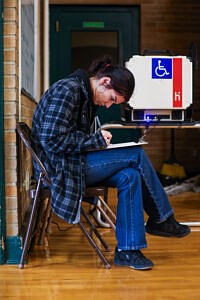
First-time voter Abigail Strand registers to vote during the general election on Nov. 3, 2026, at Borah High School in Boise. (Photo by Pat Sutphin for the Idaho Capital Sun)
In Idaho’s general election on Tuesday, some voters were voting hours after polls had closed in the state’s second most populated county.
Voting bled into Wednesday. The last voter in Canyon County cast their ballot at 12:20 a.m., Idaho Secretary of State Phil McGrane said in an interview Wednesday morning.
In Idaho, polls close at 8 p.m. local time. But voters can still cast votes if they are in line by the deadline. And in Canyon County in southwest Idaho, some voters waited in lines for more than four hours, McGrane said. The lines there, driven by high turnout and long ballots, were one of his biggest challenges of the night.
“The interesting thing, both visiting with the poll workers and watching some of the news outlets that visited out there, the voters were really patient, really kind, very determined to want to be able to cast their vote. I think it was incredible just to see the sense of community out there,” McGrane said. “Regardless, I think we owe it to the voters, and we’ve certainly heard some feedback just in terms of how frustrating that was. We want to make sure the voting process goes smoothly.”
The lines were a sign of a bigger trend.
In Tuesday’s general election for statewide offices, congressional seats, legislative seats and ballot measures, including an abortion ballot initiative, Idaho voters turned out at high rates. A midterm record high of 731,980 voters cast ballots, based on initial voter turnout data from the Secretary of State’s Office. Overall, it seems likely that registered voters turned out in the high 60% range to vote in the election, McGrane said.
Besides the long lines in Canyon County, the day was fairly smooth, he said.
Abortion ballot initiative drove voter turnout, experts say
Proposition 1, a ballot initiative that sought to repeal Idaho’s near-total abortion ban, seemed to drive many voters to the polls. Nearly 99% of voters cast ballots in that race — more than any statewide ballot measure. Voters rejected it, with nearly 56% voting no, according to unofficial election results.
“I do think the fact that more ballots were cast on Prop 1 than any of the other statewide races indicate that it was driving some people to the polls, particularly to vote on that issue,” Boise State University political scientist Jaclyn Kettler said in an interview.
The drive to turn out was likely twofold, she said: Voters tend to care deeply about abortion and reproductive healthcare issues, and there was active campaigning from both sides.
But the blue wave in midterms across the country — where Democrats secured control of both chambers of Congress, and won control of some state legislatures and most governorships — didn’t extend to Idaho. Republican incumbents in all statewide offices and the state’s congressional delegation all easily secured reelection. Kettler wasn’t surprised.
“Idaho is a solidly Republican state. We don’t tend to see too many competitive races” in the general election for statewide races, she said. “ … It’s just solid enough Republican that it’s hard for even a blue wave in other areas of the country to have too much influence, especially for those statewide races.”
Still, Democrats saw some success in Idaho as they picked up six seats in the state Legislature, which remains under Republican supermajority control. In those wins, Democrats secured full control of three swing districts.
Tuesday’s election results in Idaho won’t become official until they are certified by the State Board of Canvassers on Nov. 24. Within the next week, McGrane said his office will conduct a random draw to determine which counties will undergo post-election audits.
How did voters turn out in Idaho’s general election?
Initial state data shows that about 69% of registered voters turned out to vote in Tuesday’s election. On paper, that would eclipse the state’s 2018 midterm elections, when more than 66.5% of voters turned out when no incumbent ran for governor and a Medicaid expansion ballot initiative was up for a vote.
But McGrane expects this year’s voter turnout rate to drop while his office processes at least 43,000 voters who registered at the polls on Election Day.
About 290,000 of the more than 731,000 ballots cast in Tuesday’s election came through absentee and early voting, according to the Secretary of State’s Office. That is 100,000 more of those voting types than in 2022, the state’s last election for statewide offices, according to the state election agency.
At the county level, turnout varied widely — up to as high as nearly 85.1% in rural Butte County in eastern Idaho, where less than 1,400 ballots were cast, down to as low as 56.8% turnout in Madison County in eastern Idaho, the early results show. In Ada County, the state’s most populated, more than 232,000 voters cast ballots at a turnout rate of nearly 74.6%.
Even though some races saw political control flip, McGrane said he doesn’t expect any races will be close enough to trigger an automatic recount.
In Canyon County, election officials evaluating if they have enough polling places
By peak voting time, after 5 p.m. Mountain time, McGrane was warning about delayed election results from Canyon County, which had long lines.
Many other counties, he said Wednesday morning, had absorbed their lines. But Canyon County had three polling places with “excessively long lines.”
Late in the night, around 1:30 a.m., McGrane said he went out and visited a polling place there. Then he took a one-hour nap on a couch in his office in downtown Boise around 4 a.m., and got back to work. Canyon County officials didn’t finish reporting election results until around 10 a.m., local officials said.
Canyon County Clerk Jess Urresti, the local election official, could not be immediately reached for comment midday Wednesday. McGrane said he and the clerk believe that: “no voter should have to wait that long.”
“We’re going to be working very hard to make sure that that doesn’t happen again,” McGrane said.
The county’s director of constituent services, Steve Cushman, said the clerk and the local election team had left for rest after a long night.
Cushman said part of the reason for the county’s long lines was limited space in some polling locations and a high number of voters turning out. About 79,000 of the county’s more than 119,000 registered voters turned out for this election. That made for a nearly 66% turnout rate for Canyon County, which is slightly below the statewide rate.
After this election cycle, he said local officials are evaluating if the county has enough voting locations. The county is up to 51 precincts, an increase from a steep decline during the pandemic, Cushman said. Before then, he said the county had 64 precincts.
“That’s something they’re definitely going to evaluate to see how we can get some more locations,” he said.
Long ballots played a role too, he said. His own ballot was four pages long. That means voters might need more time in the booths, he said.