

Election Day approaches
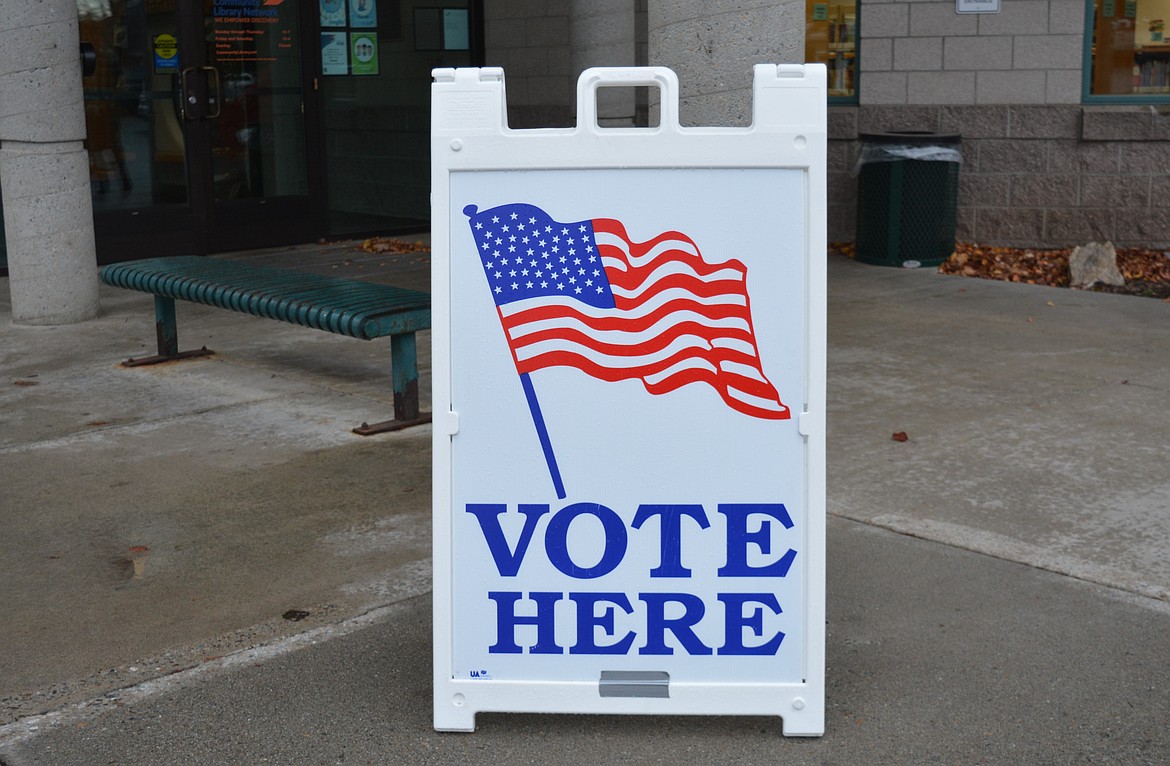
A "vote here" sign indicates the Post Falls Library as a polling place on Election Day.
CAROLYN BOSTICK/Press
Election Day is almost here, North Idaho.
Early voting ended Friday ahead of Tuesday's general election.
Though all county races are uncontested, every Kootenai County voter has something to vote for during this election, including school and fire levies and local and state ballot questions. Every local state legislative race is contested, except for one.
Two of the five seats on NIC's nonpartisan board of trustees are up for election Tuesday. Incumbents Tarie Zimmerman and Brad Corkill, both elected in 2022, will run unopposed.
Kootenai County elections staff predict a voter turnout of around 70% in the general election. The national conversation around the midterm elections and hot topic ballot questions are expected to drive turnout across Idaho.
Contested legislative races
State Representative, Seat 3A
• Melissa Mateer, Democrat
• Vito Barbieri, Republican
State Representative, Seat 4A
• Maxwell McSwain, Democrat
• Joe Alfieri, Republican
State Representative, Seat 4B
• Aaron Hayes, Democrat
• Elaine Price, Republican
State Representative, Seat 5A
• Mirna Pleines, Democrat
• Ron Mendive, Republican
State Representative, Seat 5B
• Lee Wallace, Democrat
• Tony Wisniewski, Republican
State Senator, District 3
• Brian Seguin, Democrat
• Doug “Doug O” Okuniewicz, Republican
State Senator, District 4
• Carissa Brewer, Democrat
• Ben Toews, Republican
State Senator, District 5
• Adam Chapman, Democrat
• Carl Bjerke, Republican
Ballot questions
Kootenai County commissioners placed an advisory question on the ballot asking if county taxpayers should "be responsible for managing a bus system that benefits Coeur d'Alene, Hayden, Post Falls and Dalton Gardens."
Voting "yes" indicates support for the existing public transit model for Citylink with Kootenai County at the helm, while a "no" vote means voters don't want the county to manage the transit system.
Several statewide questions are also on the ballot. They need more than 50% of the vote to pass.
Proposition 1 would repeal Idaho’s abortion ban, allowing abortion up to fetal viability or beyond in case of a medical emergency. It would also protect rights to reproductive healthcare, such as access to IVF and contraception, and provide protections for physicians providing reproductive healthcare.
Under Idaho’s abortion laws, it is a felony to provide an abortion, except in cases of rape and incest in the first trimester with a police report or to prevent the death of the mother. Doctors can be sued for a minimum of $20,000 for providing an abortion.
Proponents say Prop 1 would restore the standard Idaho operated under for almost 50 years, with health and life exceptions for the abortion ban, including cases of fatal fetal diagnosis. It would also protect doctors and nurses from criminal prosecution for providing standard medical care.
Opponents say Prop 1 is too extreme because it includes a right to abortion up to the point of a fetus's ability to survive outside the womb and after fetal viability in cases of medical emergency.
House Joint Resolution 4 would amend Idaho's constitution and give state lawmakers the exclusive authority to legalize marijuana and other psychoactive substances in the state of Idaho. Voters would lose the ability to make changes to Idaho's controlled substances laws using the initiative process.
Proponents say that decisions about legalizing marijuana and other psychoactive substances are so important that they should go through the legislative process.
Opponents say the proposed amendment would take power away from Idaho voters by getting rid of their ability to pass drug legalization laws on their own through ballot initiatives.
English has been Idaho's official language since 2007, when state lawmakers passed a law requiring English to be used as "the sole language of government." Now Idaho voters will decide whether to amend the state's constitution to declare English as Idaho's official language.
Proponents of House Joint Resolution 6 say it could encourage non-English speakers to learn English to be able to better participate in public life and limit government resources spent on communications in languages other than English.
Opponents say the amendment is unnecessary because a law designating English as the state's official language already exists and is better than the proposed amendment because it's more detailed.
School and fire levies
Coeur d'Alene Public Schools are looking to pass $60.5 million, two-year replacement levy. The levy would largely pay teacher and support staff salaries and benefits at $12 million per year, with $7 million per year budgeted toward career technical education, advanced placement and other academic programs.
The levy would cost taxpayers $110 per $100,000 of taxable assessed value. That's an increase of $19 from the expiring levy.
The Post Falls School District is seeking to pass $13.57 million, two-year levy. It would cost taxpayers $64.90 per $100,000 of taxable assessed value, an increase of about $3.55 from the existing levy.
Maintaining safety, security, counseling and nursing support services is the biggest line item, at a cost of $1.7 million per year, while $1.2 million per year would go toward renewing extracurricular and athletics funding.
Another $1 million is allocated for student behavioral support staff. The remaining $1.7 million covers access to the Kootenai Technical Education Campus, K-3 literacy support staff and two new school buses.
Northern Lakes Fire Protection District is seeking a $9 million temporary levy that would provide $4.5 million per year for two years. According to the district, this revenue would be used to maintain current firefighter staffing and current fire and EMS service levels and continue staffing the three stations operating today.
The levy would cost taxpayers $35.88 per $100,000 of taxable assessed value. That's an increase of about $6.90 from the current temporary levy.
Spirit Lake Fire Protection District is seeking a permanent $785,000 levy that would replace the district's current temporary two-year levy of $477,000 and provide ongoing funding to support emergency response, staffing, equipment, facilities, training and safety.
The levy would cost taxpayers $32.70 per $100,000 of taxable assessed value. That's an increase of about $10,60 from the current temporary levy.