

Best Night Sky Events for November
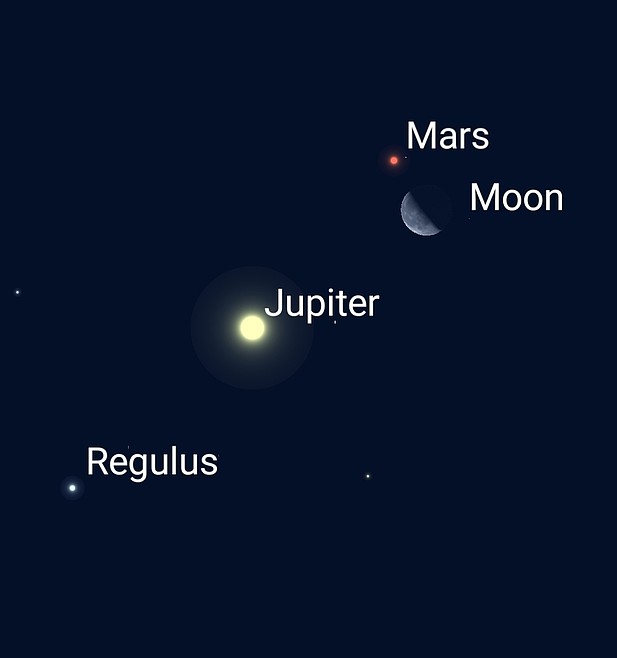
Regulus is the brightest star in the constellation of Leo. Image courtesy of John Taylor and Sky Safari 6 Pro.

Regulus is the brightest star in the constellation of Leo. Image courtesy of John Taylor and Sky Safari 6 Pro.
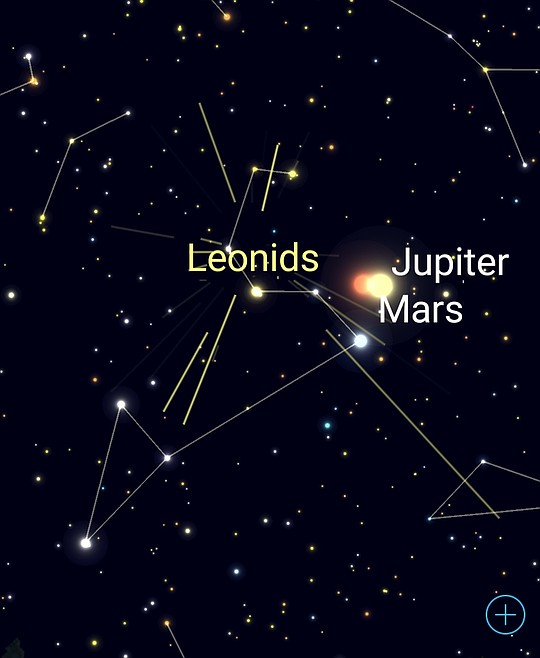
The “sickle” portion of the Leo constellation is very prominent, especially with Jupiter and Mars right next to it. Image courtesy of John Taylor and Sky Sarari 7 Pro.
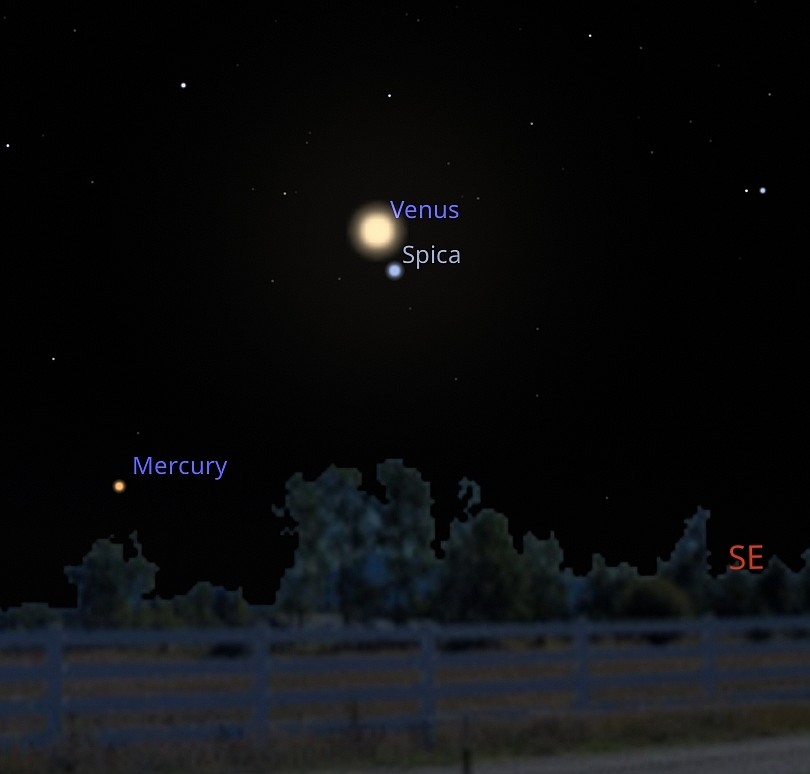
Venus, Spica, and Mercury in the Pre-dawn Sky. Image courtesy of John Taylor and Stellarium.
Well folks, we’re heading into the overcast skies of winter. Being optimistic that we will get a few clear nights this month, November is shaping up to be a great month for bundling up and taking a peek outside.
This month features overlapping meteor showers, plus the Leonids, a brilliant "Supermoon" passing right next to a famous star cluster, and a rare pairing of Mars and Jupiter (multiple times). Plus, all seven planets are visible this month: Mercury, Venus, Mars, Jupiter, Saturn, Uranus and Neptune!
Nov. 1 – Back to Standard Time
This morning at 2 a.m. turn your clocks back one hour. Doing this takes us from Pacific Daylight Time to Pacific Standard Time. It also means the Sun will now set depressingly early. On the bright side, our night sky appears one hour earlier, so that’s a good thing, right?
Nov. 1 – Third Quarter Moon
The third (or last) quarter phase, at 12:28 p.m, shows the moon appearing half-illuminated on its western, or left side. It rises before midnight local time and then remains visible until it sets in the western daytime sky in the early afternoon. The dark, moonless evening skies that follow this phase gives you an opportunity for observing deep sky targets, like the Andromeda galaxy!
Nov. 2 – Close Approach of the Moon and Mars Plus a Conjunction with Jupiter
If you are an early riser this will be quite the sight. The Moon and very red Mars will be less than 1° apart (one finger’s width, held up at arm’s length) and the Moon/Mars combo will be just over 5° apart (four fingers held up at arm’s length) from the bright planet Jupiter. Look toward the South at 5:30am till dawn to see this semi-rare sight.
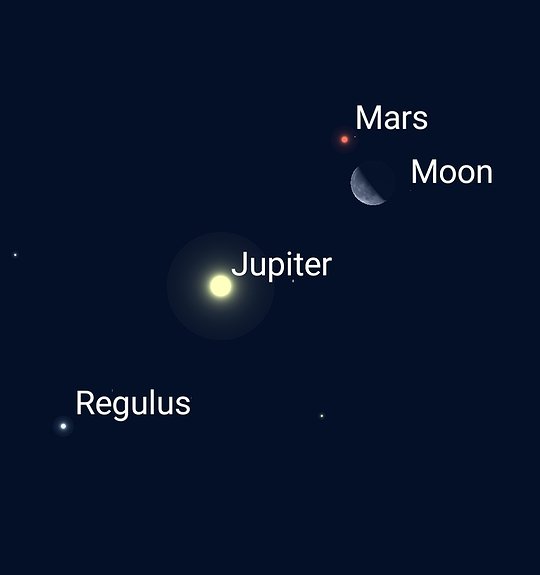 Regulus is the brightest star in the constellation of Leo. Image courtesy of John Taylor and Sky Safari 6 Pro.
Nov. 5 & 12 – The Southern & Northern Taurids Meteor Shower
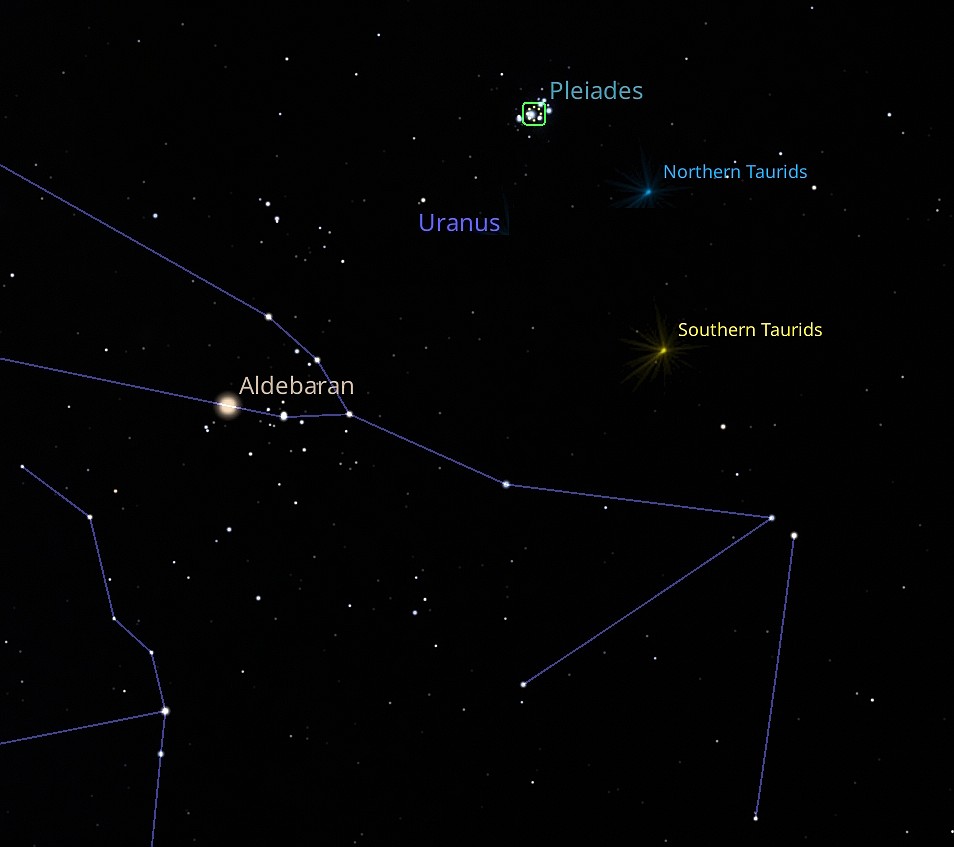
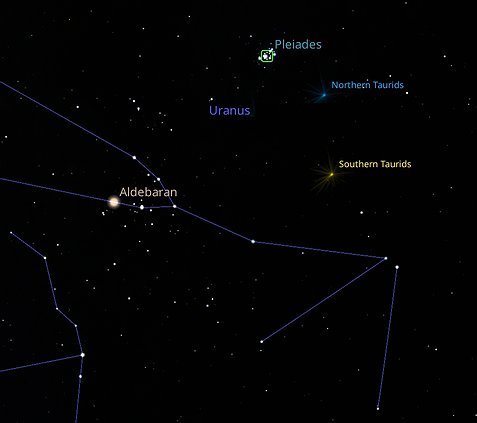
Separated by just a week, with both their radiant’s in the constellation of Taurus, the Southern and Northern Taurids will produce around 5 meteors per hour, respectively. These are lesser-known showers but if the night is clear, bundle up and go take a peek. The radiant for these two showers is very close to the Pleiades star cluster. As with all meteor showers, viewing after midnight is your best viewing window. You’ll notice Uranus in the image; it comes into opposition later this month.
Nov. 8 – New Moon
On this evening at 11:02 p.m., the moon will officially reach its new moon phase. The moon is now between Earth and the sun, and the side of the moon facing toward us receives no direct sunlight, making it hidden from view from anywhere on Earth for about a day or two. This is a weekend new Moon, so it is your best opportunity to get away from city lights and put you out under very dark skies to see what there is to see. One of the things to see is the Perseus Double Star Cluster. It is well placed. Look toward the high in Eastern sky after 8:00pm. You’ll need binoculars to see this lovely star cluster.
Nov. 10 – Venus and Spica Conjunction
On this morning, for you early risers, look low in the Eastern between 5:30 and 6 a.m. to see Venus and Virgo’s brightest star, Spica, in a close conjunction, just a little more than 1° apart (on finger extended at arm’s length.) See the November 18th image.
Nov. 15 – Close Approach of the Jupiter and Mars
And yet another early morning event. On this morning, look high in the Southern sky to see very bright Jupiter and very red Mars just over 1° apart. These two planets are hard to miss.
Nov. 15 – Saturn and Neptune Fairly Close to Each Other
All month-long Saturn and Neptune will occupy our night sky. Saturn is the bright yellow star high in the Southern sky at 9 p.m. and Neptune is just a fists width at arm’s length, less than 7° to the right. Be advised,
Neptune is a very faint planet. An experienced observer can find it in binoculars. Realistically because it is an 8th magnitude object, you’ll need a telescope at roughly 200x to see its disc and its deep blue color.
Nov. 17 – Leonid Meteor Shower
At its peak, the shower is expected to produce as many as 15 meteors per hour. At 11:00pm the constellation of Leo will be rising in the East. The radiant for this meteor shower is in the “sickle” portion of the constellation. The best viewing opportunities occur when the radiant is above the horizon. So, from 11:00pm to well into the wee hours of the morning of the 18th is your best time to see these slow-moving bright meteors. You know you’re looking in the right place because bright Jupiter and red Mars will be just to the right of the radiant for this shower.
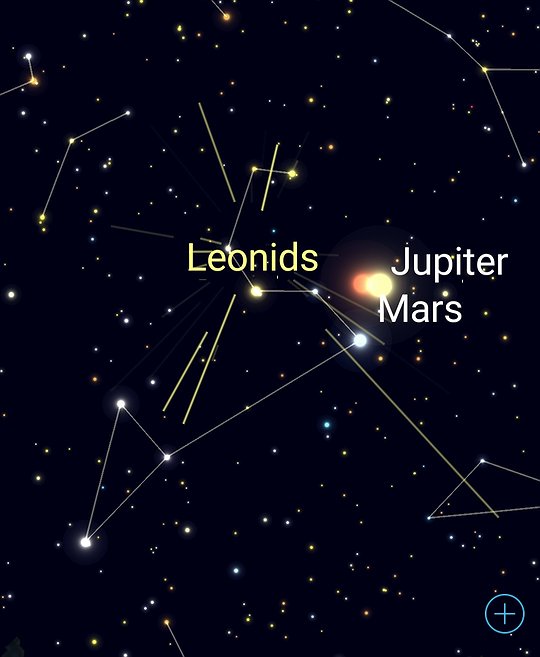 The “sickle” portion of the Leo constellation is very prominent, especially with Jupiter and Mars right next to it. Image courtesy of John Taylor and Sky Sarari 7 Pro.
Nov. 17 – First Quarter Moon
When the moon completes the first quarter of its journey around Earth at 3:48 a.m., its 90-degree angle between us and the sun will cause us to see the moon half-illuminated — on its eastern side, the right side.
At first quarter, the moon always rises around mid-day and sets around midnight, so it is also visible in the afternoon daytime sky. The evenings surrounding first quarter are the best evenings to use a telescope or even a pair of binoculars for seeing the lunar terrain which will be dramatically lit by low-angled sunlight, especially along the terminator, the pole-to-pole boundary that separates the light and dark hemispheres.
Nov. 18 – Venus and Spica Still Close, Plus Venus, Mercury, and Spica Prominent in the Morning Sky
And yet another event for you pre-dawn risers. Look to the Southeast between 5:30 and 6:00am to see a close conjunction between Venus and Spica (again), and Mercury at its highest point in the pre-dawn sky.
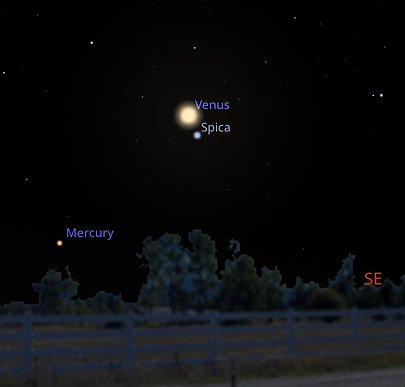 Venus, Spica, and Mercury in the Pre-dawn Sky. Image courtesy of John Taylor and Stellarium.
Nov. 24 – Full Moon, The Beaver Moon
The Moon will be located on the opposite side of the Earth as the Sun and its face will be fully illuminated. This phase occurs at 6:53 a.m. This full moon will be a super Moon and we be about 15% brighter than an average full Moon.
According to the Farmer’s Almanac, November’s full Moon is called the Beaver Moon because historically, the beavers were finishing their winter dams and lodges. Other cultures traditional November Moon names include: Frost Moon / Freezing Moon, and the Mourning Moon / Darkest Depths Moon.
Nov. 30 – Last Quarter Moon, again
This is the second occurrence of the third (or last) quarter phase. It will occur at 10:08 p.m., and the moon will appear half-illuminated on its western, or left side. It rises before midnight local time, and then remains visible until it sets in the western daytime sky in the early afternoon. The dark, moonless evening skies that follow this phase gives you an opportunity for observing deep sky targets, like the Pleaides star cluster!
Lastly, whether you’re choosing your first telescope, setting up gear, tracking down night sky objects, or diving into astrophotography, just ask at:
http://ncmrrimrockobservatory.space/contact/
• • •
John Taylor is an amateur astronomer who lives in Hayden.