
Best Night Sky Events for July
The month of July 2026 is filled with several enjoyable celestial events. Events include July’s only meteor shower, Venus still dominating the Western evening sky, a full Buck Moon, planetary and lunar conjunctions, our normal lunar phases and more.
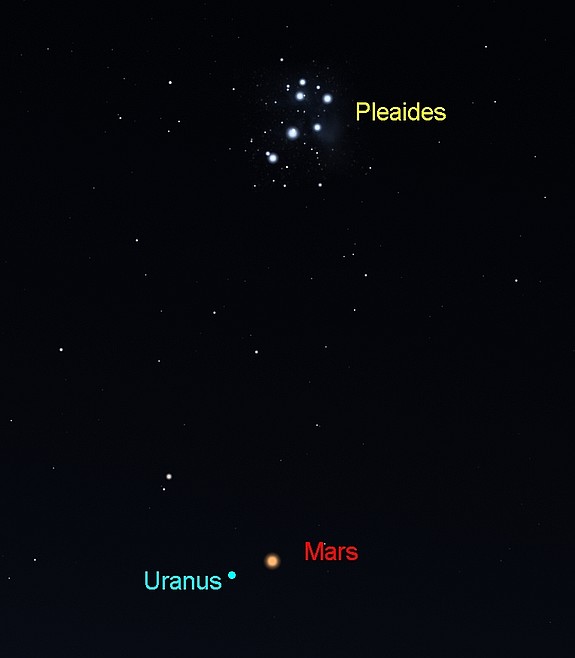
July 3 — Conjunction of Mars and Uranus
On this early morning, Mars and Uranus will be a mere half a degree apart. You will need binoculars for this event as Uranus is not visible to the unaided eye. At 3:30 a.m., look to the Eastern horizon to first find the Pleiades star cluster, then move your binoculars straight down the horizon until you see very red Mars. Now, look to the left of Mars to see a turquoise blue dot, that’s Uranus. Both Mars and Uranus will fit in the field of view of your binoculars.
July 7 — Last Quarter Moon
The Last Quarter Moon is the third and final quarter phase of the moon during its monthly cycle. At this point, the moon appears half-illuminated, with the left half visible from the Northern Hemisphere. This moon is visible after midnight and throughout the morning.
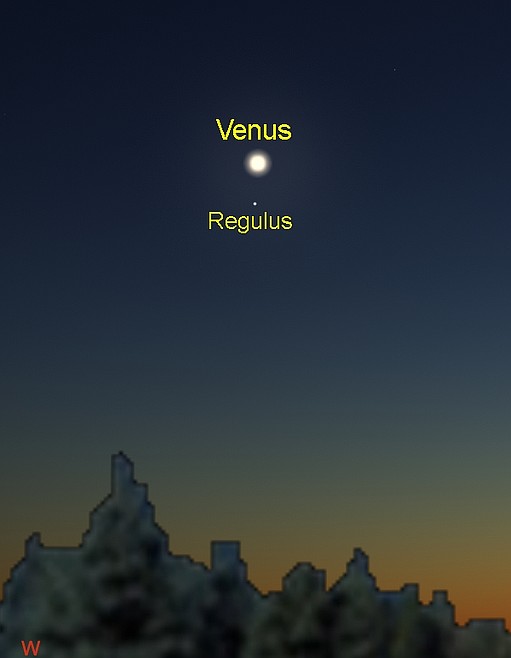
July 9 — Venus 1 degree north of the bright star Regulus
Look to the West at 9:45 p.m. to see bright Venus just 1 degree away from Leo’s brightest star, Regulus. These two objects will be low on the western horizon, so your opportunity to view them will be relatively brief.
Image courtesy of John Taylor and Stellarium.July 14 — New Moon
The New Moon is the beginning of the lunar cycle when the moon is not visible from Earth. It occurs when the moon is positioned between the Earth and the Sun. Since the illuminated side of the moon is facing away from us, the night sky will be especially dark, making it an excellent time for stargazing without moonlight interference.
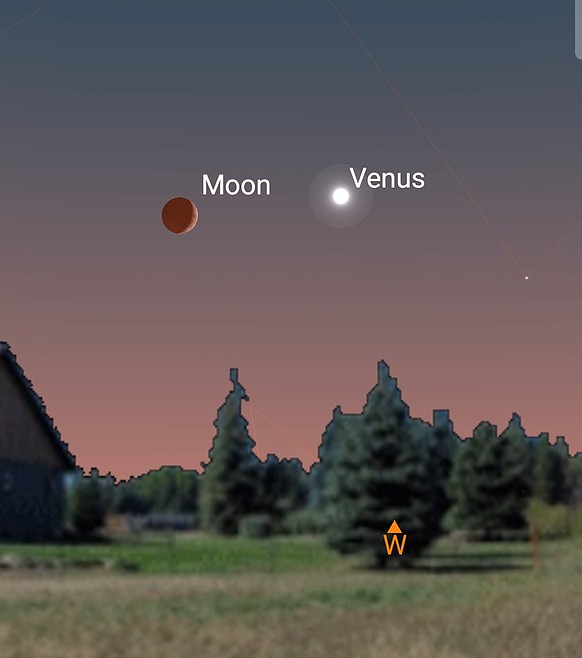
July 17 — Moon and Venus Are Picture Worthy
Look to the west at 9:30 p.m. to see the moon and Venus giving us a picture-worthy display. It’s not a conjunction or an appulse, but you will see a very young (just a sliver) moon and very bright Venus fairly close to the right of the moon. Grab your smartphones and snap a few images.
July 20 — Apollo 11 On the Moon, 57th Anniversary
On this date in 1969, Apollo 11, crewed by Mission Commander Neil Armstrong and lunar module pilot Buzz Aldrin, landed safely on the moon. The lunar module, named Eagle, landed on a lunar feature named the Sea of Tranquility. Six and a half hours after landing, the first human being, Neil Armstrong, set foot on the moon, uttering these now infamous words, "One small step for man, one giant leap for mankind."
July 21 — First Quarter Moon.
The First Quarter Moon marks the halfway point between the New Moon and the Full Moon. It appears as a half-illuminated disk with the right half visible from the Northern Hemisphere and is visible in the afternoon and evening sky.
July 29 — Full Moon, The Buck Moon
The moon will be located on the opposite side of the Earth from the sun, and its face will be fully illuminated. The Buck Moon is the traditional name for the full moon in July. It gets its moniker from the Algonquin tribes of North America, who observed that the antlers of male deer (bucks) are undergoing rapid growth. Other cultures also know it by different names, like the Thunder Moon, the Hay Moon, and the Berry Moon.
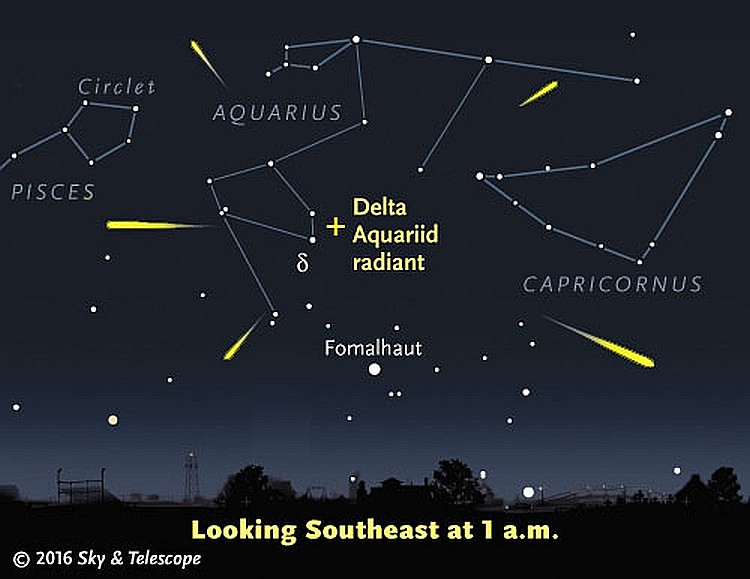
July 29 & 30 — Delta Aquarids Meteor Shower
The Delta Aquarids meteor shower will be taking place on the night of the 29th and the early morning of the 30th. On this night, the meteor shower will be at its peak, where you could witness up to 20 meteors per hour. These meteors are known for producing faint, yellow streaks and occasional persistent trails. Even though the constellation of Aquarius is low in the Southeastern sky, the meteors can appear
anywhere. This event happens annually from mid-July to mid-August as we pass through the debris field of comet 96P/Machholz.
And finally, whether you’re choosing your first telescope, setting up gear, tracking down night sky objects or diving into astrophotography, ask at: ncmrrimrockobservatory.space/contact/
• • •
John Taylor is an amateur astronomer who lives in Hayden.