

Best Night Sky Events for February 2026
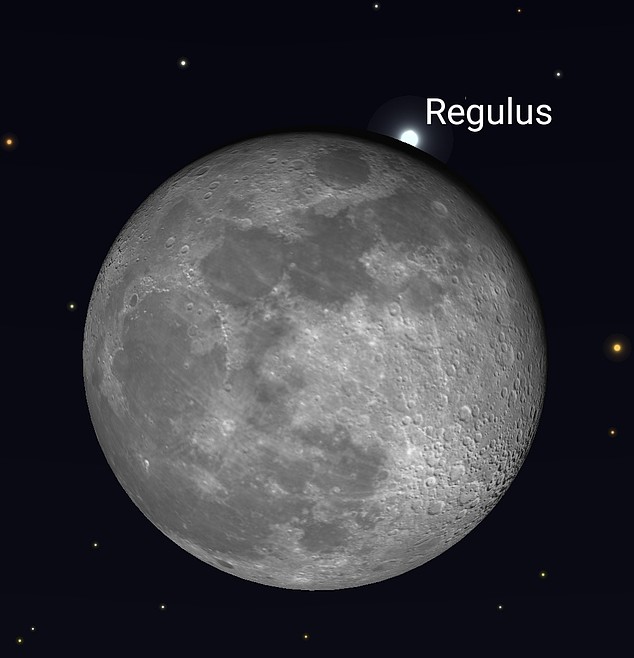
Here you see the bright star Regulus emerging from behind the Moon at 6:39 p.m.
Image courtesy of John Taylor and Sky Safari Pro 6.
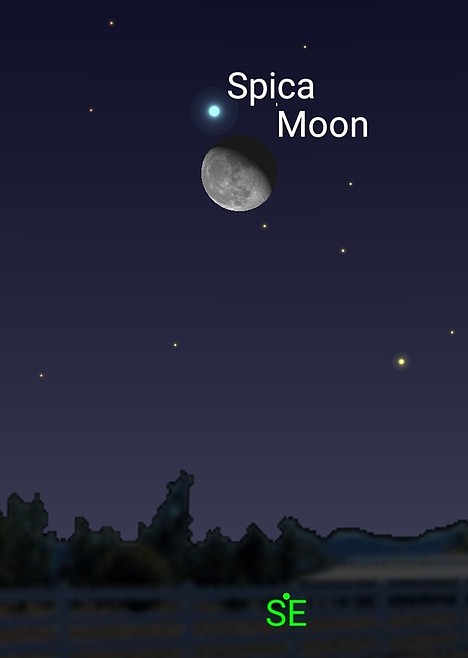
This image shows the conjunction of the Moon and Spica just after rising above the southeastern horizon. Image courtesy of John Taylor and Sky Safari Pro 7.
John Taylor
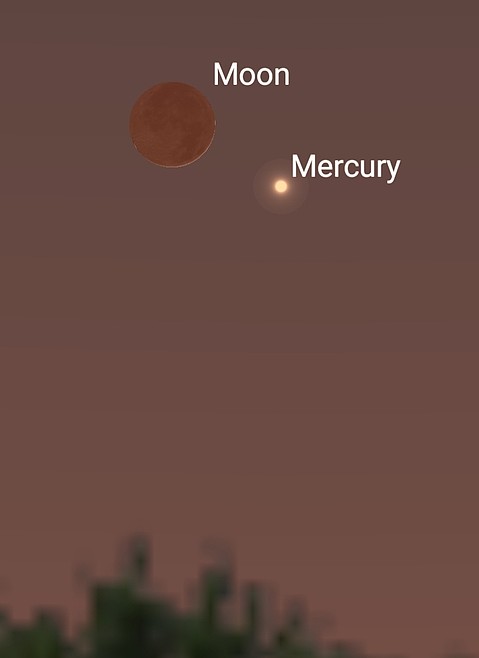
This image shows a very young Moon (crescent barely visible) and Mercury our most fleeting planet very low on the western horizon. Image courtesy of John Taylor and Sky Safari Pro 7.
This image shows a very young Moon (crescent barely visible) and Mercury our most fleeting planet very low on the western horizon.
Image courtesy of John Taylor and Sky Safari Pro 7.
As February arrives, the clouds are still above us. These conditions sadly hinder our ability to view astronomical events. So, the lunar phases, conjunctions, and an occultation listed below are there just in case we get some clear nights that coincide with these events. If a clear night happens on a date not listed below, there is always bright Jupiter available for viewing.
Feb. 1 — The Full Moon — the Snow Moon
The moon is now on the far side of the Earth from the Sun, and its face will be fully illuminated. This phase occurs at 2:09 p.m. This full moon was known by some Native American tribes as the Snow Moon.
Feb. 2 — Lunar Occultation of the Bright Star Regulus
The moon will pass in front of Leo’s brightest star, Regulus (Alpha Leonis), creating a lunar occultation visible from Coeur d'Alene. An occultation is when one celestial body passes in front of another, temporarily hiding the more distant object from an observer's view. Binoculars will definitely help you see the reemergence of Regulus, a singular experience. It will begin with the disappearance of Regulus behind the moon at 5:58 p.m., which is before local moonrise. Its reappearance will be visible at 6:39 p.m., though at a low altitude, just above the eastern horizon.
Feb. 7 — Close Conjunction of the Moon and the bright star Spica
Look low in the Eastern sky around 1 a.m. to see Virgo’s bright blue star, Spica, a mere 2½ degrees (less than three fingers at arm’s length) from the waning gibbous moon. This event is for all you night owls out there.
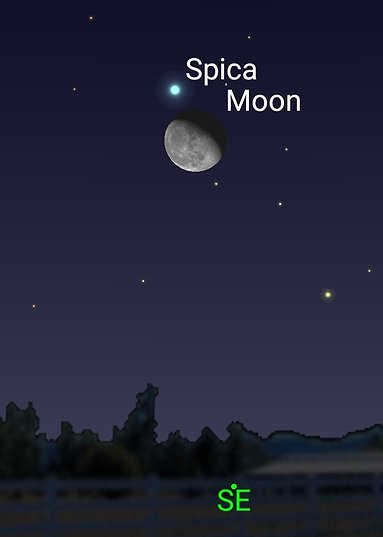 This image shows the conjunction of the Moon and Spica just after rising above the southeastern horizon. Image courtesy of John Taylor and Sky Safari Pro 7.
This image shows the conjunction of the Moon and Spica just after rising above the southeastern horizon. Image courtesy of John Taylor and Sky Safari Pro 7.
Feb. 9 — Third Quarter Moon
At its third (or last) quarter phase at 4:43 a.m., the moon appears half-illuminated on its left side, which is its western, sunward side. It rises around midnight local time and then remains visible until it sets in the western daytime sky in the early afternoon. Before moonrise, the dark evening sky is best for observing deep sky objects like the Pleiades star cluster, which at 7 p.m. is directly overhead.
Feb. 17 — The New Moon
The moon is now located on the same side of the Earth as the Sun and so it will not be visible in the night sky. This phase occurs at 4:01 a.m. This is the best time of the month to observe faint objects such as galaxies (Andromeda), nebulae (Orion’s sword) and star clusters (like the Perseus double cluster) because there is no moonlight to interfere. A pair of 10x50 binoculars is a great tool for observing these objects.
Feb. 18 — Close Conjunction of the very young Moon and Mercury
The Moon and Mercury will make a close approach, passing within 1 ° of each other. The pair will be visible above the western horizon for a short period, from 6 to 6:15 p.m. They will be visible to the naked eye, but preferably through binoculars. This is a very rare opportunity to see a very young moon. The moon will only be 34 hours past the New Moon phase, making this a 34-hour-old moon. The crescent will be so skinny that you will need binoculars to see it. This is one of the few times this year you’ll be able to see Mercury, our most fleeting planet.
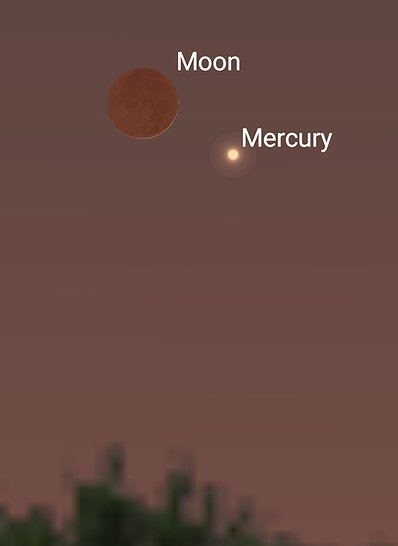 This image shows a very young Moon (the crescent is barely visible) and Mercury, our most fleeting planet, very low on the western horizon. Image courtesy of John Taylor and Sky Safari Pro 7.
Feb. 23 — Close approach of the Moon and M45, The Pleiades Star Cluster
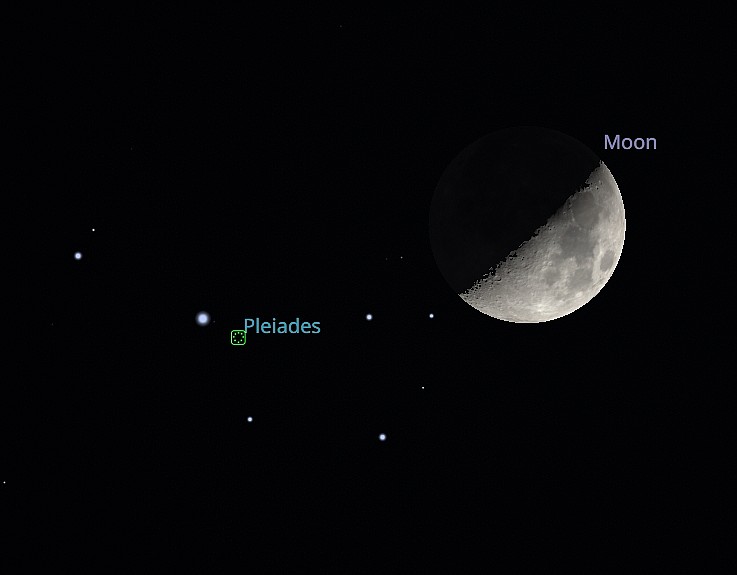
The Moon and M45 will make a close approach, passing a little over 1° apart. The pair will become visible around 6:08 p.m., high in the southern sky as dusk fades to darkness. They will then sink toward the western horizon, setting at 1:20 a.m. They will be too widely separated to fit within the field of view of a telescope, but will be visible to the naked eye or through a pair of binoculars.
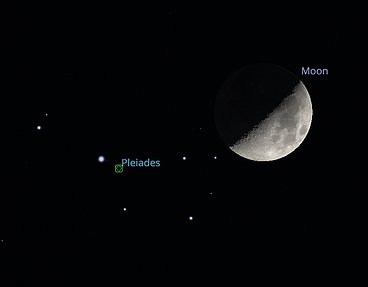 This image shows a very young Moon (the crescent is barely visible) and Mercury, our most fleeting planet, very low on the western horizon.
Feb. 24 — The First Quarter Moon
When the moon reaches first quarter at 4:27 a.m., its 90-degree angle from the Sun will make it appear half-illuminated on the right (its eastern) side. In the first quarter, the moon always rises around midday and sets around midnight, so it is also visible in the daytime sky. The evenings surrounding the first quarter are the best ones for seeing the lunar terrain when it is dramatically lit by low-angled sunlight, especially along the terminator, the pole-to-pole boundary that separates the light from the dark hemispheres.
• • •
John Taylor is an amateur astronomer who lives in Hayden.