

VETERANS PRESS: Portrait of a Soldier
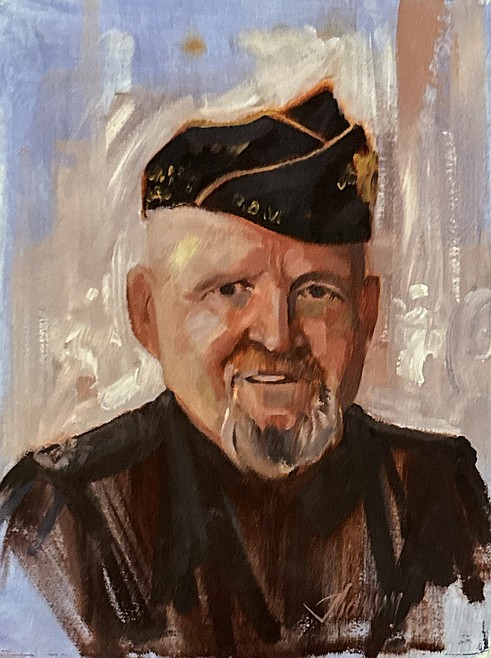
Portrait of veteran Benjamin White, who served in Southeast Asia in 1960. The portrait is part of the “Vets: Fifty Portraits of Veterans and Their Stories” book of paintings by former courtroom artist John Thamm.
JOHN THAMM/Courtesy photo
Remembering a dramatic period in his military life, Benjamin White says, “I was privileged to spend 54 days with a broken back on the floor of the jungle during monsoon season. I was cold and wet with no fire and no friends.” He uses the word “privileged” because of what he learned: "Of all the ways there are to die, I will not starve to death. I found that I could eat just about anything if it didn't eat me first."
With a cynical smile, he adds, "That includes raw tiger."
He'd broken his back while parachuting into the area, but he kept his rifle handy. When the tiger approached, he recalls, it crouched 8 feet from him. But White's terror served him well. He fired half a magazine, of which only half a dozen rounds hit the tiger.
"I tell people that the tiger and I were going to have a meeting of the minds over lunch. But he lost his mind and became lunch."
Because the enemy would easily locate White if he built a fire, he couldn't cook his meat. But that was fine because, he admits, "I didn't eat the tiger. I just tasted him."
Even so, the memory of that dangerous moment stays with him. "I still have a hard time getting along with cats."
A couple of years before the tiger incident, White had entered the Marine Corps, and in late 1960, he landed in Southeast Asia. He and many others thought they were prepared for anything, but the field training surprised even the toughest of them.
An officer grabbed a bullhorn and announced, "My name is Lt. Col. Black. When I give you the word, I want you to follow me. Leave your gear where it is." With that, he turned toward the trail. White recalls a unique marking on the back of the man's shirt. "It was two lines of writing. The first line said, 'Follow me, and the second said, 'Keep up if you can.' About 5,000 people fell in after the lieutenant colonel, but when they finished the training, the number had dwindled to a mere 165.
"That was the only time I ran 44 miles in a single day in my life," White says.
Halfway into the run, they stopped for food and water. White and others grabbed bread and slabs of steak for sandwiches. After an hour and 45 minutes, Lt. Col. Black ordered them up and moving. "We weren't expecting that," White says. "We thought the run was over."
Despite the grueling training, White still has a high regard for that colonel. "He was the epitome of a leader. He never asked us to do anything he wasn't willing to do himself. He was about 6-foot-1 and 170 pounds — just tougher than leather."
White doesn't say precisely where this training took place. He can't even say with certainty that he was in Vietnam — then or in the months that followed — because the Vietnam conflict wouldn't begin for another three years. White's unit was in the area unofficially: "Our president later said we don't have any people there," he remembers. The men were not allowed to wear uniforms or carry identification. The MIC (Man in Charge) was the one with the most expertise in that phase of the mission.
During his time in Southeast Asia, White often endured brutal conditions. But the worst was the long-term incident with the broken back. His rescue eventually came from a surprising source. "I got out of there when two fishermen found me."
He remembers that Lt. Col. Black had spread an announcement to local villages to prevent the mutilation of Americans' bodies. The colonel offered $200 for "any cadaver returned to camp." Of course, when the fishermen approached White, he didn't know if they would kill him and return his body for the reward. He couldn't speak their language, and they didn't know English. But for reasons he'll never understand, they took him back to camp without further harm.
White suffered other injuries during his tour, including numerous broken bones and bullet wounds. But he wasn't alone. "Nobody came back uninjured," he says. In fact, only seven of them came back at all.
Years later, White still feels the effects of battle. "I have metal in my head, metal in my chest, some metal in my spine and metal in my knee." In addition, he's endured skin cancer, psoriasis and PTSD.
To illustrate the extent of his trauma, he remembers the Christmas of 2001, when he gave his wife a kitchen faucet.
"The pain I was having from trying to install it was so great. I was lying on my belly, and my legs were twisted around," White said. Three hours later, he went to the hospital handcuffed to a gurney.
“My wife was trying to soothe me and I didn’t know who she was,” he says, explaining that he sometimes loses sight of reality. “That’s why I wear a rubber band on my wrist. I can snap it to bring me back to the here and now instead of there and then. I've raised a blister on my wrist, snapping it for as long as 35 minutes."
After the military, White moved from El Toro, Calif., to North Idaho, where he has worked a variety of jobs, including construction. He worries about the direction the United States is taking, particularly concerning his right to bear arms. Above all, he recalls his days in Southeast Asia.
"Why were there only seven of us that came back, White asked. "We all received the same training from the same people."
Because his question remains unanswered, he may never experience complete peace of mind.
"I have survivor guilt," he says. As a service to his fellow veterans, White is presently the assistant chaplain in the Priest River, Idaho Chapter of the Disabled American Veterans.
• • •
The Benjamin White portrait and story are included in the book “Vets: Fifty Portraits of Veterans and Their Stories.” The portraits are by John Thamm. Tom Davis compiles the stories. Most of the veterans have local roots or connections, and each story and portrait make up an uplifting and emotional tribute to these and all veterans. A courtroom artist, John lives in Spokane with his wife, Kathy. You can find this book and much more about John Thamm at https://jthamm.com. Portraits and stories printed with their permission.