
Aquifer holding strong despite water demands
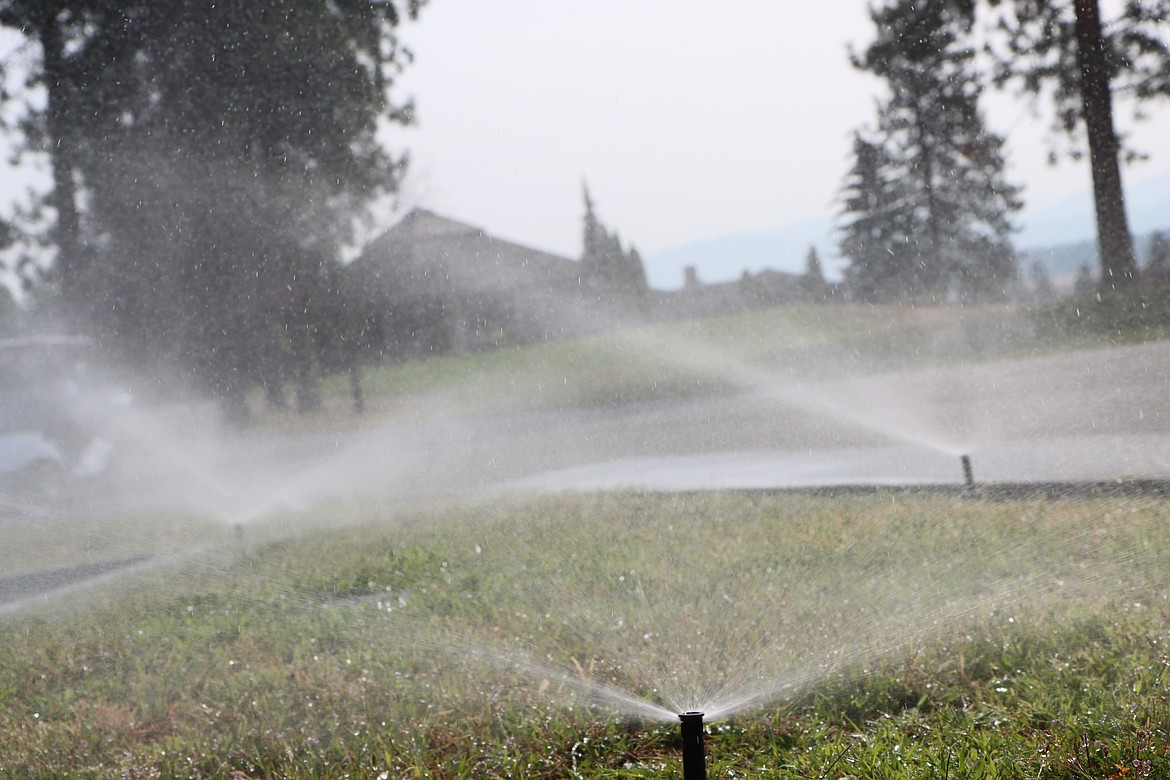
The Highlands Golf Course in Post Falls waters the lawn in front of the Highlands Grill and Taphouse around 8 a.m. on Friday, August 21.
JACK DeWITT/Press
No need for waterworks or worry over the health of the Spokane-Rathdrum Prairie Aquifer, yet.
East Greenacres Irrigation District Manager Ron Wilson said that despite reports of concern on the aquifer's health, his numbers in Idaho remain steady.
"I hear people say the aquifer's lower than it's ever been, I don't see that with my transducers," he said. "The aquifer is healthy."
He says that the fluctuations in his numbers are consistent with years past, though he does believe that change in the aquifer is happening. Wilson said there is still much that is unknown about the aquifer, despite years of study, and that something outside the current realm of understanding could be causing the difference in numbers.
"We just don't see it yet," he said.
Good thing.
Cities across North Idaho are pumping millions of gallons of water daily, most for irrigation, which is watering of lawns.
The Post Falls Water District, one of three water districts serving the city, pumped around 2.35 billion gallons of water in 2025. The Greenacres Irrigation District and the Ross Point Water District also serve Post Falls, as well as county residents.
The city has 10 active wells, one booster station, four reservoirs with around 5.5 million gallons of capacity, as well as 128 miles of water line managed by nine employees.
Craig Borrenpohl, utilities manager for Post Falls, said peak yearly water usage runs from late June to early September, due to irrigation demand, with peak demand time between 4 and 7 a.m.
Winter usage sits around 2 million gallons per day in the winter and 14 million in the summer, according to city statistics.
The city's new 20-year master plan for the public water system is under development. Borrenpohl said they are combing through historical usage data to help determine future demand.
He also said the use of historic data to anticipate the city's future needs has actually highlighted the importance of one thing: simple, at-home maintenance on a resident's own irrigation or sprinkler system.
"When system users take a few minutes to fix leaking fixtures, replace broken sprinkler heads, and properly adjust irrigation schedules, the water savings show up in less water needing to be pumped,” Borrenpohl said.
Water quality has not suffered in recent years, Borrenpohl said, and the sole water source for Post Falls is the Spokane-Rathdrum Prairie Aquifer because of its high quality and reliable supply, which meets and often exceeds what is required by the Safe Drinking Water Act.
Water samples are taken on a monthly basis to make sure it's safe for users.
Post Falls could not provide data about the largest consumers of water within the city’s district.
Coeur d'Alene
The city of Coeur d’Alene Water Department has 11 wells, six booster stations, and seven tanks with a variety of different capacities, 2 million gallons being the largest, according to Glen Poelstra, assistant director of the Coeur d’Alene Water Department.
During the year, Water Department staff see a large increase in usage from the winter months to the summer months largely due to landscape irrigation, he said.
“Our daily winter usage ranges from 4-6 million gallons per day increasing to 37.5 million gallons peak day demand thus far in August 2026,” he said. “Our peak days and weeks are largely dependent on the weather throughout the summer months. July and August are our high demand months of the year ranging in the low to mid 40 million gallons per day.”
Peak demand challenges for Coeur d’Alene are in the early morning hours starting about 3 a.m. when irrigation systems are starting up and customers are getting ready for the workday, he said. Water tank levels peak during the evening hours and quickly drop as demand increases resulting in the need for all 11 wells to run simultaneously.
According to the 2023 Comprehensive plan update, the largest water users in the city of Coeur d’ Alene are housing developments with large amounts of greenspace, city parks, school district properties, resort hotels, car washes, and apartment complexes.
“Water conservation is encouraged throughout the city to ensure that people are mindful of our natural resource that provides such quality drinking water," Poelstra said.
The Spokane-Rathdrum Prairie Aquifer remains a steady resource to provide quality drinking water for the citizens of Coeur d’Alene and the surrounding areas.
Poelstra said department staff regularly monitor aquifer levels and have not seen any changes that would indicate a problem. Water quality samples have been consistent with years past and haven’t shown a change in water quality.
East Greenacres Irrigation District
East Greenacres serves about a third of Post Falls' population, according to Wilson. He said the loss of agriculture on the prairie over the past two decades has cut into their water demand
"Agriculture is a very hungry field," said Wilson.
Wilson estimates their district has lost around 1,500 acres of agricultural land to development and housing, which require less water.
East Greenacres has 14 wells, running at 5,400 hp each, one reservoir, and around 120 miles of water main, two power grids and five industrial generators.
It can store a max of 325,000 gallons, however, according to Wilson, it is currently in the design and planning phase to construct a 1.5-million-gallon tank.
Yearly peak usage runs from May to September, which is mostly for lawn and farm watering, according to Wilson.
East Greenacres also boasts a 4.72 water loss percentage, Wilson said that anything below 10% is "beautiful." He said East Greenacres has worked diligently to keep that percentage low because it wants to get as much of the water it pumps to the user as it can.
Wilson called the winter water demand a "fraction" of the summer's and said they use one single 200 hp well to serve the entire water demand.
Wilson said that when water usage is high, it is consistent across all days of the week and the only real driver of East Greenacres' fluctuation in water usage is the season.
Apartment complexes, trailer parks and hotels are the biggest residential and commercial users of East Greenacres' water, while its primary irrigational use is for agriculture and farming.
Wilson said the district's biggest challenge in the coming years will be to meet the cost of new infrastructure and to overcome the challenges of urbanization.
"Our community is growing at an exponential rate," he said.