
OUR GEM: How wildfire smoke can affect aquatic ecosystems
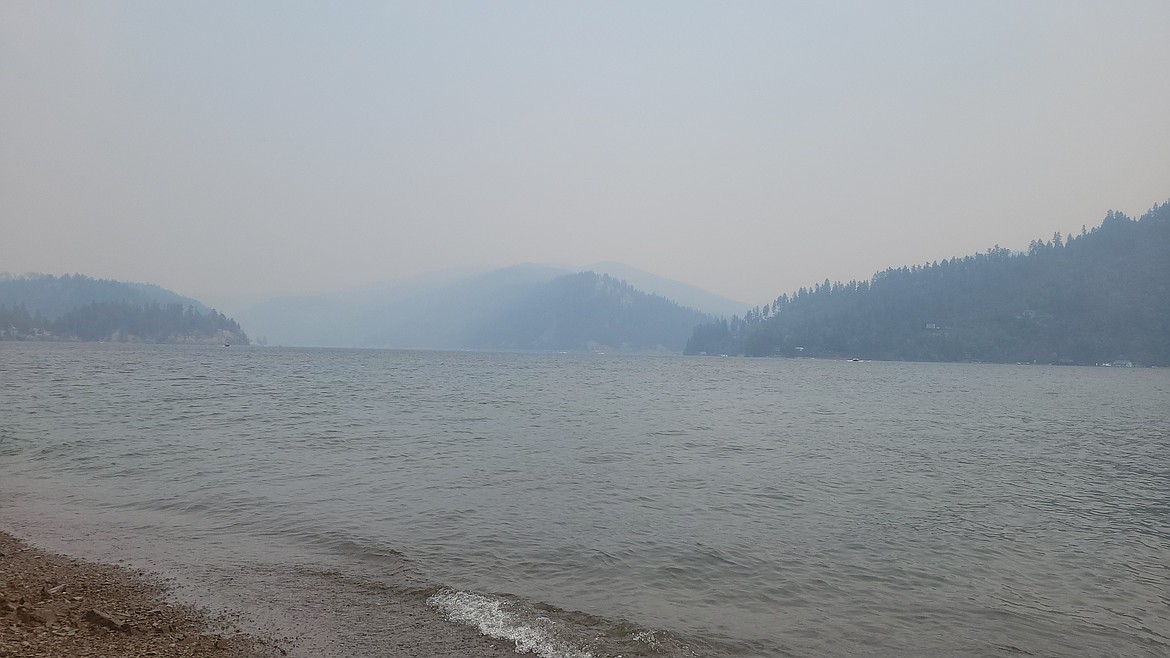
Smoke shrouds Lake Coeur d'Alene. Photo by Jade Clinkenbeard.
KAYE THORNBRUGH/Press
As the 2026 wildfire season intensifies across the West, the connection between wildfire and water is becoming increasingly relevant. The western United States has experienced severe fire and weather conditions this summer, with multiple large fires burning just west of Coeur d’Alene (including the Old Trails, Autumn Lane, and Fairview fires in Spokane). At the same time, numerous other wildfires continue to send smoke across the broader Northwest. As a result, North Idaho has already experienced some of the worst air quality days in recent record due to wildfire smoke.
For residents looking across a smoky landscape, the most obvious effects of these fires may be hazy skies, poor air quality and reduced visibility. But what happens when that smoke passes over a lake? Increasingly, scientists who study “smoke ecology” are finding that the connection between wildfire and water extends much farther than the land touched directly by flames.
When we think about wildfire and water quality, we often picture a burned landscape followed by rain washing ash, soil and debris into nearby streams and lakes. This is an important pathway, but it is only part of the story. An aquatic ecosystem does not have to be surrounded by burned forest (or even be close to a wildfire) to experience fire’s effects.
Wildfire smoke, containing small and large particles of both burned and incompletely burned materials, heavy metals, and biological organisms like bacteria and fungi, can travel hundreds or even thousands of miles. As it moves, smoke passes over lakes and rivers far beyond the area directly affected by fire, and some of its contents are deposited.
For communities that depend on healthy lakes for recreation, fisheries, drinking water, tourism and quality of life, this atmospheric pathway is becoming increasingly important. A recent study led by Dr. Facundo Scordo at the University of Nevada, Reno, found that wildfire smoke affects approximately 270,000 lakes per year across the United States and Canada, about ten times more than the 25,000 lakes whose watersheds are directly burned.
What happens when smoke emissions reach a lake?
Wildfire emissions are more complicated than the smoke we see in the sky. Fires release particles of many different sizes. The smallest smoke particles can remain airborne and travel great distances, while larger pieces of ash and other fire-generated particles generally fall closer to the fire.
These particles can contain carbon, nutrients such as nitrogen and phosphorus, trace metals, and living microbes. When they settle onto a lake, they can change the supply of materials available to blue-green algae (cyanobacteria), other bacteria, and other aquatic organisms. At the same time, the smoke remaining above the lake changes the amount and type of sunlight reaching the water.
Both processes can influence how a lake functions
Research has shown that smoke can reduce incoming sunlight and alter lake temperature and biological activity. Other studies suggest that wildfire emissions can influence cyanobacteria production and nutrient cycling. Adding nutrients from wildfire particles could stimulate algal growth under some conditions, while reduced sunlight could limit growth under others. Some studies suggest that microbes themselves are deposited into water, and research from the University of Idaho at Coeur d’Alene has shown that cyanobacteria are sometimes found in smoke.
Not every lake will respond to smoke in the same way. The effects depend on factors such as the amount and composition of deposited material, distance from the fire, lake depth, existing nutrient concentrations and even the time of year when the smoke and ash arrive. A nutrient input in midsummer would likely stimulate algal growth because light and temperature conditions are optimal. However, the same nutrient input arriving in late fall may have a much smaller impact because reduced light and cooler temperatures limit algal growth. That uncertainty is a major scientific challenge. While researchers have studied wildfire effects on burned watersheds for decades, far less is known about how airborne emissions affect lakes beyond burned areas.
To help close this gap, scientists at the University of Nevada, Reno, recently launched FIRE-NET: Wildfire Airborne Particles: Emissions, Transport, Fate, and Their Influence on Lake Ecosystems, a collaborative research network supported by the U.S. National Science Foundation. The network (which includes a local fire scientist from the University of Idaho) brings together about 30 researchers with expertise in wildland fire science, atmospheric science, aquatic ecology, chemistry, microbiology, engineering and modeling.
The scientists are working to answer several fundamental questions: How far do wildfire particles travel? What chemicals, nutrients and microorganisms does smoke carry? How do those particles change as smoke moves through the atmosphere? Where do they eventually settle? And, importantly, what happens when they reach freshwater ecosystems?
For communities surrounding lakes such as Coeur d’Alene, Hayden, Pend Oreille and Fernan, these questions matter for practical reasons. Healthy lakes support fisheries, recreation, tourism, drinking-water supplies and many of the cherished experiences that connect people to the landscape. As wildfire seasons intensify, understanding how smoke affects the lakes beneath those smoky skies will become increasingly important for protecting the waters we value.
Facundo Scordo, PhD, is Assistant Research Professor, Tahoe Institute for Global Sustainability, University of Nevada, Reno. Leda Kobziar, PhD, is in the Department of Forest, Rangeland, and Fire Sciences, University of Idaho, Coeur d’Alene, ID, USA
Learn more about the Our Gem Collaborative at uidaho.edu/OurGem.