
Fighter Leo Lomski and the Elks' gymnasium
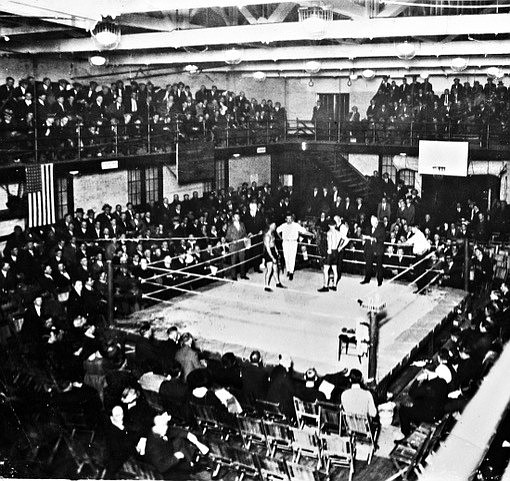
Lomski vs Conley — December 1923 — The photo shows a nearly packed house anticipating the beginning of an exhibition boxing match between two fighters who are believed to be middleweight professionals, Leo Lomski of Mullan and Billy Conley of Spokane. The fight was sponsored by 4-L, a local men’s social club, and it was estimated that 1,200 people watched Lomski win on points. Pictured are (from left) Leo Lomski, Referee Bill Guimond, Billy Conley, Ring Announcer Joe Adams and fighter Fred Lenhart, who was there to challenge the winner. -- REC-13-008 - Museum of North Idaho Photo
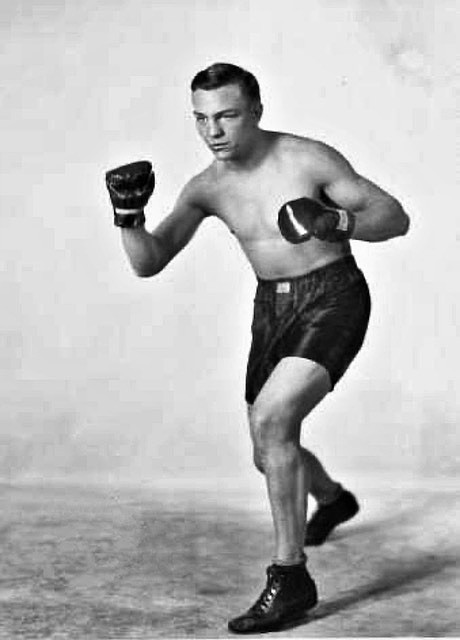
Leo Lomski, pictured in this 1927 photo, appears to have begun fighting professionally in May of 1922. For his first few fights, he was billed as “Battling Lomski,” but as his reputation grew as a tough fighter, he was referred to as the “Aberdeen Assassin.” He would fight professionally for 15 years before retiring.
Box-Rec Photo
In a recent post on the Museum of North Idaho’s Facebook page, a photo was shared of two boxers preparing to fight before a near-capacity crowd at the Coeur d’Alene Elks' gymnasium. It was printed in the Coeur d’Alene Press in February 1958 to illustrate a story about the Lake City’s reputation as a top location for professional boxing matches in the 1920s.
The Elks' gym, part of the Benevolent Order of Elks #254 Lodge building at 418 Lakeside Avenue, was completed in August 1923. Primarily used for lodge meetings, the facility also hosted many community events, civic activities, and sporting events, including professional boxing.
The photo description identified the six men in the boxing ring but gave no other details of the event thought to have taken place in the mid-1920s. Preparing to fight were Leo Lomski and a challenger, a man named Davis, from Chicago. It was noted that the referee was Bill Guimond, who was wearing white clothing.
Always looking for the backstory for such photos, I decided to track down the details of when exactly the event occurred, what the outcome of the fisticuffs that night had been and perhaps a bit of information about Mr. Lomski and Mr. Davis.
Fortunately, an online boxing history database, boxrec.com, allowed me to quickly establish that the Elks' gym had hosted only three boxing matches, and that all three had featured Leo Lomski. But interestingly, none had featured a fighter named Davis.
The dates of the three fights had been Dec. 12, 1923; Jan. 22, 1923; and March 2, 1924. Fighting as a middleweight, Leo Lomski of Mullan had headlined all three boxing cards, winning two of the three matches before capacity crowds.
From the Coeur d’Alene Press and Spokesman-Review archives, I found stories about the three fights. Based on the details found there, I concluded that the fight in the Coeur d’Alene Press photo in the museum’s archive was likely the one that had occurred Dec. 23, 1923.
The event was significant since it happened only a few months after the building’s dedication. Lomski had defeated Billy Conley of Spokane on points that night, and the bout had been refereed by Bill Guimond.
I next turned to researching Lomski’s background and found that he was born in Davenport, Okla., in October 1903. He then moved with his parents to Aberdeen, Wash., at an early age, grew up there and attended school.
At 18, Leo joined the Navy and began fighting, winning all three bouts fought during his two years as a sailor. Returning to civilian life, he became a lumberjack while continuing his fight. He established the Morning Club in Mullan as his base and gained a reputation as one of the region’s best, winning fights in Kellogg, Wallace and Spokane.
Lomski split the other two Elks' gym fights. He won the second via a disqualification by Billy Wright and lost the third bout, a rematch against Conley, via a technical knockout. He rebounded from the loss with a 23-fight winning streak, capped off by becoming the West Coast Middleweight Champion.
Along the way, Lomski faced and defeated notable middleweights and light heavyweights, including James J. Braddock, Maxie Rosenbloom and Mullan’s “Young Firpo," aka Guido Bardelli. All told, he fought 17 main events at New York’s Madison Square Garden but lost to Johnny Loughran for the Light Heavyweight Crown and never had another title shot.
Over his 15 years as a fighter, Lomski fought an estimated 146 times and had 103 wins, 27 losses and 16 draws. He retired in 1936 and returned to Aberdeen, where he joined the Merchant Marine. He died Nov. 12, 1975, at age 72, and was cremated. His ashes were then spread on the Pacific Ocean, where he had spent much of his life when not fighting.
 Leo Lomski, pictured in this 1927 photo, appears to have begun fighting professionally in May of 1922. For his first few fights, he was billed as “Battling Lomski,” but as his reputation grew as a tough fighter, he was referred to as the “Aberdeen Assassin.” He would fight professionally for 15 years before retiring.