

Proponents tout Idaho gold-antimony mine as lawsuits threaten its prospects
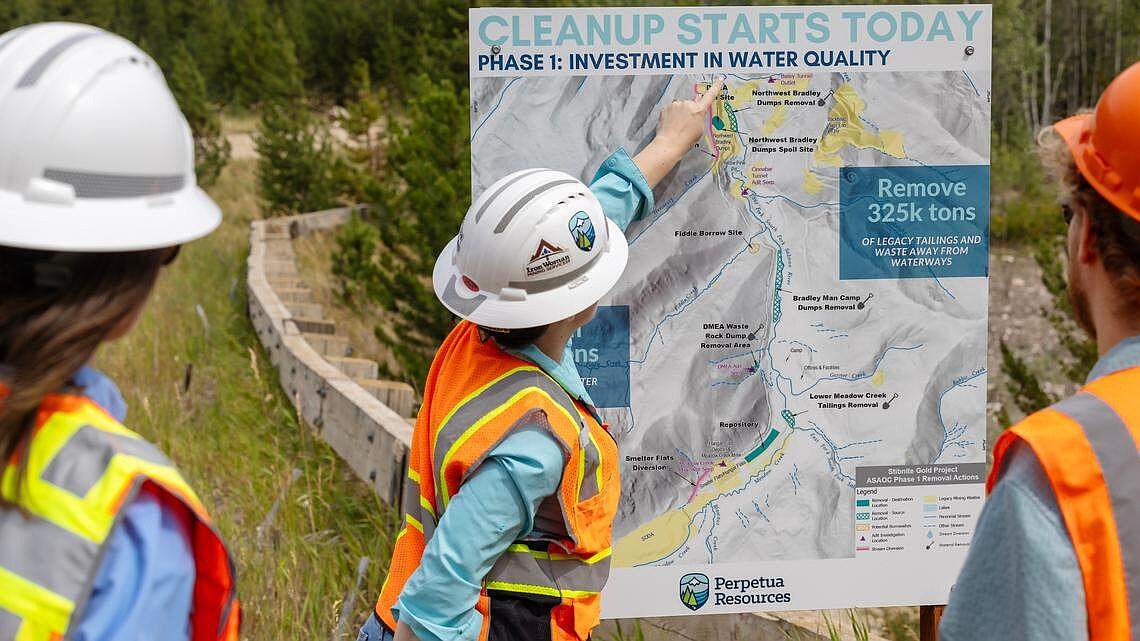
Mckinsey Lyon, vice president of external affairs for Perpetua Resources, points out the layout of some of the mining company’s environmental restoration plans at its proposed Stibnite Gold Project. The company hopes to begin mining operations for gold and antimony by 2029. Sarah A. Miller [email protected]
In the face of mounting legal challenges, the corporate backers of a gold and antimony mine in Central Idaho hosted state and federal dignitaries Friday at the remote site to celebrate recent approvals that have advanced the multibillion-dollar venture — which is at least another three years from operations.
The occasion, labeled a “ribbon cutting” by Perpetua Resources, the mining company behind the large-scale project, was more than eight years in the making. The U.S. Forest Service took that length of time before giving its blessing for the open-pit mine in the Payette National Forest mountains east of McCall — a point of frustration about such permits for Idaho’s federal lawmakers, who have all fully endorsed the project.
Perpetua earned federal approval in January to reopen the abandoned site near the community of Yellow Pine, which has been mined off and on dating to the late 19th century. The publicly-traded Canadian gold mining firm, now with its headquarters in Boise, spent handsomely to push what it called the Stibnite Gold Project through the demanding environmental review process.
“After eight years of extensive permitting review and over $400 million invested, it is finally time for the Stibnite Gold Project to deliver for America,” Jon Cherry, Perpetua’s president and CEO, said in a news release. “A united vision to produce critical resources urgently needed for national security and to restore an abandoned site, along with the feedback from our communities, have guided us to this monumental milestone.”
At the ceremony Friday, Cherry and other speakers promoted the mine’s importance in delivering the most shovel-ready domestic reserve of antimony in the U.S., including for its use in national defense, the company said in a report of the event. The critical mineral is needed for munitions, including missiles, some nuclear weaponry and other military equipment like night-vision goggles.
“This mine offers a secure, reliable, domestic resource for military-grade antimony sulfide and is aligned with the Army’s ongoing ‘Ground-to-Round’ assured munitions strategy for establishing a complete domestic supply chain — from raw material access to material processing to ammunition production — as we modernize and fortify the ‘Arsenal of Democracy,’ ” U.S. Army Maj. Gen. John Reim told attendees.
Antimony also is used in clean-energy technologies, including liquid-metal batteries, and for purifying glass in solar panels.
Perpetua also announced Friday that it obtained the Forest Service’s permission to begin initial construction in the near future, contingent on securing project financing. That’s expected to be in place “in the coming weeks,” the news release said.
But lawsuits cloud the current mining plan and timeline, which envisions about 15 years of operations. Years more would then be spent cleaning up the site, including restoration of historical habitat where salmon spawn along the Salmon River. Perpetua has reported spending more than $20 million already to improve water quality and clean up legacy waste from past mining at the site.
The Nez Perce Tribe holds exclusive treaty rights to fish, hunt and gather on the land where the mine is planned. The tribe’s original agreement is from 1855 — predating both the U.S. Mining Law of 1872 and Idaho statehood in 1890.
Last month, the Nez Perce sued in federal court to overturn the Forest Service’s decision to grant final approval to Perpetua. The mine would restrict access to its tribal members, on top of creating heightened risks of mine runoff entering into the headwaters and decreasing dwindling fish populations, according to the lawsuit.
“The Forest Service dismissed our requests to consider alternative approaches that would avoid and minimize harm to our treaty rights and life sources and instead adopted Perpetua’s goals and interests for the mine,” Shannon Wheeler, the Nez Perce’s tribal chair, said last month in a statement.
“We are filing suit to force the Forest Service to address the mine’s enormous and long-term degradation and destruction to our treaty life sources, and to honor our reserved right to fully and freely exercise our treaty fishing, hunting, and gathering rights as the U.S. government promised over 170 years ago.”
Earlier this year, several conservation groups sued in federal court over their own environmental worries from Perpetua’s proposal to mine the old site in a rugged part of Valley County. The lawsuit cited concerns that the project would use toxic chemicals to extract gold, which could harm sensitive ecosystems and salmon near the border of the Frank Church-River of No Return Wilderness.
Perpetua has signed on as a defendant in both lawsuits, which are in their early stages.
This article was originally published by Idaho Statesman. To read more, click here.