

Stinging things
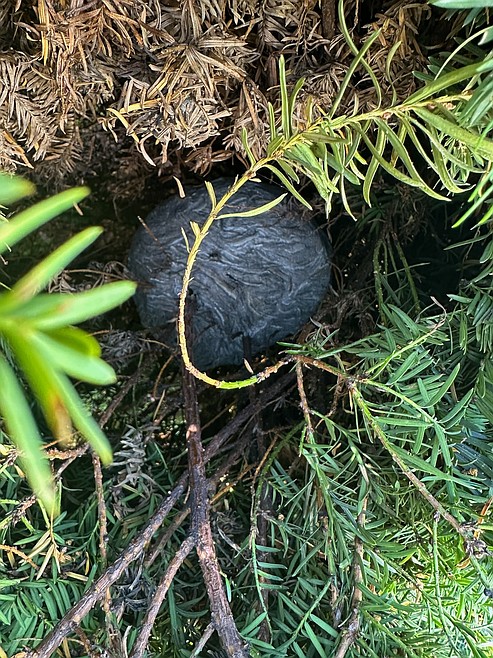
After experiencing a painful sting by a yellow jacket, Alan Greenwood learned about resources for stinging insects in the area, Greenwood was told about free insect removal from a company called ALK Source materials in Post Falls.
The volleyball-sized nest was eventually removed by Bug Blasters.
Courtesy photo
Alan Greenwood was taking care of his mother’s yard in Hayden when he was stung on his ankle.
He didn’t think much about it and went back to work. Later, he found the source of the problem.
“There's wasps flying in and out of that bush, I bet there’s a nest in there,” Greenwood said.
A few days later, he started feeling itchy and after going for a 4-mile walk, the pain suddenly ratcheted up.
“It triggered the venom and then I couldn’t stand on this foot. It was a nine on a pain scale and I started wondering if I needed to go to the hospital,” Greenwood said.
A man delivering wasp traps to Greenwood mentioned he had heard of a company called ALK Source Materials in Post Falls that will collect hornets, wasps and yellow jackets to use in allergy immunotherapy research.
"I just thought it was fascinating,” Greenwood said.
ALK Source Materials sends staff wearing protective bee suits to extract the insects from their nest using special vacuum equipment and can remove nests if they’re in a home.
Since Greenwood already had an appointment with Bug Blasters, he went through with the nest removal and a volleyball-sized nest from the hedges, but he was excited to learn about ALK, which researches allergic reactions to stinging insects.
“I learned more about wasps than I ever thought possible and there's a place for both pest control and ALK,” Greenwood said. “If you’re a person who needs insects removed and maybe you just flat-out can’t afford it, it’s cool to know that it exists.”
ALK later extracts materials from stinging insects in their laboratory to use for treating millions of people around the world who are allergic to stings.
An ALK staff member declined to comment on local collection efforts.