
Study: Fishing a billion-plus industry
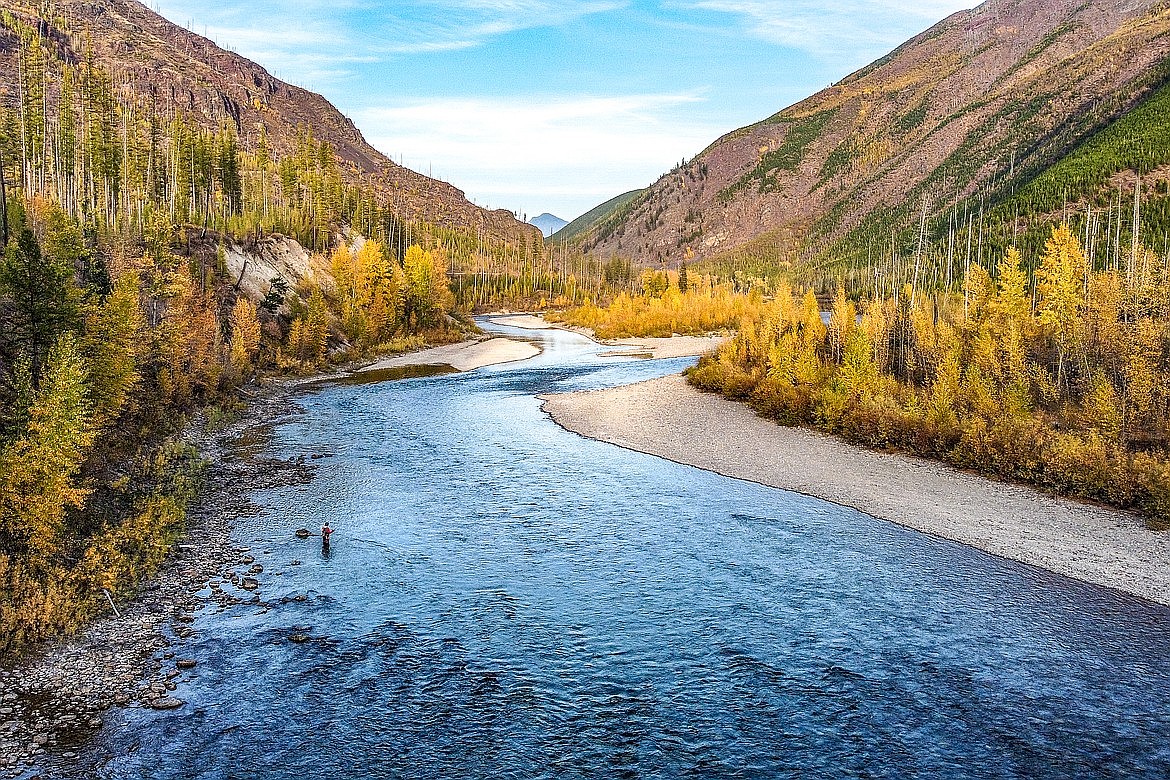
Nick Goodwin of Whitefish casts on the North Fork just outside of Glacier National Park earlier this month. (JP Edge photo)
Trout might as well be gold.
Fishing is big business, a recent study by the University of Montana, Bureau of Business and Economic Research and Montana Fish, Wildlife and Parks found.
In 2024, more than 450,000 resident and nonresident anglers spent a combined $1.27 billion on fishing trips in Montana, the study found.
The BBER study found that cold water fishing — primarily for trout — accounted for most economic activity, which was generated primarily from nonresidents. Cold-water fishing generated about $1.1 billion in trip-related expenditures. More than 70% of the cold-water fishing expenditures came from nonresident anglers
It comes as no surprise, but nonresidents spend substantially more on travel-related items such as accommodations, outfitter and guide services, restaurants and bars, and vehicle rentals. On average, nonresident license holders spent $3,923 annually, more than double the $1,897 spent by Montana residents. These higher costs reflect the tourism-based nature of nonresident fishing trips, which often involve higher travel expenses and overnight accommodations, the study found.
The bulk of nonresident spending went toward accommodations, but they also spent about $700 on guides and fees and $436 in bars and restaurants.
Residents, by contrast, spent the most on fuel, about $337 annually. Nonresidents spent about $200 on fuel. Residents spent far less on guides, only about $177, as many don’t use guides at all, or at a limited capacity.
Other highlights from the study found that cold water fisheries, which make up the bulk of the fishing in Flathead County and almost all of Glacier National Park, supported 14,355 jobs and generated $385.3 million in personal income statewide.
The study did not break down amounts by county or region, however.
The economic footprint of fishing in Montana varies significantly by species group and angler residence, the study found. While nonresidents account for most cold-water fishing expenditures, warm-water fishing is dominated by resident anglers. Residents are responsible for nearly two-thirds of all warm-water-related spending, “underscoring the importance of warm-water fisheries to Montana’s communities and their local anglers,” the study found.
But there are significant issues with Montana’s cold-water fisheries that the study doesn’t examine.
Namely, the lack of cold water.
In 2024, the North Fork of the Flathead had “hoot owl” restrictions placed on it for about two weeks in late July and August when water temperatures warmed over thresholds that are lethal to westslope cutthroat trout.
It was the first time ever that restrictions had been placed on the river.
Hoot owl restrictions prohibit fishing from 2 p.m. to midnight each day when water temperatures are at their highest.
At the time, water temperatures on the North Fork were at or above 66 degrees almost daily during a climate change-induced heat wave, which saw record-high air temperatures into the upper 90s to 100.
The upper water temperature threshold for westslope cutthroat trout, the most common species in the Flathead River drainage, is about 66 degrees.
In the big-name rivers south of here, the Bitterroot, Blackfoot, Big Hole and Madison rivers all experienced hoot owl restrictions in July on at least some sections.
July is the month that most nonresidents visit the state to fish.
The drought also persisted into the fall. The Middle Fork of the Flathead reached a record low flow in September. It didn’t have hoot owl restrictions, however, as the water temperatures managed to stay lower than the hoot owl threshold.