
OUR GEM: k’wne’ ‘ulchiyark’wmtsut – Fisheries restoration connecting two restored reaches
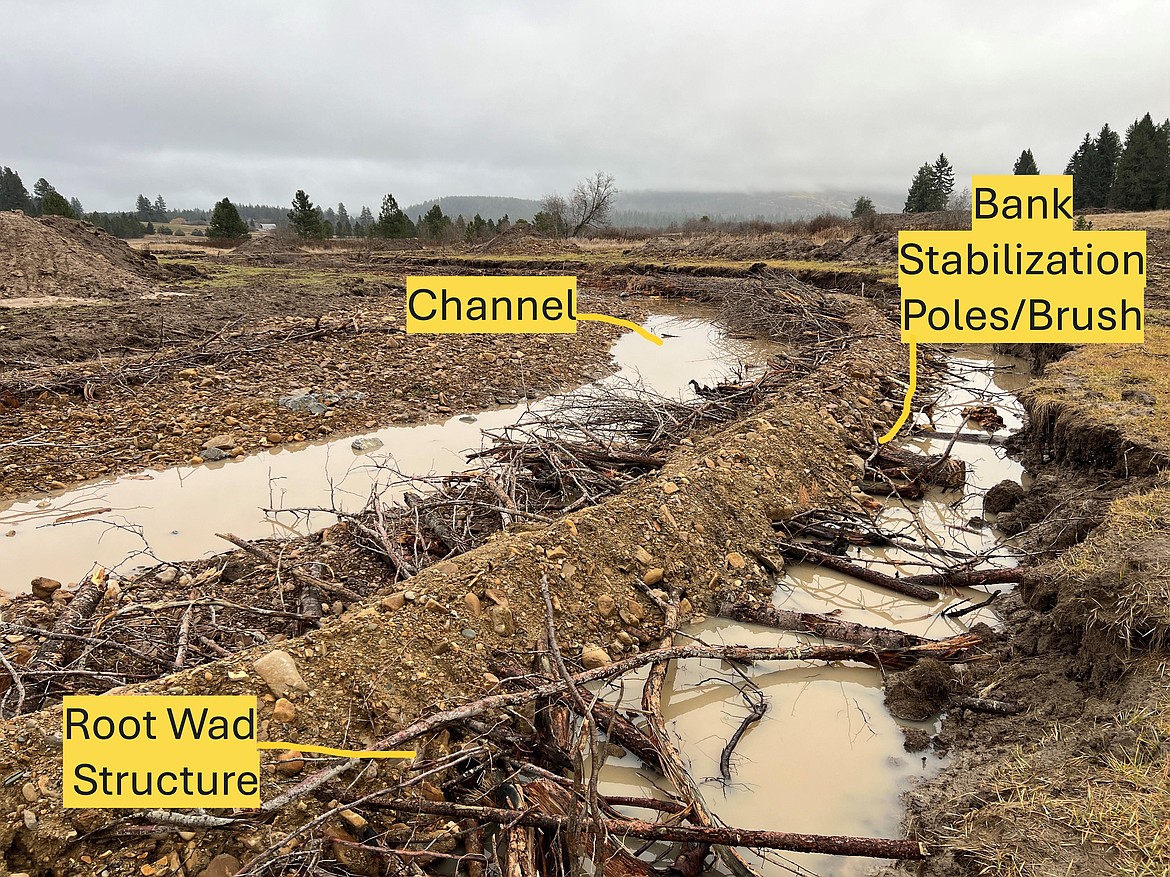
New Channel Construction on Hangman Creek in 2025 showing LWD, channel alluvium and staged fill material. Image via Our Gem.
The Hangman Creek Fisheries Restoration Project began in 2002 and is funded by Bonneville Power Administration under the Fish Substitution Policy to compensate for lost salmon harvesting. Early research found the limiting factors to be a lack of connection between channel and floodplain, a lack of large woody debris (LWD), excess fine sediments, and high stream temperatures associated with a lack of tree canopy.
Initial work on Hangman Creek below the Sanders townsite began after a series of land purchases that at present are 3 contiguous miles of valley bottom. The project name “k’wne’ ‘ulchiyark’wmtsut” translated to “to make it crooked again” was named by tribal leader and elder Felix Aripa. The initial goal of restoration was primarily to reconnect the stream channel to the floodplain by redirecting flow into historic channels and filling straightened man-made channels, building flow choke structures and analog beaver dams (BDAs), and installing extensive riparian plantings to support beaver populations.
In the upstream section of Hangman Creek lies a channel where riparian enhancement efforts have been very successful, because the channel was somewhat connected to the floodplain, aided by BDAs. In the downstream section is the first relict channel reactivated in 2014 and subsequently occupied by beavers, which led to successful riparian enhancement. In the middle is a more recent land purchase where the elevation of the channel is 6 feet lower than its desired elevation to form a natural gradient contiguous with the section on either side. This resulted in a deep, stagnant pond with no shade trees.
A decision was made to hire an engineering contractor that could handle this complex design. Design goals include: improve valley floodplain connectivity, reestablish a channel network with year-round flow and frequent flooding, enhance off-channel habitats that will function naturally and in conjunction with beaver activity, create conditions for native wetland plant communities to flourish, and remediate perennial deep-water habitats that are oxygen-deficient and unsuitable for native redband trout.
In 2023, River Design Group was contracted to provide three restoration options for consideration to the Tribe’s Fish & Wildlife Program. Alternative 1 proposed a process-based approach called Stage Zero. This involved pilot channels that would then form channels across the valley floodplain that would form naturally during flood events. Alternative 2 involved working with the existing conditions by packing the channel with wood and rock to agrade (raise) the channel and narrow it within an inset floodplain. Alternative 3 called for the construction of a completely new channel with extensive LWD (such as root wad structures) built into the banks. All three alternatives involved the excavation of three wetland ponds to provide fill material for various needs. After reviewing the project objectives and budget, it was determined that Alternative 3 was the middle ground for cost and was the only option that fulfilled all of the goals set forth. The other two only fulfilled two of the five goals.
Construction began in 2024 and when complete in fall 2025 will include; removal of a bridge, removal of a railroad bed and road bed; excavation of three wetland ponds; construction of 1.1 miles of new channel heavily loaded with LWD, 55,000 willow cuttings, and channel grade controls; and conversion of existing channel to shallow open water wetland habitat with 9 plugs to prevent blowout.
• • •
Bruce Kinkead is a fisheries biologist with the Coeur d'Alene Tribe.
The Our Gem Coeur d’Alene Lake Collaborative is a team of committed and passionate professionals working to preserve lake health and protect water quality by promoting community awareness of local water resources through education, outreach and stewardship. Our Gem includes local experts from the University of Idaho — Idaho Water Resources Research Institute, Coeur d’Alene Tribe, Idaho Department of Environmental Quality, the Basin Environmental Improvement Project Commission, Kootenai Environmental Alliance, Coeur d’Alene Regional Chamber of Commerce and Kootenai County.