

Irrigation meters may help with Coeur d'Alene wastewater rate
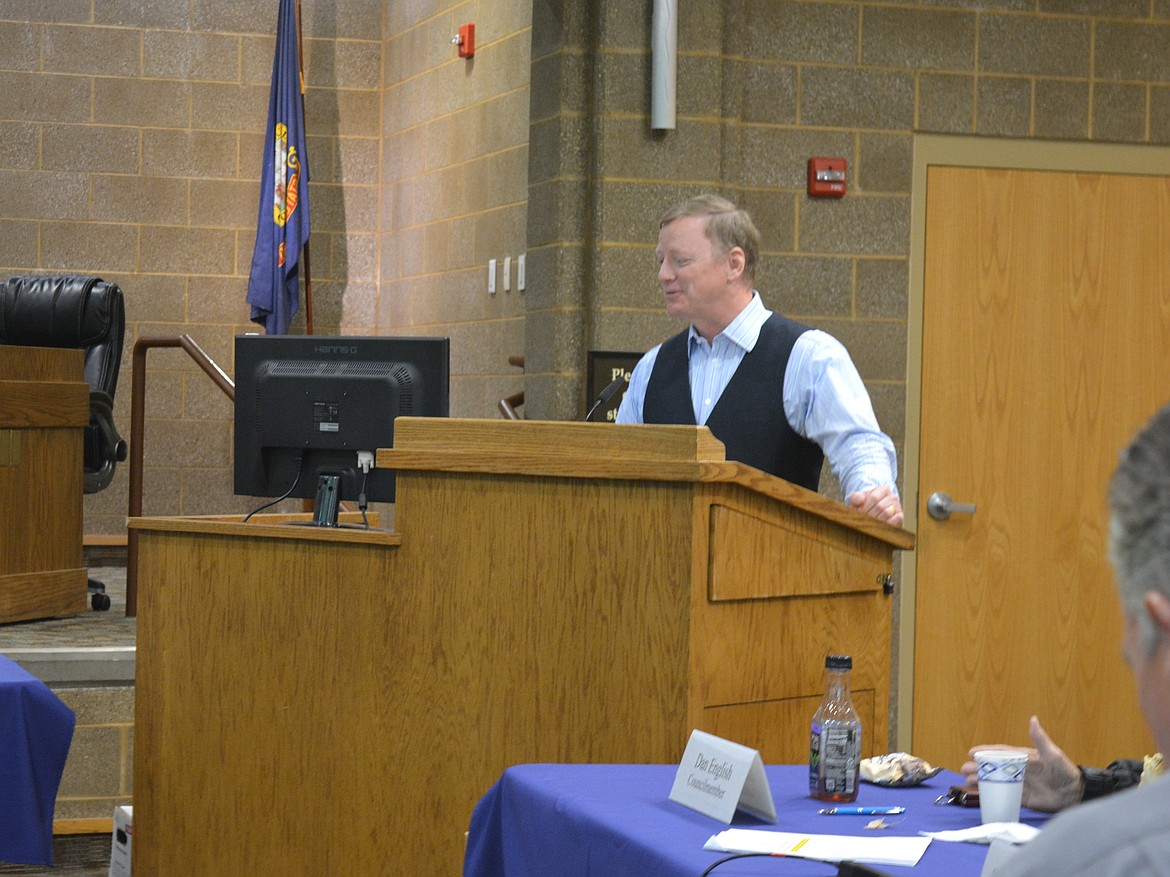
Mike Anderson, wastewater director for the City of Coeur d'Alene, explains how wastewater is reliant on water usage numbers during a City Council workshop Monday at the Coeur d'Alene Library.
CAROLYN BOSTICK/Press
The city of Coeur d'Alene is looking to improve the way it charges for wastewater service.
“The rates are increasing so much and it’s because of the irrigation water,” Wastewater Director Mike Anderson said at a City Council workshop Monday.
The solution in cases where water use varies due to irrigation is to potentially get an irrigation meter to more accurately measure water.
Commercial properties in the city are currently required to implement an irrigation meter, but that wasn’t always the case, Anderson said.
Without it, irrigation is included in wastewater billing even though it doesn’t enter the sanitary sewer.
Residential water use remains fairly steady throughout the year, primarily using a flat rate for an existing three-quarter meter for each household.
Commercial use, however, has much more variable use, especially in the spring and summer due to irrigation use, reaching about 40 million gallons daily in July or August versus 9 million gallons in the winter.
“It's why we need to separate the irrigation from the domestic meters,” Anderson said.
The main goal is to keep rates cost-appropriate based on the available water use data.
“We have to be sustainable when we look at utility billing,” City Administrator Troy Tymesen said.
City Councilor Dan Gookin asked if there was a way to create a tier system for commercial properties to better fit the use and cost of water/wastewater usage.
“You don’t want to be paying for things you’re not using,” Gookin said.
City Councilor Christie Wood wondered if the city’s rates have “hamstrung people” and asked whether the city could enact a loan business to help property owners work up to paying for the costs to implement irrigation meters to more accurately represent wastewater.
“The biggest complaint we hear is that these rates are sky-high,” Wood said.
Mayor Woody McEvers asked whether Coeur d’Alene should even consider getting into the loan business.
As of Aug. 1, capitalization fees for irrigation meters range from $4,911 for the three-fourths smallest size meter to $376,546 for 10 inches for the largest service size.
By April 1, 2026, that range will go up to $7,367 for three-fourths and $564,819 for 10-inch.
Another city rate study will be conducted in 2028 to assess usage.