

Best Night Sky Events for October 2025
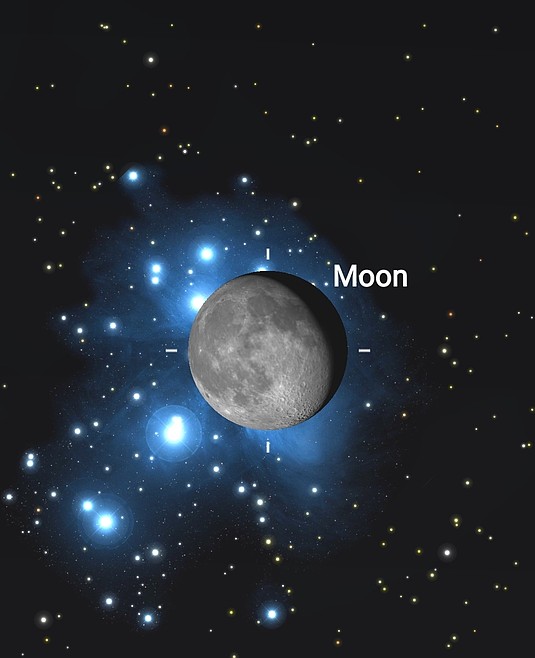
This simulated image shows the moon surrounded by the Pleaides star cluster (M45) as seen through a pair of binoculars.
Image courtesy of John Taylor and Sky Safari Pro 7.
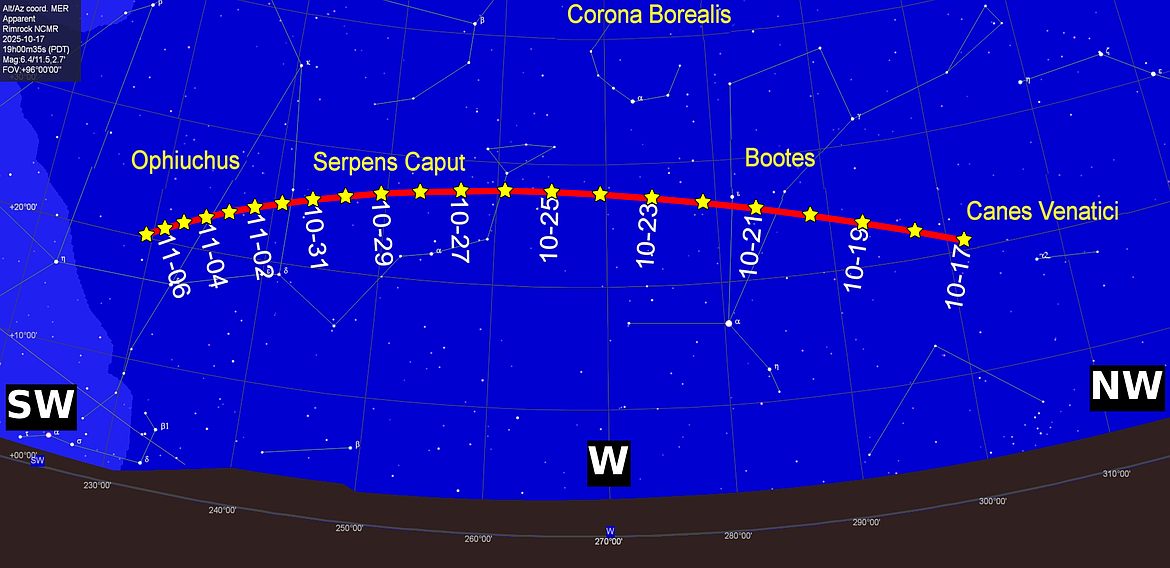
The arc shows the path of comet Lemmon throughout the last half of the month. The yellow stars and numbers along the arc show the position in the sky, the month, and the day of comet Lemmon as it moves through the early evening sky (7 p.m.).
Illustration courtesy of John Taylor and Cartes du Ciel.
This month offers prime skywatching adventures, featuring a major meteor shower, the super harvest moon and planetary and lunar conjunctions. In the latter part of this month, a potentially bright comet will be a prominent object for telescopic viewing. So, without further ado, let’s dive in.
Oct. 6 — Full moon, the “harvest moon," a super moon
At this point in the moon’s orbit, it is on the opposite side of the sky from the sun. This occurs at 8:47 p.m. This is why we see it fully illuminated. This full moon was once used to harvest many different crops well past sunset, ergo its “harvest moon” name. It is also called the "hunter’s moon” or the “beaver moon.” It gets these names because, oddly enough, both hunters and beavers are particularly active this time of year. This moon is also a “super” moon, meaning that this phase of the moon occurs when the moon is closest to us in its orbit. A “super” moon can appear to be up to 14% larger and 30% brighter than a “normal” full moon because of its closer proximity to Earth.
Oct. 9 — The moon surrounded by the Pleiades
The moon will be immersed within the visible star cluster, the Pleiades (M45), on this early evening. Look to the east between 7 and 10 p.m. A simple pair of binoculars will add immeasurably to viewing this event.
This simulated image shows the moon surrounded by the Pleaides star cluster (M45) as seen through a pair of binoculars. Image courtesy of John Taylor and Sky Safari Pro 7.
Oct. 13 — Last quarter moon
The last quarter moon is the third and final quarter phase of the moon during its monthly cycle. At this time, 11:12 a.m., the moon appears half-illuminated, with the left half receiving sunlight. This moon is visible after midnight and throughout the morning.
Oct. 16 — The moon and Regulus conjunction
For you early risers, look to the East to see the waning crescent moon pass within 2 ½ degrees from the bright star Regulus. You should be able to see this from 4 a.m. till dawn. Look due east for this event.
Oct. 21 — Comet C/2025 A6 (Lemmon)
Comet C/2025 A6 (Lemmon) is a non-periodic comet discovered by the Mount Lemmon Survey of the sky. It will pass closest to the sun Nov. 8, when it will be a mere 49 million miles from the sun. It makes its closest approach to Earth on Oct. 21, when it will be 56 million miles from the Earth and may be visible to the naked eye. Look due West one hour after sunset. As of this printing, the comet is not yet visible to the naked eye, but it will be brightening throughout the month. It will be visible through binoculars, about two fists at arm’s length above the bright star Arcturus, starting on the 17th. By Halloween, it is still roughly the same distance above the horizon, but will have moved from the western sky to the southwestern sky.
The arc shows the path of comet Lemmon throughout the last half of the month. The yellow stars and numbers along the arc show the position in the sky, the month and the day of comet Lemmon as it moves through the early evening sky (7 p.m.). Illustration courtesy of John Taylor and Cartes du Ciel.
Oct. 21 — The Orionid meteor shower
The Orionid meteor shower is one of the year’s major showers and is produced from the debris left behind by Halley’s Comet! Tonight is the peak of meteor activity and you may see as many as 15 meteors per hour. The constellation Orion is the radiant (emanating point) for these meteors and it doesn’t rise above the horizon till around 10 p.m. So, look for the meteors after 10 p.m. till dawn. Remember, these meteors can appear anywhere in the sky. Because this is the night of the new moon, there should be no interference from the moon’s light hiding some of the fainter meteors. So, if you have the opportunity to go somewhere dark for this event, do so.
Oct. 21 — New moon
The new moon occurs at 5:25 a.m. The days surrounding the new moon are excellent times for stargazing! The moon is not in the night sky because the moon is now between the Earth and the sun. So, tonight is a great opportunity to take out your binoculars or telescope and view the starry, moonless sky above you. The Andromeda and Pinwheel galaxies should be prime targets for tonight’s activities.
Oct. 29 — First quarter moon
The first quarter moon occurs at 9:21 a.m. This phase marks the first quarter of travel of the moon in its orbit around the Earth. This is the halfway point between the new moon and the full moon. So, the moon appears with the right half of the disk illuminated.
• • •
John Taylor is an amateur astronomer who lives in Hayden.
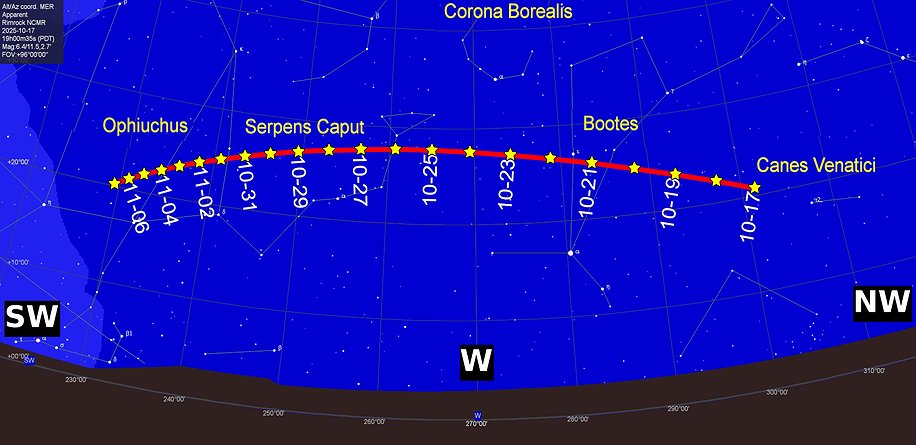 The arc shows the path of comet Lemmon throughout the last half of the month. The yellow stars and numbers along the arc show the position in the sky, the month, and the day of comet Lemmon as it moves through the early evening sky (7 p.m.).