

Best night sky events for June 2025
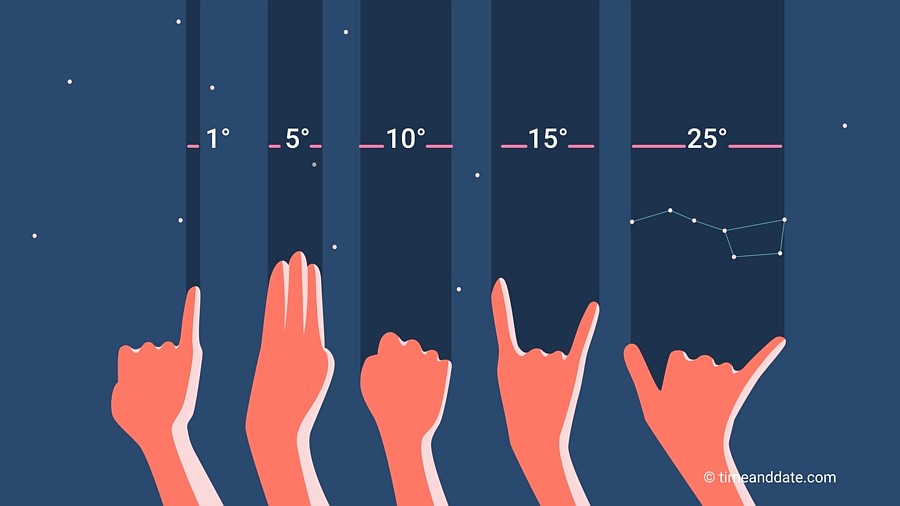
Here is a handy reference guide to somewhat accurately gauge how many degrees one object is from another.
Image courtesy of timeanddate.com
June has arrived, and way up here, being just a stone’s throw away from the Canadian border, we get to experience wonderfully long days and disappointingly short nights. Starting this month, look for the summer Milky Way rising in the east just after dark (11 p.m.!). So, enjoy the now warm evenings because this month is packed with plenty of events to keep you busy.
June 2 — First quarter moon
The first quarter moon marks the halfway point between the new moon and the full moon. It appears as a half-illuminated disk with the right half visible from the Northern Hemisphere and the left half visible from the Southern Hemisphere and is visible in the afternoon and evening sky.
June 5 — The moon nears Spica
The bright star Spica, in the constellation Virgo, and the moon will be around 4 degrees from each other, forming a pleasing conjunction. Look for this conjunction just before midnight in the southwest sky.
June 9 — The moon nears Antares
The bright star Antares, in the constellation Scorpio, and the moon will be less than 2.5 degrees from each other, forming a satisfying conjunction in the southern sky. Look for this conjunction in the southern sky just before midnight.
June 11 — Full moon
The moon will be located on the opposite side of the Earth as the sun and its face will be fully illuminated. This full moon was known by early Native American tribes as the Strawberry Moon because it signaled the time of year to gather the ripening fruit. This moon has also been known as the Rose Moon and the Honey Moon.
June 17 — Mars’ close approach to Regulus
On this day, the evening sky hosts a wonderful conjunction as Mars appears less than a degree from Regulus, Leo’s brightest star. This pairing offers a striking contrast in color — the angry glow of the Red Planet beside the bright blue star in the constellation Leo. Look for this event in the western sky starting just after dark.
June 18 — Last quarter moon
The last quarter moon is the third and final quarter phase of the moon during its monthly cycle. At this point, the moon appears half-illuminated, with the left half visible from the Northern Hemisphere and the right half visible from the Southern Hemisphere. This moon is visible after midnight and throughout the morning.
June 20 — Summer solstice
This is the day when the sun reaches its greatest distance north of the Earth’s equator in its annual journey around the sun. This marks the official start of summer in the Northern Hemisphere and winter in the Southern Hemisphere. In the north, it’s the longest day of the year (or shortest night of the year).
June 25 — New moon
The new moon is the beginning of the lunar cycle when the moon is not visible from Earth. It occurs when the moon is positioned between the Earth and the sun. Since the illuminated side of the moon is facing away from us, the night sky will be especially dark, making it an excellent time for stargazing without moonlight interference.
June 27 — June Bootid meteor shower
On the night of June 27, you may get a surprising show from the June Bootid meteor shower. It’s a somewhat unpredictable but sometimes rewarding shower. At times it’s quiet; other times it surprises with bright, slow-moving meteors lighting up the night. Either way, it’s a great reason to spend some time outside after dark because the moon will be just past its new phase. Remember, the best time to catch meteors is after midnight, and they can appear anywhere in the sky.
June 29 — Moon, Mars conjunction
On this night, look for the moon to be just to the left of the planet Mars. The moon will come within 1.5 degrees of the red planet. Look to the west around 9:30 p.m. to see this catchable sight. Using a pair of 10x50 binoculars will really enhance the view.
Lastly, here is a handy reference guide to somewhat accurately gauge how many degrees one object is from another.
• • •
John Taylor is an amateur astronomer who lives in Hayden.