
MOVING HISTORY FORWARD: Charles Westley Wood and the Pony Express Saddle
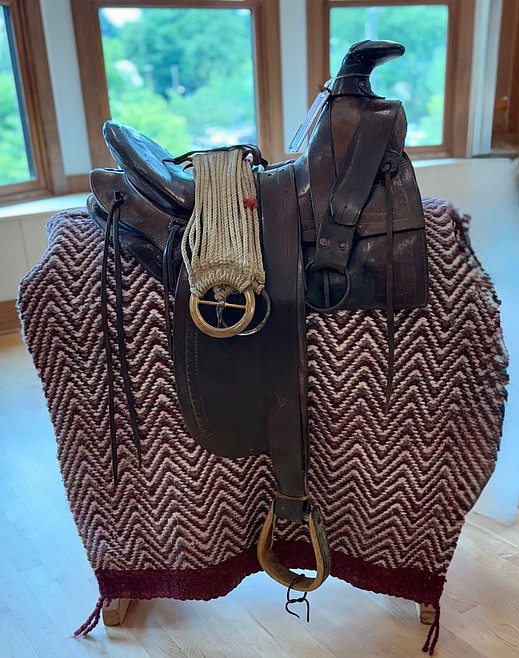
The saddle pictured in this photo was donated to the museum by Paul Tullenor, a collector of old saddles. According to the provenance accompanying the saddle, it was made by Main and Winchester of San Francisco before the Civil War. In the early 1870s, it was owned by Charles Wesley Wood while he was a rider on the Huntley Express Mail route.
Photo courtesy of MUSEUM OF NORTH IDAHO
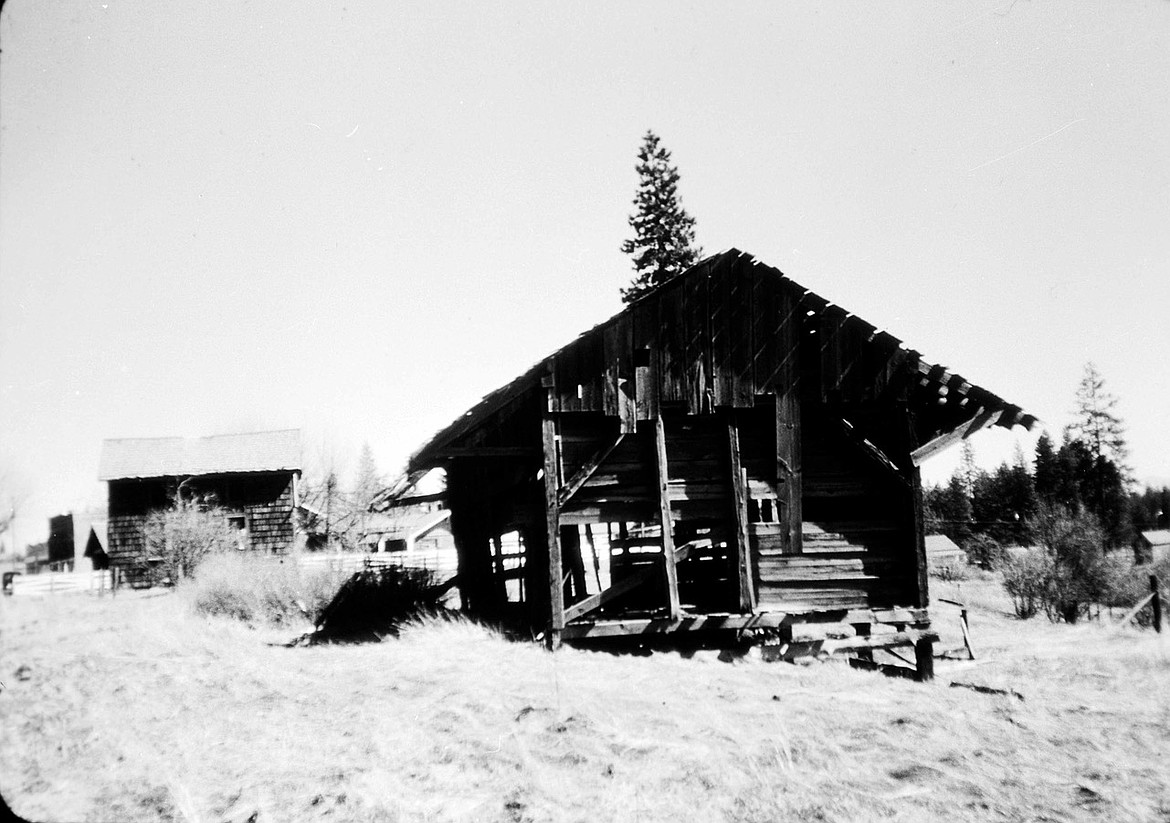
The two buildings shown in this Museum of North Idaho photo are thought to have been built around 1873 by Charles W. Wood on his farm near where the village of Westwood (now Rathdrum) was platted. The structure in the background was reportedly the home of Wood and his wife, Mary. Wood used the building in the foreground as a barn for his horses.
Photo courtesy of MUSEUM OF NORTH IDAHO

While volunteering at the Museum of North Idaho recently, I helped several staff members bring exhibit items to the second floor for a new exhibit celebrating a century of outdoor regional adventure. Some of the items were once owned by local historic figures.
I noticed one of the items was a beautiful old half-seat western saddle with a hand-crafted blanket and asked about its history. Museum Director Britt Thurman identified the saddle’s owner for me, and her brief description of its history sparked my interest.
Paul Tullener, a saddle collector, donated the saddle to MoNI a few years ago. He also provided the saddle’s provenance, stating it was created by the Main and Winchester Company in San Francisco more than 10 years before the Civil War.
Founded in 1849 during the California Gold Rush, Main and Winchester produced high-quality western gear, including saddles, bits and spurs. As the first company of its kind on the West Coast, it supplied some of the tack for the Pony Express.
Tullener claimed that the saddle was created around 1850 and that its owner was Charles Westley Wood.
Wood was born in Ogdensburg, N.Y., on May 14, 1843. After he came west, he was a driver for a Montana stagecoach company from 1868 to 1871. Tullener and other sources also claimed that he rode legs on a Pony Express mail route from Walla Walla, Wash., to Missoula, Mont., but the true Pony Express route never set foot in Montana, Idaho or Washington.
Idaho State Historian Alice B. Nash wrote in an April 1935 Coeur d’Alene Press article about a leg of the Pony Express route that ran through Kootenai County. The route, part of a nearly 400-mile express mail route with 21 stations and 25 riders, covered 40 to 70 miles daily with relays.
Mrs. Nash’s story listed stops from Walla Walla through Colville and Sandpoint, crossing the Spokane River Bridge into Idaho and continuing to Missoula. She was likely referring to the express mail route operated by Silas S. Huntley and his cousin, Charles, which closely matched her story but was never a formal branch of the Pony Express. Some sources claim Charles Wood was given the title of Pony Express rider to describe his carrying the mail on horseback between the Bonners Ferry stop and the Spokane Bridge for want of a better term.
Following Charles’ marriage to Mary C. Post, he is said to have left the mail route. Her father, Frederick Post, deeded a parcel that was said to be either 120 or 240 acres of prairie farmland south of Post Falls to his daughter and new son-in-law. It is thought that Charles then built a house and barn on the land. As settlers moved into the area, Wood platted part of his land to make a town site, selling the parcels to the newcomers.
Initially named Westwood, the town was renamed Rathdrum in 1884 to avoid confusion with other post offices with a similar name. There is much more to the story, and it may soon become part of a MoNI newsletter.
We encourage you to visit the museum to see the saddle and other historic objects in the new Adventure Awaits: Outdoor Recreation in North Idaho exhibition. Hours are 11 a.m. to 5 p.m., Monday through Friday, at 720 E. Young Ave. near McEuen Park.
 The two buildings shown in this Museum of North Idaho photo are thought to have been built around 1873 by Charles W. Wood on his farm near where the village of Westwood (now Rathdrum) was platted. The structure in the background was reportedly the home of Wood and his wife, Mary. Wood used the building in the foreground as a barn for his horses.