

Former U.S. attorney for Idaho defends plea deal in Kohberger case
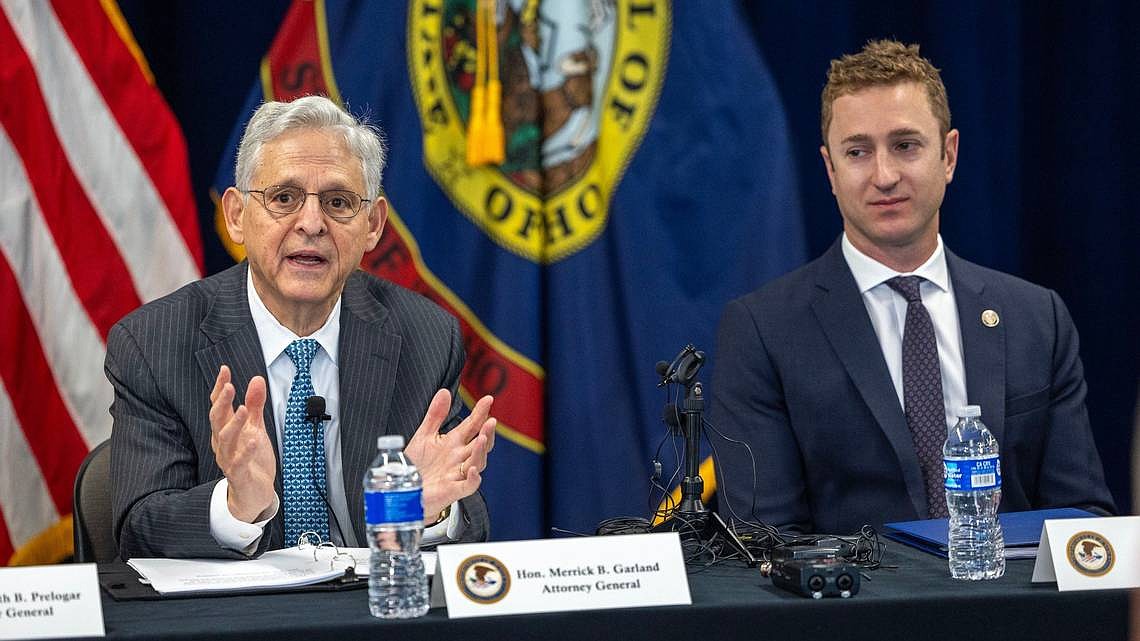
Josh Hurwit, former U.S. attorney for the District of Idaho, right, with former U.S. Attorney General Merrick Garland, both appointees of former President Joe Biden, at a news conference in August 2024. Hurwit has joined the summer 2025 prosecution of Idaho student murder suspect Bryan Kohberger. Darin Oswald [email protected]
Debate over a plea agreement for Bryan Kohberger in the University of Idaho student murder case should not overshadow crack police work and a prosecution that had the defendant admit guilt, former U.S. Attorney for Idaho Josh Hurwit said in an interview with the Idaho Statesman.
In his first comments about the case since the court’s gag order was lifted, Hurwit — who later joined the Kohberger prosecution team — sought to remind the public that solving the quadruple homicide and bringing the killer to justice was never a given.
“Let’s not forget there was no guarantee at the outset that anyone would be held accountable … if we could find this person,” he said. “And then to actually do it in a way that allowed successful prosecution — and it was a successful prosecution, because there were convictions that will not be appealed.”
Kohberger, 30, was sentenced Wednesday to four consecutive life sentences, plus 10 years for felony burglary, as part of a plea agreement reached earlier this month to avoid the death penalty. In addition to waiving his appeals, Kohberger also won’t be eligible for parole as part of the plea deal. Kohberger admitted guilt to the five charges, including four counts of first-degree murder in the students’ fatal stabbings in November 2022.
The victims were U of I seniors Madison Mogen and Kaylee Goncalves, both 21; junior Xana Kernodle, 20; and freshman Ethan Chapin, 20. The three women lived in a rental house on King Road in Moscow near campus with two other female roommates who went physically unharmed in the attack. Chapin was Kernodle’s boyfriend and stayed over for the night.
Hippler lifted the court’s gag order in the case last week, but members of the prosecution, led by Latah County Prosecutor Bill Thompson, declined to speak about the case until after Kohberger was sentenced Wednesday. Kohberger’s defense attorneys issued a statement that they will not comment at all, and cited ethical obligations to require their client’s consent to release information under the Idaho State Bar rules of professional conduct.
Hurwit was appointed by former Democratic President Joe Biden to his prior role as Idaho’s lead federal prosecutor and confirmed in 2022. As Republican President Donald Trump returned to office, Hurwit transitioned out as U.S. attorney for Idaho in February and then joined the Kohberger prosecution team after Thompson asked him to do so, he told the Statesman.
“For me, it was important to pursue justice in this way,” Hurwit said. “It was an opportunity to serve and do work that was really important for our state, and for that community.”
But Hurwit, as Idaho’s U.S. attorney, was involved in the U of I student homicide case almost from the get-go.
He was quickly informed of the deaths, he said, and attended a vigil the university hosted at the Kibbie Dome in Moscow two and a half weeks later. At that time, no suspects had been identified, which left students and residents of the small town in a “very challenging” and “traumatic” situation, Hurwit said.
“The community was shocked, grieving, but also scared,” he said. “And there was uncertainty about what had happened, who had done this, was there any other danger at that point? So it was a very dark period for Moscow.”
Hurwit acknowledged that he was consulted on some of the FBI’s investigative efforts in the closely watched case, which included use of investigative genetic genealogy, or IGG, to arrive at Kohberger as the suspect. The advanced policing technique involves submitting crime-scene DNA to public ancestry databases to narrow down the list of possible culprits. But Hurwit declined to address any specifics, citing confidential federal tactics.
On Dec. 19, 2022, the FBI sent along Kohberger’s name to local law enforcement, according to court records. Hurwit was kept in the loop about that, as well as the arrest operation later planned for the early morning of Dec. 30 in eastern Pennsylvania, he said.
“As the investigation unfolded, I was aware of how things were progressing,” Hurwit said.
Arresting Kohberger took about seven weeks. Investigators worked tirelessly to catch the killer as quickly as possible, Hurwit said.
“It was the time required and needed to do the right type of investigation, to do it the right way. I’m confident in law enforcement that there were no delays,” he said. “People were working — I know this — literally around the clock when, in a case like this, it took the time it took, and what matters ultimately is the way the person was held accountable.”
• • •
This story was originally published by the Idaho Statesman. To read more, click here.