

Best night sky events for July 2025
The month of July 2025 is filled with several enjoyable celestial events. The range of events includes the first meteor shower after a two-month hiatus, Venus still visible in the morning sky, a full Buck Moon, planetary and lunar conjunctions, our normal lunar phases, and more.
July 2: First Quarter Moon 12:30 p.m. — The First Quarter Moon appears as a half-illuminated disk. It will show the right half visible from the Northern Hemisphere and the left half visible from the Southern Hemisphere, and is visible in the afternoon and evening sky.
July 3: Spica and the just passed First Quarter Moon conjunction 10 p.m. — Look to the Southwest around 10 p.m. (or just as it’s getting dark) to see Virgo’s bright blue star Spica, a mere 4 degrees from the slightly passed First Quarter Moon.
July 7: Antares and the nearly full Moon conjunction 9:30 p.m. — Look to the South-southeast around 9:30 p.m. to see Scorpio’s red supergiant star Antares and the almost-full moon separated by a little under 6 degrees.
July 10: Full Moon 1:37 p.m. — The Moon will be located on the opposite side of the Earth from the Sun with its face will be fully illuminated. This full moon was known by many names; they include: the Buck Moon, the Thunder Moon and the Hay Moon.
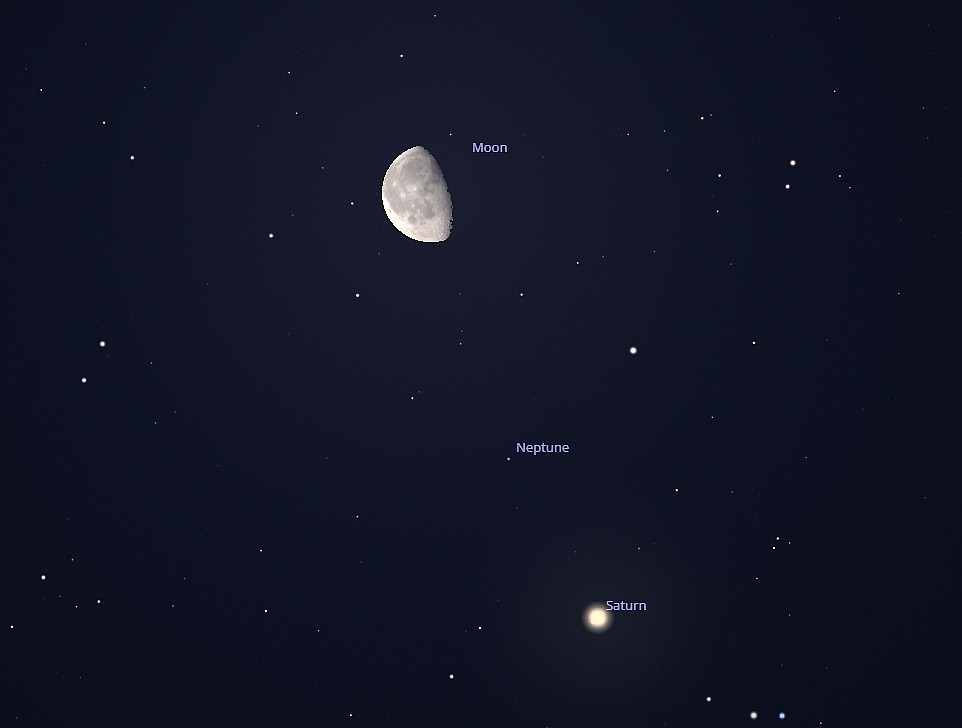
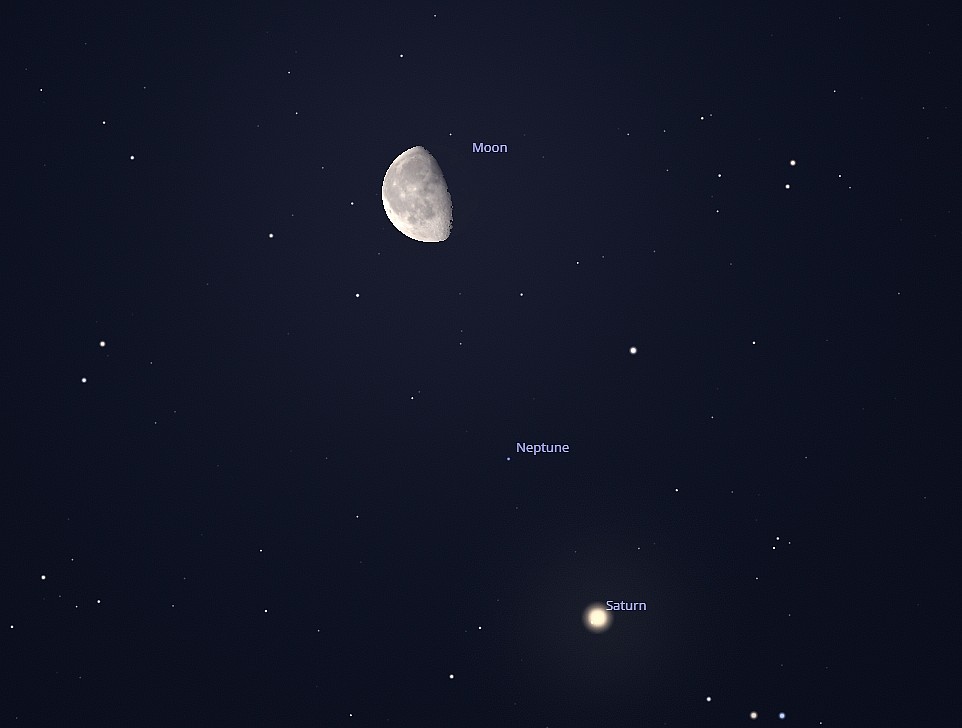
July 16: Saturn, the Moon and Neptune close conjunction 12:30 a.m. — At just past midnight in the east, check out Saturn and the waning gibbous moon form a close conjunction, only 2 ½ degrees apart from each other, plus the planet Neptune directly inline between the two! You’ll need a telescope to see Neptune, an 8th magnitude object.
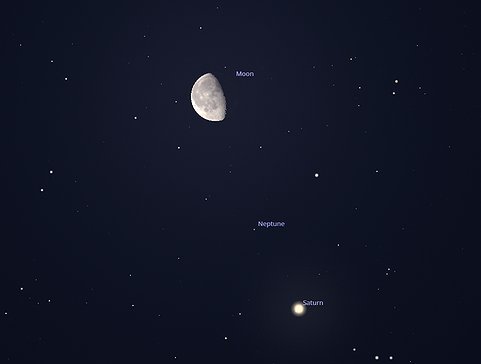 Image courtesy of John Taylor and Stellarium (Insert image Moon Sat Nep Conj.jpg)
July 17: Last Quarter Moon 5:37 p.m. — The Last Quarter Moon is the third and final quarter phase of the Moon during its monthly cycle. The Moon appears half-illuminated, with the left half visible from the Northern Hemisphere and the right half visible from the Southern Hemisphere. This moon is visible after midnight and throughout the morning.
July 20: Apollo 11 On the Moon, 56th Anniversary — On this date in 1969, Apollo 11, crewed by Mission Commander Neil Armstrong and lunar module pilot Buzz Aldrin, landed safely on the moon. The lunar module, named Eagle, landed on a lunar feature named the Sea of Tranquility. Six and a half hours after landing, the first human being, Neil Armstrong, set foot on the moon, uttering these now infamous words, "one small step for man, one giant leap for mankind."
July 24: New Moon 12:11 p.m. — No Moon! — It will be absent from the night sky for ±2 days from this date, creating an ideal opportunity for stargazers to watch the unobstructed view of the stars present in the night sky. Without the Moon's bright glow, the sky becomes darker, enhancing the visibility of stars, constellations and distant nebulae and galaxies.
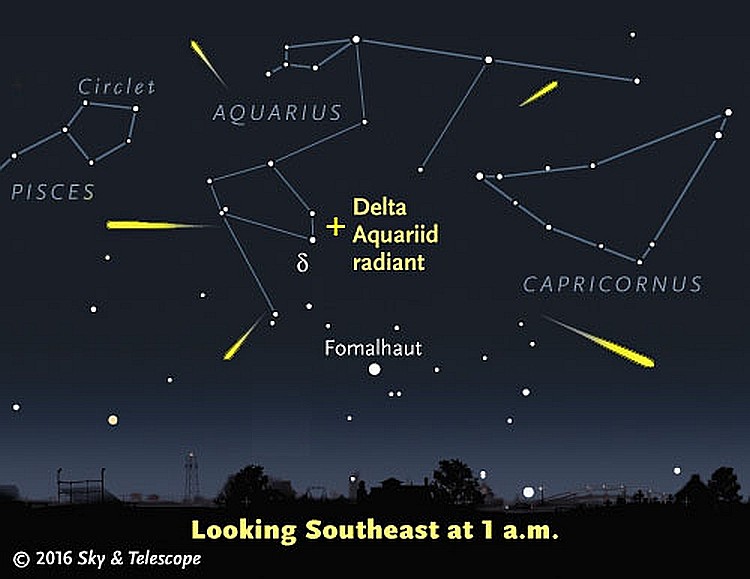
July 29 & 30: Delta Aquarids Meteor Shower — The meteor shower named Delta Aquarids will be taking place on the night of the 29th and the morning of the 30th. On both days, the meteor shower will be at its peak, where you could witness up to 20 meteors per hour. Even though the constellation of Aquarius is low in the Southeastern sky, the meteors can appear anywhere. This event happens annually from mid-July to mid-August as we pass through the debris field of comet 96P/Machholz.
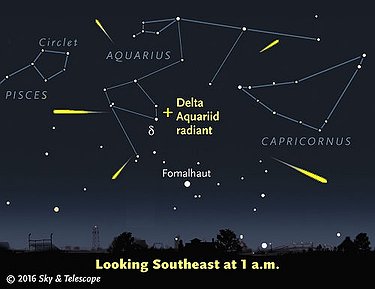 Image courtesy of Sky & Telescope Magazine (insert image Delta Aqr Meteors.jpg)
• • •
John Taylor is an amateur astronomer who lives in Hayden.