

MOVING HISTORY FORWARD: Bad Luck Boneta — Part 1 of 3
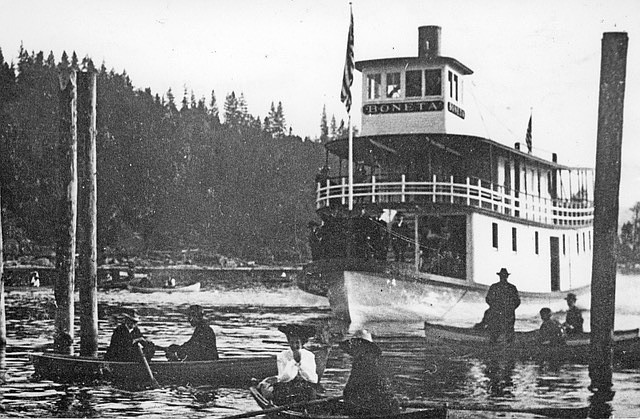
This photo from the Museum of North Idaho Archives shows spectators in small boats watching the Oct. 23, 1904, launch of the steamer Boneta from Peter W. Johnson’s boat works on the Coeur d’Alene’s waterfront.
Photo courtesy of MUSEUM OF NORTH IDAHO
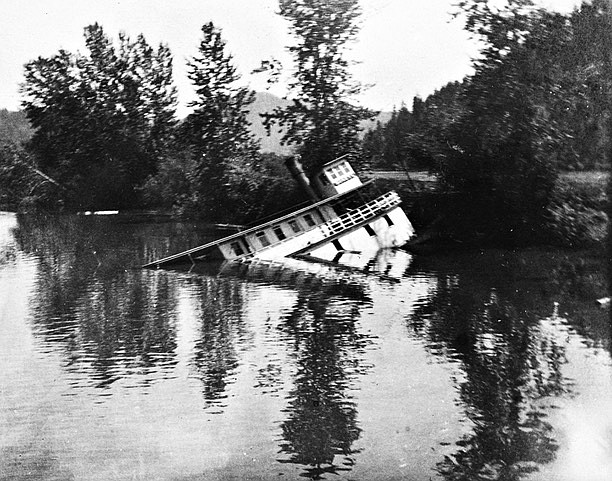
This is the photo of the Boneta with its stern sitting on the bottom of the St. Joe River on July 17, 1905. It was the inspiration for writing a three-part story of its history.
Photo courtesy of MUSEUM OF NORTH IDAHO

As a volunteer for the Museum of North Idaho, I recently had the opportunity to teach a group of elementary school-age young people participating in the museum’s new History Summer Camp program about the history of steamships and the rich history of steamers on Lake Coeur d’Alene.
While I was preparing to teach the lesson, I came across a photo of a steamboat that was partially submerged in the St. Joe River. The caption identified it as the Boneta. I immediately saw the potential for a Moving History Forward story and began digging for information about the Boneta’s history, especially about its near-sinking.
I quickly found that the Boneta was a stern-wheeler that had been custom-built for owners George Reynolds, J.D. McDonald and Frank Bishop during the summer of 1904. Construction took place at Peter W. Johnson’s boat works on the Coeur d’Alene waterfront, taking nearly four months to complete. It was launched Oct. 23, riding on a set of rails down a wooden incline and into the lake as several hundred spectators watched from the waterfront and aboard boats that included the steamer Colfax.
At 96 feet long, the white with red-trimmed Boneta was far from the largest boat on the lake. It weighed in at 80 tons and sported a beam of 18 feet that was enhanced by guard extensions of 2 feet on each side that brought the boat’s width to 22 feet at its widest point.
The depth of the Boneta’s draft — the distance measured from the waterline to the lowest point of the hull when submerged under the water — was only 14 inches, giving it a slim, trim profile on the water. Boneta’s water tube boiler and two marine engines were capable of producing 250 horsepower, powerful enough to drive the boat’s 14-foot paddle wheel against a strong current. This configuration was perfect for traveling on most of the shallow rivers that flowed into the lake.
According to reports at the time of the launch, the boat had been specially designed for navigating the upper St. Joe River to the head of navigation. Four days after the launch, it took its first excursion down the lake to the town of St. Joe under the command of George Reynolds. It would be the first of many uneventful round-trips the steamer would make during the remainder of 1904 and into the summer of 1905.
That would all change Monday, July 17, 1905, when the incident occurred that put the Boneta’s aft end sitting solidly on the bottom of the St. Joe River, making it the subject of the Coeur d’Alene Press photo that caught my attention 120 years later. We will explore the details of that incident in Part 2 of “Bad Luck Boneta” next month in the September edition of Moving History Forward.
 This is the photo of the Boneta with its stern sitting on the bottom of the St. Joe River on July 17, 1905. It was the inspiration for writing a three-part story of its history.