

Best night sky events for September 2025
In September, the cosmos puts on a memorable celestial show where the moon and Saturn will be occupying center stage! While August dazzled us with meteor showers and planetary alignments, September also has quite a lineup: many lunar conjunctions, including a triple conjunction, Saturn at opposition, the Aurigid meteor shower and many other notable events that are worth setting your stargazing calendar for. Let's begin!
Sept. 1 — Aurigid Meteor Shower:
For this meteor shower, the meteor shower's radiant point is located in the Auriga constellation, which gives this shower its name. Even though we list this shower’s best night as starting on the 1st, your best chance to see meteors is after midnight of the 2nd. The first quarter moon has already set so it will not hinder your ability to see any meteors, even so, don’t expect to see more than around five meteors per hour.
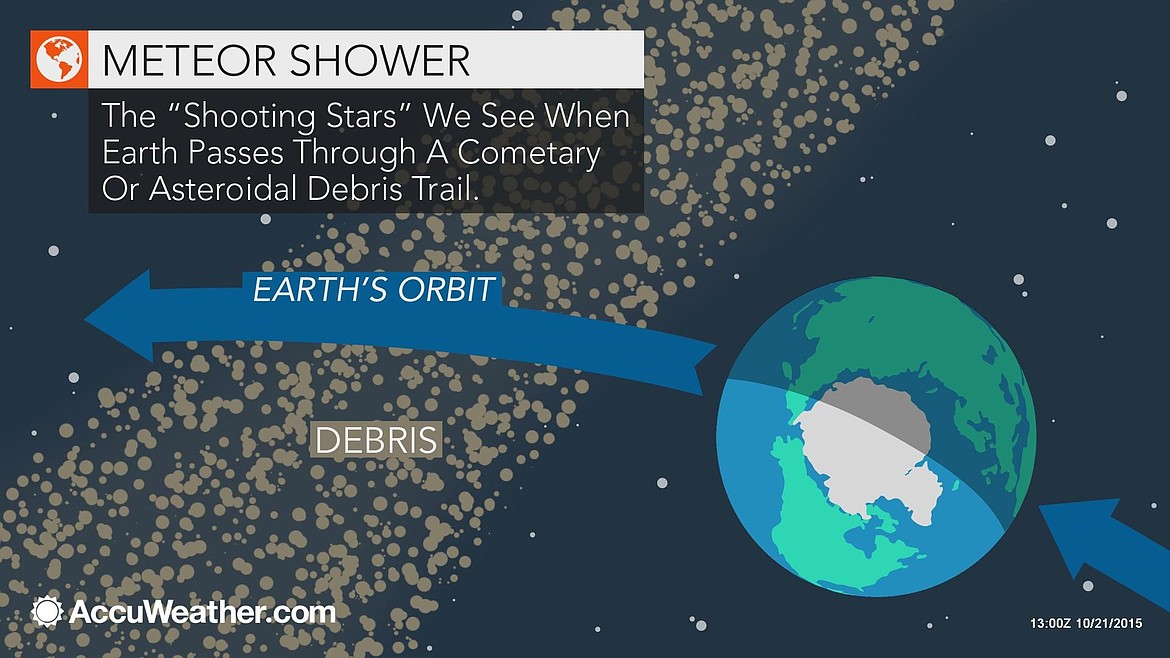
If you’ve ever wondered why we experience the same meteor showers around the same time every year, it has to do with asteroids and comets (like Haley’s comet!). Along a comet or asteroid’s path, they continuously “vent” bits of themselves into space, which then form a debris field in a specific part of Earth’s orbit. When we pass through this area, the rocks, ice and even particles as small as sand cause a meteor shower as they fall through our atmosphere (for example, Haley’s comet causes the Orionids meteor shower every October). This also explains why the meteors look like they “radiate” from a certain constellation, that’s the direction we’re flying through the debris field!
Sept. 7 — Full Moon, The “Corn Moon”
At this point in the moon’s orbit, it is on the opposite side of the sky from the sun. This occurs at 11:09 a.m. This is why we see it fully illuminated. This particular full moon is called the "Corn Moon” or the “Barley Moon” as this is the Native American name for the full moon that occurs in September. It gets its name because it coincides with the traditional time of the corn and/or barley harvest in many parts of the Northern Hemisphere, particularly among some Native American tribes. Interestingly enough, if this moon is closer to the autumnal equinox than the October full moon it is also called the harvest moon. This year though the harvest moon falls in October.
Sept. 8 — The Moon and Saturn Conjunction
Just before dawn’s twilight, look southwest this morning at 5:15 a.m. and you’ll see yellow Saturn about 5 degrees to the upper left of the just passed full moon.
Sept. 14 — Last Quarter Moon
The Last Quarter Moon is the third and final quarter phase of the moon during its monthly cycle. At this time, 3:33 a.m., the moon appears half-illuminated, with the left half receiving sunlight. This moon is visible after midnight and throughout the morning.
Sept. 16 — The Moon and Jupiter Conjunction
An early morning sight. Look east around 4:30 a.m. to see a waning crescent Moon a mere 4 degrees to the upper left of bright Jupiter.
Sept. 19 — A Triple Conjunction: The Crescent Moon, Venus and Regulus
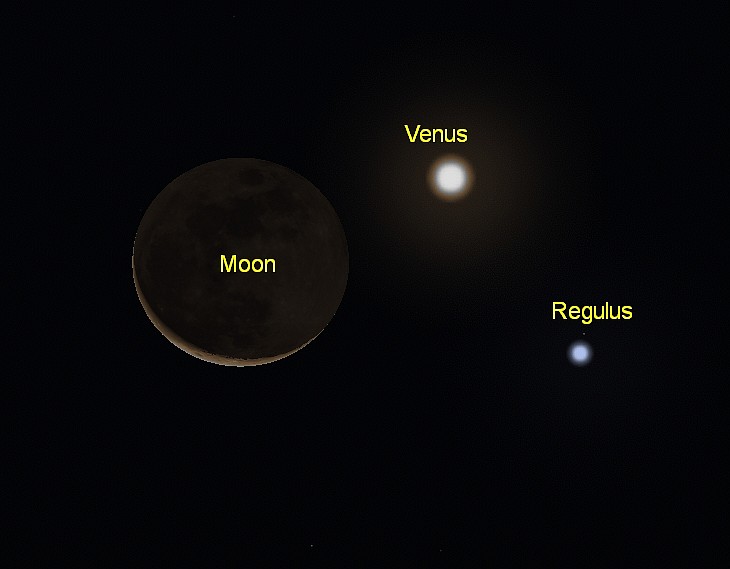
This morning, approximately 30 minutes before dawn starts to light the morning sky, around 5:00 a.m., look east to see a waning crescent moon, Venus and the bright blue star Regulus low on the eastern horizon. The moon will appear as a thin sliver next to very bright white Venus and bright blue Regulus. All three of these objects will be less than 1 degree apart. It should be quite the spectacle. If you have a pair of binoculars, use them! Also, a cellphone on a tripod can take amazing pictures.
Sept. 21 — New Moon
The New Moon occurs at 12:54 p.m. The days surrounding the New Moon are excellent times for stargazing! The moon is not in the night sky because the moon is now between the Earth and the sun. So, tonight is a great opportunity to take out your binoculars or telescope and view the starry moonless sky above you.
Sept. 21 — Saturn Directly Opposite Us from the Sun (Opposition)
Saturn reaches opposition tonight at 10:37 p.m. and shines brightly all night long and for most of the month. This opposition is a great time to break out your telescope to see Saturn’s reappearing rings. After being edge-on for nearly six months, the rings are now starting to show themselves again. Look for Saturn in the southeast sky an hour after sunset, at the stellar magnitude of +0.6 it will be the brightest object there. By midnight, the bright yellow planet will be fairly high in the southern sky.
Sept. 22 — Autumnal Equinox
The Autumnal or September equinox (at 11:19 a.m.) marks the beginning of autumn for those of us in the Northern Hemisphere and the start of spring for those in the Southern Hemisphere. During the equinox, there is just about equal duration of day and night (hence the name equinox). On this date, the sun is moving across the equator from north to south so our days will continue to get shorter until the Solstice in December.
Sept. 29 — First Quarter Moon
The First Quarter Moon occurs at 4:54 p.m. This phase marks the first quarter of travel of the moon in its orbit around the Earth. This is the halfway point between the New Moon and the Full Moon. So, the moon appears with the right half of the disk illuminated.
Here is a better explanation of why we see periodic repeating meteor showers. On certain days of the year, the Earth's orbit intersects with particularly dense areas of debris associated with comets or asteroids. These solar system objects have vented (blown out) particularly large amounts of solid material into space all along their orbital path. All our meteor showers recur on an annual basis because whenever the Earth, moving along in its orbit, passes through a particular debris field associated with a solar system object (comet or asteroid) we get a meteor shower. The denser the debris field, the better the meteor shower!
• • •
John Taylor is an amateur astronomer who lives in Hayden.
 This picture shows how close these three objects will be.