

VETERANS PRESS: History of the POW/MIA flag
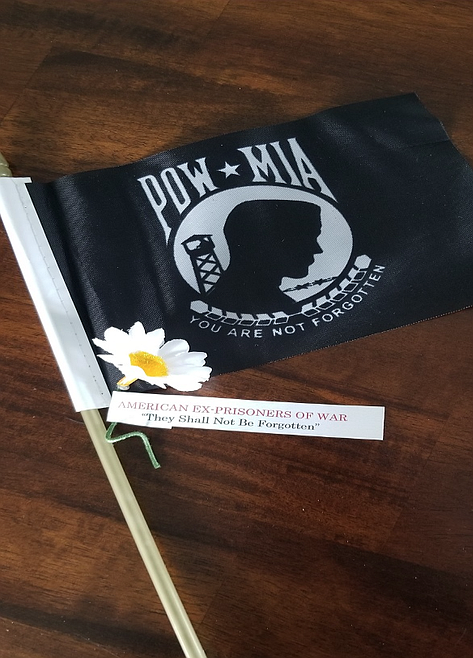
Courtesy photo
In 1971, Mrs. Michael Hoff, the wife of a U.S. military officer listed as missing in action during the Vietnam War, developed the idea for a national flag to remind every American of the U.S. service members whose fates were never accounted for during the war. Mrs. Hoff went to the Annis Flag Company, who assigned the task to their advertising agency in New Jersey.
Newt Heisley, a former World War II veteran pilot and creative director at the agency, was honored and inspired when the design of the flag emblem became his project. The flag depicts a black and white image of a gaunt silhouette, a strand of barbed wire and an ominous watchtower. Some claim the silhouette is a profile of Heisley’s son, who contracted hepatitis while training in Marine boot camp. The virus ravaged his body, leaving his features hollow and emaciated. Heisley saw the stark image of American service members held captive under harsh conditions.
By the end of the Vietnam War, more than 2,500 service members were listed by the Department of Defense as Prisoner of War (POW) or Missing in Action (MIA). In 1979, as families of the missing pressed for full accountability, Congress and the President proclaimed the first National POW/MIA Recognition Day (the third Friday of September) to acknowledge the families’ concerns and symbolize the steadfast resolve of the American people to never forget the men and women who gave up their freedom protecting ours. Three years later, in 1982, the POW/MIA flag became the only flag other than the Stars and Stripes to fly over the White House in Washington, D.C. On Aug. 10, 1980, Congress passed U.S. Public Law 101-355 designating the POW/MIA flag: “The symbol of our Nation’s concern and commitment to resolving as fully as possible the fates of American still prisoner, missing and unaccounted for in Southeast Asia.”