

Sunset Fire reaches 32% containment as evacuation orders lifted
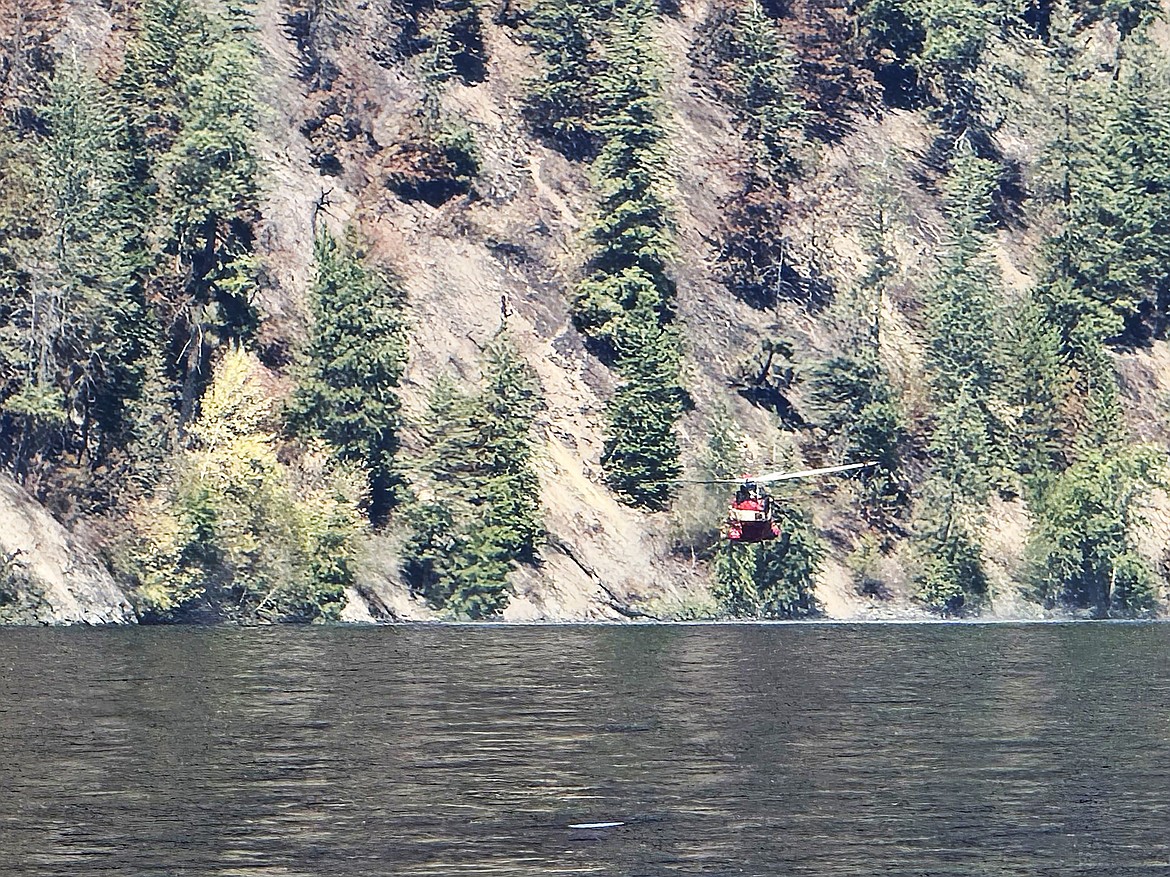
A helicopter works on the Sunset Fire in southern Bonner County Monday.
Photo courtesy IDAHO DEPARTMENT OF LANDS
SANDPOINT — Firefighters have made swift and significant gains on the Sunset Fire in recent days, bringing containment to 32% and completing a direct handline around the fire's perimeter.
The fire, first reported Aug. 13, has burned 3,230 acres. There are 670 personnel assigned to the fire.
And, as importantly, "Go" evacuation orders were lifted and residents in southern Bonner County were told they could now go home. Residents in the Talache area were downgraded to "Set" status. “Go” status is the final stage of the Ready-Set-Go evacuation protocol. “Ready” means residents should have an evacuation plan. “Set” means they should begin implementing that plan.
As residents return to their homes, Bonner County Sheriff Daryl Wheeler said the forest remains closed to the public and that burning restrictions in the region remain in place.
"Please do not enter public lands and disrupt the firefighters working on your behalf," Wheeler said.
Established checkpoints in southern Bonner County will continue to be manned to prevent non-residents from entering the formerly evacuated areas.
"You are returning to an active fire scene where hundreds of personnel are still working," Wheeler said. "You will encounter heavy equipment and fire trucks throughout the area. Please give them the right-of-way as you travel."
News on the Sunset Fire was equally as good with Northern Rockies Team 5 officials noting that crews had a highly productive weekend.
"We do have containment on the map," Northern Rockies Operations Section Chief Greg Shenk said Monday. "We still continue to mop up and we're shooting for 100 to 200 feet."
Shenk said the fire has been halted on its southern end and "no progression whatsoever" is expected all the way up the western edge. Crews have completed direct and indirect handlines in the area, with hose lays and sprinklers spread out in the area as firefighters work to secure hot spots, Shenk said.
Infrared technology is being used extensively on the fire, from drones to aircraft flying at 18,000 feet, Shenk said.
"We can actually talk to the pilots," the operations chief said. "We can talk to the people in the back who are working through all this infrared to really pinpoint these hot spots. That's been super helpful, because that is real time information that we can get down to the crews, and they can really target those areas."
In the Maiden Creek area, Shenk said three Hotshot crews and three or four Type 2 initial attack crews have completed handlines near the fire's northern edge where most of the concentrated area of heat remains. The steep terrain in the area means that the labor-intensive work can only be done by hand and is especially difficult due to the uneven, patchy pattern of burned and unburned fuels across much of the fire area.
"They are continuing to mop up in there and secure it for the heat that we are expected to have here in the middle of the week," Shenk said. "However, we don't anticipate any surprises in there."
Added cloud cover, and potential rain, are possible and would be a "huge win for this fire," he said.
Helicopters continue to assist all firefighting efforts using water drops and long lines to insert supplies to crews on the ground, Northern Rockies officials said. From the lakeshore, watercraft will insert crews and provide logistical support and lookouts.
A structure protection unit remains near the fire’s northern flank as it continues to assess protections for homes and buildings in the area. Plumbing, hose lays and sprinklers have been added south of the Talache area.
"They're continuing to triage, still continuing to test pumps to make sure we're ready just in case something happens," Shenk said. "I don't anticipate anything happening here on the lake. … No structures are threatened and everything is looking really good."
Boats will continue to be utilized to ferry supplies and personnel where needed. Northern Rockies Team 5 members are keeping — and will continue to keep — a close eye on the fire.
"Not much is popping up as far as heat goes," Shenk said. "We still have a presence on the whole fire, and we will continue to do that until we feel comfortable to be able to walk away."
Near Clark Fork, the Idaho Panhandle National Forest resumed management of the Lightning Creek Fire on Aug. 18. The fire, which has burned about 2,515 acres since a lightning strike ignited it on July 30, is 15% contained and has not grown for more than a week.
Fire activity on the Lightning Creek Fire is minimal, with creeping and smoldering in isolated areas. Firefighting efforts are being led by Incident Commander Kelly Tucker of the Sandpoint Ranger District.
A temporary flight restriction is in place over the Sunset Fire, prohibiting all drones and aircraft from operating in the area without permission. Unauthorized aircraft pose a serious hazard to aviation personnel, forcing the grounding of firefighting aircraft and potentially delaying suppression efforts.
Information: Lightning Creek Fire, bit.ly/4l5NhIB; Sunset Fire, bit.ly/3HR16gm; Bonner County Sheriff's Office, bonnerso.org