

Legislators meet in Hayden to examine how family laws are applied
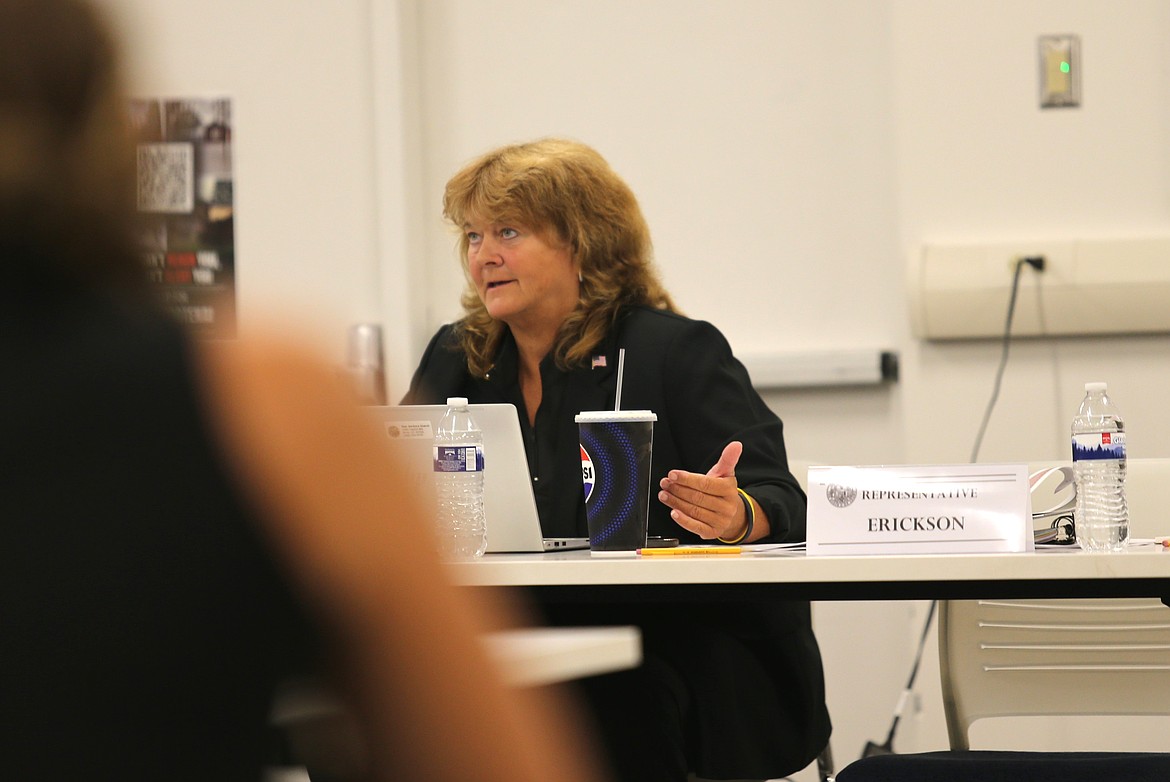
Rep. Barbara Ehardt, R-Idaho Falls, met with fellow lawmakers and North Idaho stakeholders Thursday in Hayden.
HAYDEN — State legislators are examining how laws are applied in family law cases across Idaho.
Formed this year, the Idaho Legislature’s Child Custody and Domestic Relations Task Force is charged with studying how Idaho courts are interpreting child custody and domestic relations laws for consistency with legislative intent and making recommendations if clarification of intent is warranted.
The task force convened Thursday morning at the Office of Emergency Management in Hayden, receiving input and feedback from North Idaho stakeholders.
Cochair Sen. Tammy Nichols, R-Middleton, emphasized that the task force has a narrow focus and legislators have a limited role that must respect the separation of power between branches of government.
“The Legislature makes law, but the courts decide cases and we are not here to second-guess the decisions of individual judges or to undermine the integrity of the courts,” she said.
Scott Coleman, director of the Children’s Advocacy Center at Safe Passage, told legislators that the Idaho Parental Rights Act that took effect last July has been “hugely problematic,” sometimes preventing children from receiving appropriate care.
The law allows for minors to receive medical care — including any kind of examination or treatment for any physical or mental health condition — without a parent’s consent only “in order to prevent death or imminent, irreparable physical injury.”
Coleman said the law creates a hurdle when investigating cases of child sexual abuse.
“If we have a parent who’s accused of sexual abuse, we can’t perform a forensic interview, basically an exploratory interview, on that child without a signature from the parent,” Coleman said. “If the parent is a perpetrator, that’s a problem.”
Rep. Barbara Ehardt, R-Idaho Falls, who authored the bill, insisted the law does not prevent forensic interviews with children who have experienced sexual abuse.
“That’s entirely not true,” she said. “We will add more clarification, but it specifically allows law enforcement to do that.”
While police can conduct such interviews under the law, Coleman noted, specially-trained forensic interviewers at children’s advocacy centers cannot, nor can they be authorized by police to conduct the interviews.
“Law enforcement does have trained forensic interviewers,” Coleman said. “They prefer to use us because we are completely neutral.”
Bonner County Sheriff Daryl Wheeler urged legislators to add “coercive control” as an element of domestic violence in Idaho code.
Coercive control refers to a pattern of behavior that establishes dominance over another person through intimidation, isolation and violence or threats of violence.
“The victims of coercive control are hidden in plain sight,” Wheeler said. “Their scars are invisible, but I believe they make up the majority of the high-conflict divorce and custody battles.”
Several states have made efforts to add coercive control to domestic violence statutes, according to The Marshall Project, a nonprofit news organization that covers the U.S. criminal justice system.
“This form of extreme cruelty is not recognized as a crime in Idaho,” Wheeler said. “This must be changed, hopefully this next year.”
If you or someone you know is experiencing domestic violence or sexual abuse, reach Safe Passage 24/7 by calling 208-664-9303 or texting 208-449-7228.