

Best night sky events for August 2025
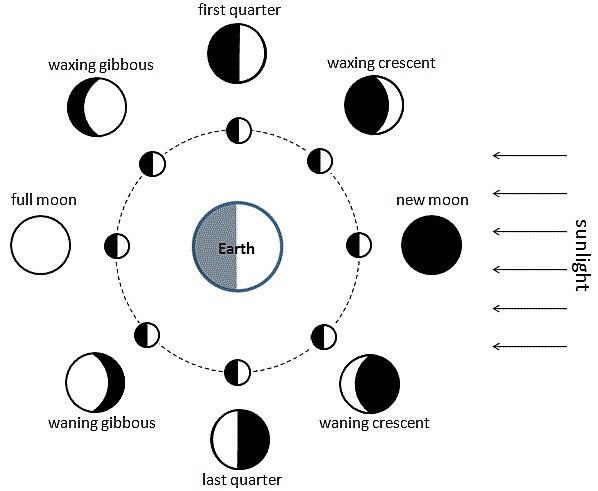
In this illustration the inner circle tells you where the moon is in its orbit around us and how the sunlight is hitting it (the sunlight is coming from the right side of the illustration). The outer circle tells us what we see and what we call that position in the moon’s orbit around us. The animation from this website does a much better job of explaining our Moon’s phases. https://astro.unl.edu/naap/lps/animations/lps.html Graphic courtesy of Wikipedia
Get ready for everyone’s favorite observing month because the nights are getting longer, are still warm, plus there is arguably the best meteor shower of the year. The August night sky brings the famous Perseid Meteor Shower, followed by the Full Sturgeon Moon. There’s a telescopic option that will appear in our night sky — the transit shadow of Saturn’s largest moon, Titan. Plus, a close conjunction between Venus and Jupiter. Here is everything worth watching, including many picturesque planet-moon pairings and suggestions for telescopic observations.
Aug. 1 — First quarter moon
When the moon completes the first quarter of its journey around Earth this morning at 5:41 a.m. Its 90-degree angle between us and the sun will cause us to see the moon half-illuminated — on its eastern side, the right side.
At first quarter, the moon always rises around midday and sets around midnight, so it is also visible in the afternoon daytime sky. The evenings surrounding first quarter are the best evenings to use a telescope or even a pair of binoculars for seeing the lunar terrain, which will be dramatically lit by low-angled sunlight, especially along the terminator, the pole-to-pole boundary that separates the light and dark hemispheres.
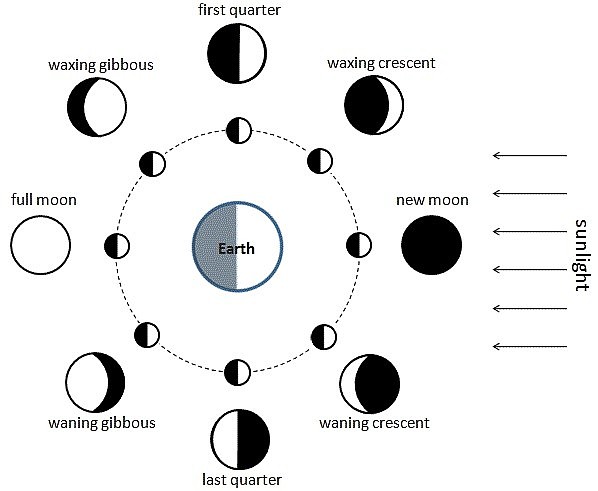
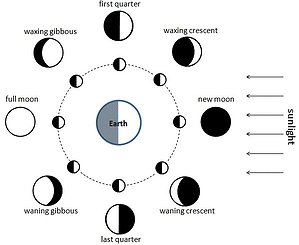 In this illustration the inner circle tells you where the moon is in its orbit around us and how the sunlight is hitting it (the sunlight is coming from the right side of the illustration). The outer circle tells us what we see and what we call that position in the moon’s orbit around us. The animation from this website does a much better job of explaining our Moon’s phases. https://astro.unl.edu/naap/lps/animations/lps.html
 Graphic courtesy of Wikipedia
Aug. 3 — A telescopic opportunity, the transit of Titan’s shadow across Saturn.
Titan (Saturn’s largest moon) shadow transits are rare, occurring only about every 15 years. You have an opportunity to see this semi-rare occurrence starting just before midnight, 11:25 p.m. till 4:04 a.m. Titan transits occur only during the relatively brief period when Earth and Saturn both lie in line on the ecliptic (the plane on which the planets’ orbits lie) which coincides with when the rings appear approximately edge-on.
What you’ll need to see this event: A telescope of at least 4 inches in aperture and 800 millimeters of focal length, an eyepiece (or eyepiece + barlow combo) that will give you at least 200x, sitting on a telescope mount that doesn’t shake too much. The disk of Saturn through the eyepiece is small, so seeing this tiny black dot on the surface is very challenging. If the atmosphere (clouds, transparency, turbulence), your equipment and your eyes all function well, you stand a good chance of seeing this event.
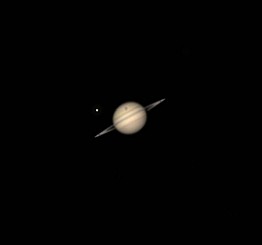
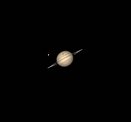 Make sure this image is no bigger than 2”x2” when printed. I hope your resolution is good enough to display the black dot.
 In this image, the tiny black dot of Titan’s shadow is above the rings in the center. This image is what you may see in a 4”, 800mm focal length telescope using a 5mm eyepiece with a 2x barlow giving you a magnification of 320x. Try to view this image at arm’s length to see if you still see the tiny black dot. Image courtesy of John Taylor and Stellarium
Aug. 9 — full moon, the Sturgeon Moon
The moon will be located on the opposite side of the Earth as the sun and its face will be fully illuminated. This phase occurs at 12:55 a.m. This full moon was known by early Native American tribes as the Sturgeon Moon because the large sturgeon fish of the Great Lakes and other major lakes were more easily caught at this time of year. This moon has also been known as the Green Corn Moon and the Grain Moon.
Aug. 12 — Venus and Jupiter conjunction
If you’re an early riser or are out late watching for early Perseids, watch for a Venus and Jupiter close conjunction (less than 1 degree apart) this morning starting on the eastern horizon around 3:45 a.m. till dawn washes out the darkness from the dawn glow. These two planets are numbers three and four in brightness, only surpassed by the sun and moon. Don’t forget to use binoculars to enhance this close conjunction.
Aug. 12 — The moon and Saturn conjunction
Continuing our Aug. 12 cornucopia of events, we also have a conjunction of the moon and Saturn. They are only 3 degrees apart. You can easily swing your binoculars from the Venus and Jupiter conjunction over to this one. It's best viewed between 4:40 a.m. and dawn.
Aug. 12–13 — Perseids meteor shower
The Perseids is one of the best meteor showers to observe, producing up to 90 meteors per hour at its peak. It is produced by the comet Swift-Tuttle, which was discovered in 1862. The Perseids are famous for producing a large number of bright meteors. The shower runs annually from July 17 to Aug. 24. It peaks this year on the night of Aug. 12 and the morning of Aug. 13. The waning gibbous moon rising at 9:30 p.m. will interfere with some of the fainter meteors in the late evening and throughout the rest of the night, but the best viewing will still be from a dark location after midnight. Meteors will radiate from the constellation Perseus, but can appear anywhere in the sky. These meteors are colorful and they frequently leave persistent trails called trains. All of these factors make the Perseid meteor shower perhaps the best and most spectacular meteor shower for the Northern Hemisphere.
Aug. 15 — Third quarter moon
The third (or last) quarter phase, occurring at 10:12 p.m., shows the moon appearing half-illuminated on its western, or left side. It rises before midnight local time, and then remains visible until it sets in the western daytime sky in the early afternoon. The dark, moonless evening skies that follow this phase give you an opportunity for observing deep sky targets, like the Andromeda galaxy!
Aug. 16 — The moon and the Pleiades
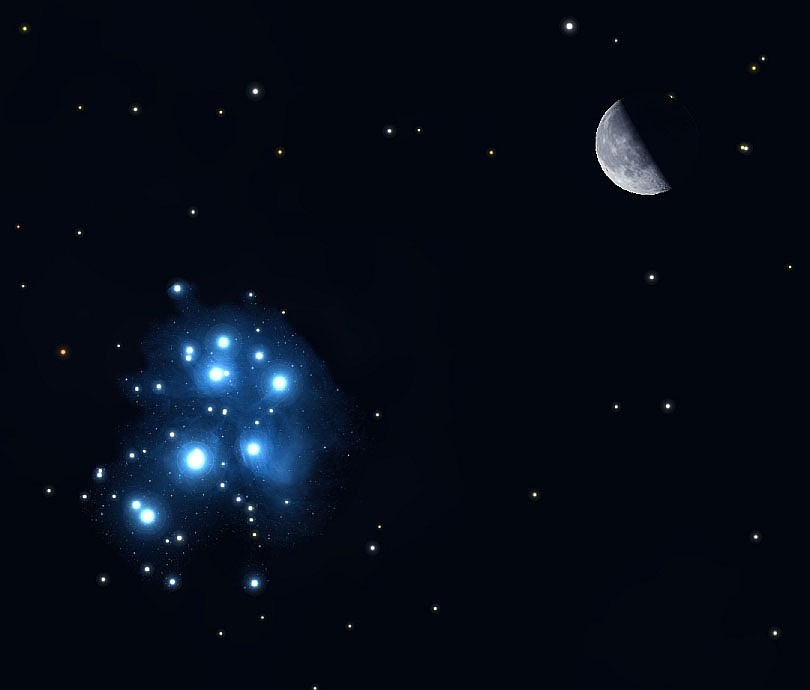
Another early riser event. Look low in the east after 4 a.m. on the 16th to see the third quarter moon’s close approach to the star cluster the Pleiades. They will pass within 2.7 degrees from one another before dawn’s light interferes.
Insert Moon Pleiades image here.
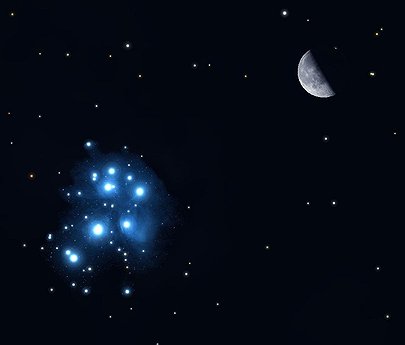 This image shows the Moon very close to the Pleiades star cluster. Image courtesy of John Taylor and SkySafari 7 Pro.
 Aug. 22 — New moon
On Friday, Aug. 22 at 11:06 p.m., the moon will officially reach its new moon phase. The moon is now between Earth and the sun, and the side of the moon facing toward us receives no direct sunlight, making it hidden from view from anywhere on Earth for about a day or two. Since the moon is new Friday, it makes Saturday and Sunday your best opportunity to get out under very dark skies.
Aug. 30 — First quarter moon
The first quarter moon appears (again this month) as a half-illuminated disk. It will show the right half visible from the Northern Hemisphere and the left half visible from the Southern Hemisphere, and is visible in the afternoon and evening sky.
• • •
John Taylor is an amateur astronomer who lives in Hayden.