

Summer comes and young moose wander
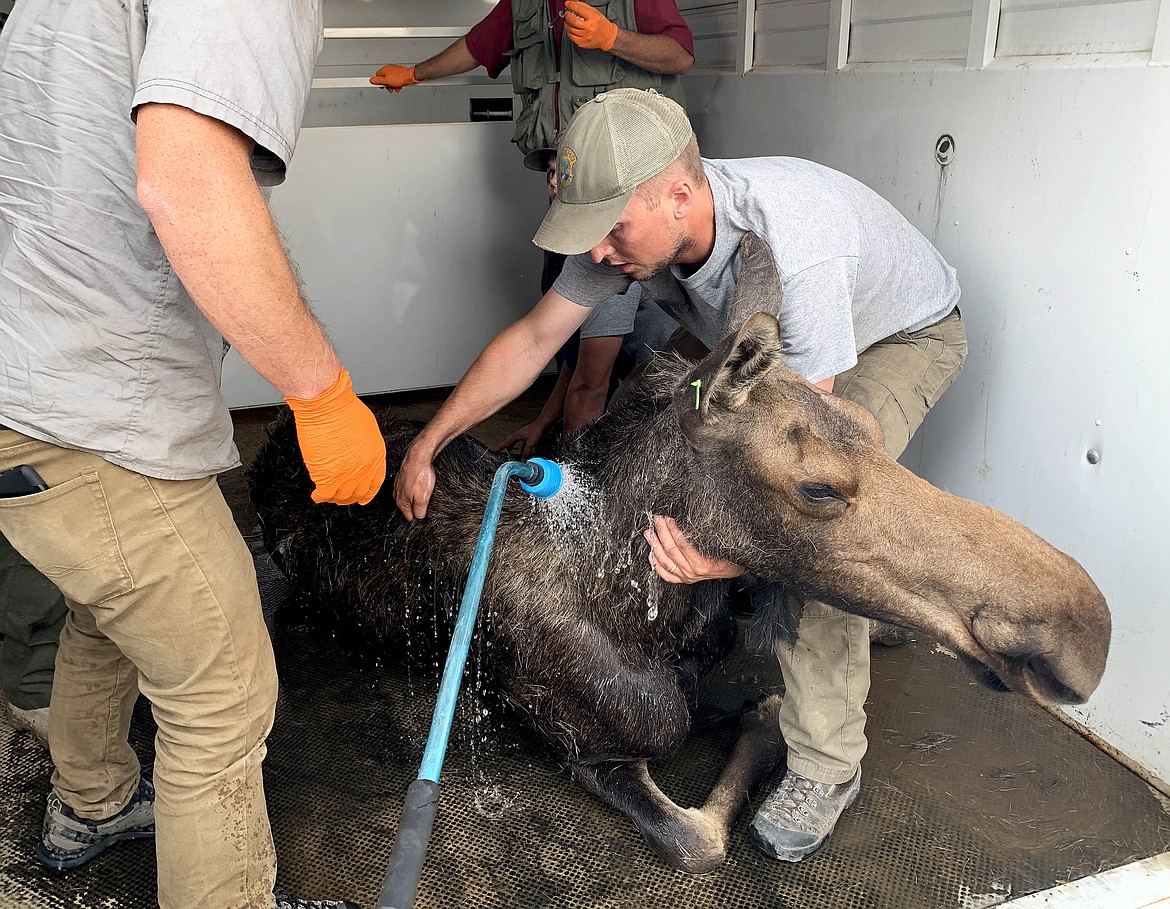
Fish and Game staff water down a moose to cool it before relocating it to a safer territory.
Photo courtesy of the Idaho Department of Fish and Game
In Idaho, as spring turns to summer, moose, especially yearling animals, begin to wander in search of new territory that will provide them with luscious food sources and cool water.
Idaho has robust moose populations, especially in the South Hills near Twin Falls and other southern Idaho mountain ranges, but also in the Panhandle. Because of this, it’s not uncommon for the Idaho Department Fish and Game to receive reports of yearling moose roaming outside their typical environments. Often these walkabouts bring moose into agricultural areas and sometimes into local communities and residential areas.
In just the last few weeks, Fish and Game biologists in the Magic Valley Region have already started to receive reports of yearling moose on the move in southern Idaho.
As moose begin to wander, the chance of having an encounter with a moose goes up. Moose often find themselves surrounded by roadways, vehicles and homes, which can create uncertainty and stress for the moose, people and their pets.
Moose are very large solitary animals and an adult bull or cow can be the size of a horse. With their long legs and big bodies, they can move with deceptive speed, which can present safety issues for people or unleashed pets taken by surprise.
Most moose will move safely across the landscape and avoid people, if left alone, but a moose too close to populated areas or trying to cross interstates or highways can become a serious public safety issue. When stressed and threatened, moose can become unpredictable. And despite their size, moose can also be hard to see with their dark hair, which increases the risk of colliding with fast-moving vehicles on roads or highways.
Most observations of moose on the move come during the early morning or evening hours when moose feed. Then they will search out cool areas to bed down during the heat of the day.
When encountering a moose within city limits, near residential areas, or close to roadways the public is strongly encouraged to contact local Fish and Game offices or local law enforcement.
If a moose becomes a public safety hazard, Fish and Game biologists will often attempt to dart and anesthetize the moose so it can be relocated to a more suitable habitat. Efforts to relocate moose are challenging and can pose significant risks to the animal, Fish and Game staff, bystanders and passing motorists.
No matter where a moose may be encountered, the following general safety precautions are likely applicable:
• Do not approach the moose.
• If a moose is seen on or near a roadway, slow down, but avoid creating a traffic hazard.
• Watch for body language that indicates the moose is stressed, such as ears down or hair on their neck stands up. They can also stomp their front hooves and grunt or snort.
• If an unexpected encounter occurs, make sure there is some type of barrier between you and the moose, such as a large tree or vehicle.
• Keep pets contained or leashed, and away from the moose. Dogs, especially those off-leash, can be perceived by the moose as a threat.
• Photographing a moose can be exciting but must be done from a safe distance.
For information about how to safely live around wildlife, contact the local Fish and Game office.
• • •
Terry Thompson is a regional communications manager with the Idaho Department of Fishe and Game.