
Form of government analysts weigh pros, cons
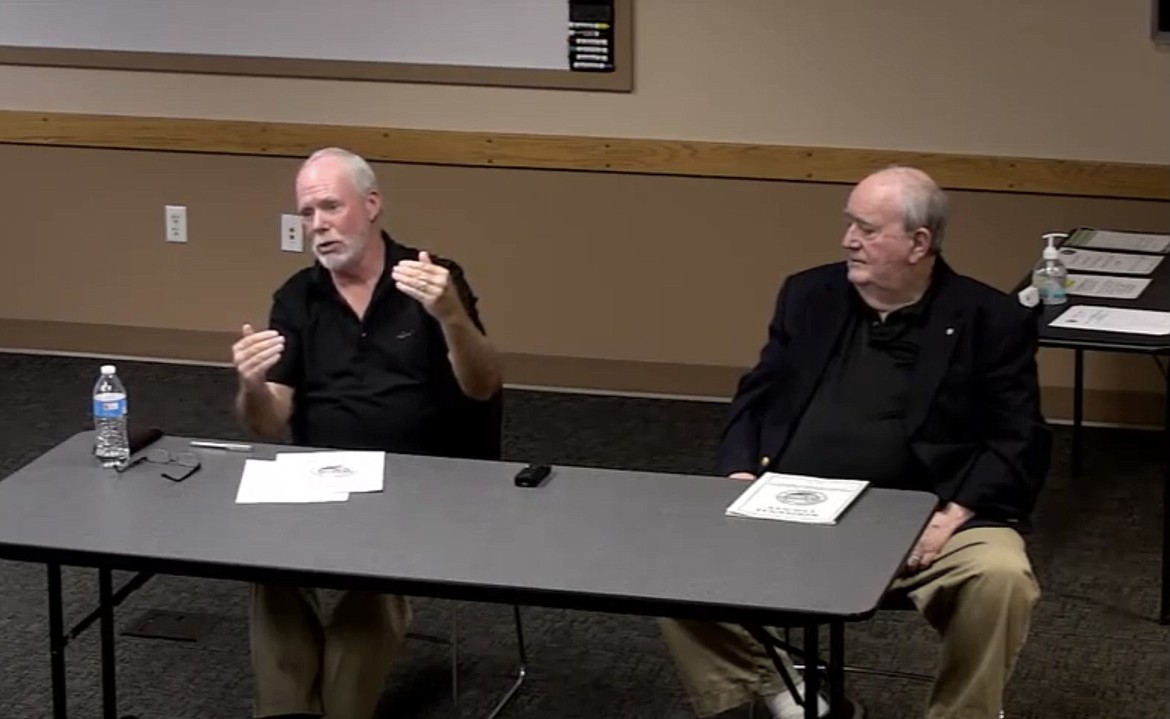
Bob Schmand, left, and Mike Anderson sat in with the Kootenai County Optional Forms of Government meeting on Wednesday to share their thoughts on participating in the 1996 study. Photo courtesy Kootenai County Youtube.
A lack of financial analysis in the 1996 recommendation to change county government structure left members of the new study commission unconvinced of its merit after a Wednesday meeting.
A quarter of a century has passed since Bob Schmand and Mike Anderson participated in a study that recommended Kootenai County switch to five commissioners, add a county manager and hire rather than elect the other six officials, including sheriff.
On Wednesday, Schmand and Anderson, joined by former county administrator Tom Taggart, discussed what led to the decision.
Taggart, formerly Kootenai County clerk, served as administrator for the commissioners after the board became overwhelmed by the volume of appeals, public hearings and management of building projects, he said. Shortly after frustration hit its peak, Taggart said, the board created the administrator position and hired him without a formal hiring process.
Taggart assisted in the budget process and supervised duties for departments, primarily aiding in communication and carrying out commissioner decisions.
“It was an experiment that I think could have worked long-term if it had been better designed, but it also pointed to a lack of professional help for commissioners at the time,” Taggart said.
In his opinion, if the county built a new government today from the ground up without any notion of current systems, “they would never create what we have.”
“(They) would never come up with something so cumbersome and difficult to manage,” he said. “It was created at a time when the world was a whole different beast.”
Still, Taggart said he would be surprised if, at the end of the 2021 study, the public would vote favorably for a change in government. Winning the popular vote would be particularly difficult, he said, if it includes eliminating an elected official.
After reviewing the document with a fresh pair of eyes over two decades later, Schmand said sheriff and prosecuting attorney should remain elected positions while the rest — clerk, coroner, assessor and treasurer — should be hired.
However, if one thing still rings true from the study, Schmand said it's the benefit of increasing the number of county commissioners to five — a decision the 1996 group attributed to the effects of growth in the 1980s and 1990s.
“We’re 25 years later, and it is even more important to broaden the voice of the general public by having five commissioners that can now voice opinions from different regions,” Schmand said.
By expanding the number of commissioners, Anderson believed county residents would feel a stronger connection to their elected officials.
“The county is growing in size, and it would give greater representation among the citizens to have more than three,” he said. “It is also more difficult to control the commission … I think it prevents a third party from taking control in terms of what the commissioners do.”
2021 study participant Tamara Bateson asked why, of the other forms permitted under Idaho Code, the 1996 commission felt their recommended structure would be more responsive to the public than others.
“When you have five commissioners, and there’s 150,000 population, then each one is voted on by a possible group of 30,000. Today it’s 50,000 with three commissioners,” Anderson explained. “There’s more responsiveness, more people to answer the phone.”
While Idaho Code permits these changes, the 2021 commission asked the former participants if they had considered how changing the government structure could financially impact the county. Schmand said the 1996 group did no studies or analysis to compare budgetary needs for the various forms.
2021 study commissioner Kurt Andersen suggested that if the group recommends hiring rather than electing officials, the process would weigh heavily on the county.
“When you’re talking about hiring these roles from a national pool of applicants, it seems that you’d have to pay a nationwide competitive salary,” he said. “Which I’m expecting would be significantly higher than the way we currently compensate our elected officials.”
Brian Cleary, vice chair of the 2021 study group, asked what benefits the former group saw from adding more government authorities in the county because it would add costs to payroll. Anderson said that part of the rationale for shifting from three full-time to five part-time commissioners was to redistribute money in a financially responsible manner. However, no study affirmed that.
Dave Botting, chair of the 2021 commission, noted that while a financial analysis is something the current group should consider, the lack of one from 1996 is insignificant to today’s standards and costs.
The commission will meet again on June 30.