Health Corridor URD focuses on transportation
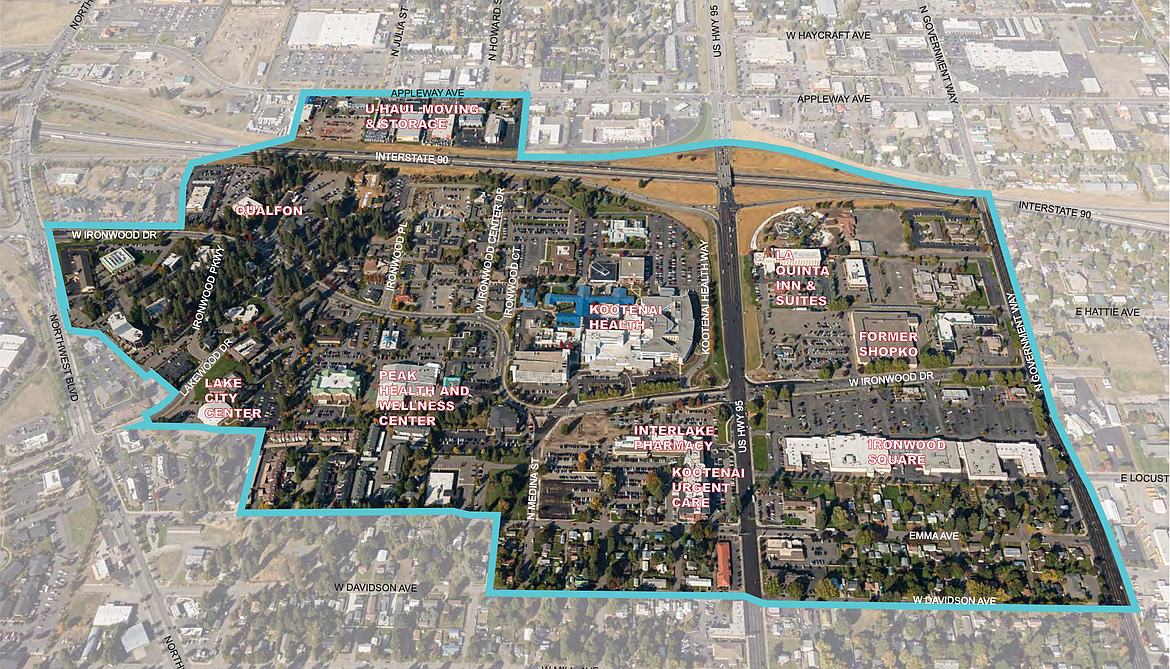
Spanning 263 acres of land surrounding Kootenai Health, the Health Corridor Urban Renewal District aims at preparing the area for growth. Photo courtesy the Kootenai Metropolitan Planning Organization.
COEUR d'ALENE — A virtual public presentation on the Health Corridor Urban Renewal District brought up old worries about agency control over private property.
Still, officials say developers have no intention of undue impositions.
Spanning 263 acres surrounding Kootenai Health, the URD master plan addresses challenges presented by the growing health care industry and improves job creation and economic development.
Since the Coeur d’Alene City Council approved the Health Corridor URD in December 2019, the Kootenai Metropolitan Planning Organization and contractor DOWL have conducted traffic analysis to forecast potential needs and changes for the area.
The study led to three different scenarios: no build, the master plan and a build-out.
Under the no-build option, developers would only update roadways around the district through transportation plans already identified — such as the Huetter Corridor and U.S. 95 interchange.
However, DOWL senior project manager Dave Simmons said traffic will not improve, instead of worsening to the failure of nine surrounding traffic signals.
The master plan scenario would add another layer of developments to the master plan, Simmons explained, including projects like:
• The Howard Overpass
• Ironwood Drive and Annie Avenue connection
• Parallel east-west local access roads on Ironwood Drive
• Ironwood Drive access management through the closure and removal of driveways
“Ironwood today is the backbone of the district and carries a lot of traffic,” Simmons said. “To improve safety and better define where those access points are, and helping traffic flow more smoothly is an important component of the master plan.”
Still, six intersections would be near failure through this option.
Of particular concern for citizen questions Thursday night was how planners would consider a driveway for closure. DOWL senior transportation engineer Adam Miles said he had worked on several management efforts over the years. Routinely, the process for closure is a collaborative effort between agencies and parcel owners through shared agreements.
“It’s not meant to be something that’s imposed in a draconian type of action that would be taken against someone,” Simmons said. “Ideally, there is an opportunity there for collaboration and discussion around what makes sense.”
Looking at collision data around Ironwood and U.S. 95, Miles noted a “consistent pattern” of rear-ends and collisions involving driveway access that the agencies would like to stop.
“Property owners like to keep as much access to their property as possible,” Miles said. “We’re just trying to make sure that their customers are getting to and from their properties in a safe and efficient manner.”
The “build-out” option involves additional developments to those listed in the master plan scenario, including constructing a Julia Street overpass, an upgrade to the Northwest Boulevard interchange, and frontage roads from Julia Street and Northwest Boulevard. This option has no intersection failures.
“We were already seeing in the origin-destination data that cutting through the residential neighborhood to get from Northwest Boulevard to U.S. 95 or vice versa was a popular movement to make,” Miles said. “Adding these medians reduces the ability for traffic to cut through and intrude into residential neighborhoods.”
In response to a question about any potential property condemnation or undertakings, KMPO transportation planner and project manager Ali Marienau explained that ignite cda, the city's urban renewal agency, has said it has no intentions to take properties.
Instead, like the driveway closures, ignite cda hopes to work with property owners if the need to acquire property arises.
“There’s no intention of condemning properties just to make this plan go forward,” Marienau said.
A comment sent in by a viewer said there have been significant objections to the development and that the political and public reaction to the designs would be substantial. Simmons assured the person that planners would consider the concerns and all impacts throughout development.
“We’re trying to be agnostic to what the development looks like, where the streets get drawn and how the development patterns occur,” Simmons said. “If a development of this type of intensity occurs … what are the things that can be done?”
The public hearing was one public outreach component KMPO and DOWL intend to gather before preparing an implementation plan.
The presentation recording will be available on the KMPO website, kmpo.net, on Monday, and the public is invited to submit comments through July 2 to [email protected] or 208-930-4164.
Citizens can view the URD Master Plan at www.ignitecda.org/districts/health-corridor/.