
Power above vs. power below
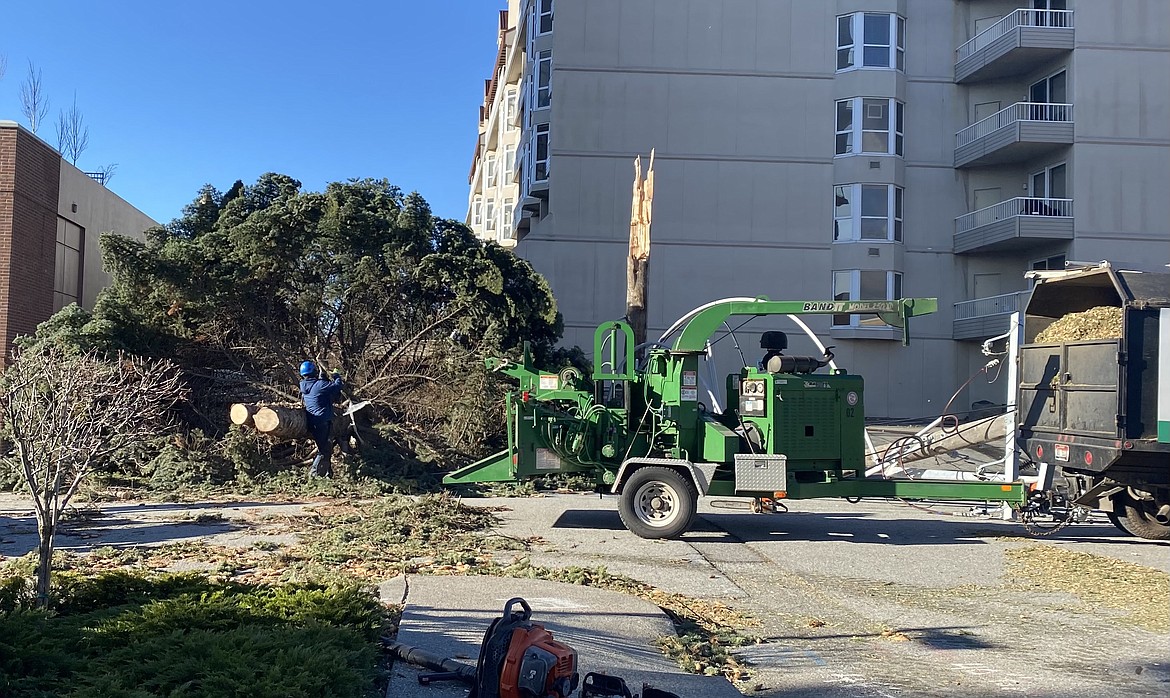
Last Wednesday's tree debris left thousands without power after fallen trees took out power lines, but could the black out have been avoided? (MADISON HARDY/Press)
When last Wednesday's windstorm hit, it took down Kootenai County's electricity with it, uprooting service towers and snapping overhead power lines that have brought light to customers for generations.
For a century, the standard design model for transmitting energy has been the wooden poles and string wires that hang between them. There are other options, generators, solar panels, the classic coal-burning furnace, or the much more common and far-reaching alternative underground utility lines.
Since the 1980s, the quality of underground cables has improved, Avista Utilities Senior Communications Manager Casey Fielder said.
"This practice continues today, as it makes sense for the safe, eligible, and affordable delivery of electricity," Fielder said. "For Avista, we work with our community and development partners to install underground facilities for new developments, unless the ground conditions make the cost unreasonable."
Fielder said the ground conditions for the area of Kootenai County that Avista services are usually able to accommodate the new underground equipment. Working with municipalities, Avista looks at the feasibility and impact the alternative transmitters would have on the local system, the impact on customers, and other factors — a large one being cost.
"In general, moving overhead lines underground in established neighborhoods is extremely costly, and this would be a cost that would impact customers," Fielder said.
Typically, the price of installing overhead transmission lines is about $500,000 per mile. To put the same level of service underground in rural zones that half a million jumps to $5 million, Fielder said. In urban or basalt-type areas, that doubles to $10 million.
Many things can drive the cost, Fielder said, including:
- Acquiring easements from property owners
- Installing new service equipment on homes
- Potential damage to the root systems of established trees
- Approval from and coordination with telecom and cable utilities to move their lines, as they currently have joint or shared use of Avista's utility poles, and
- Space constraints underground for placing new power lines because of existing water, sewer, and natural gas lines
Underground lines can protect customer electricity from windstorms like the one Kootenai County residents saw last week, Fielder said, but they aren't invisible.
"Outages can still occur with underground lines because connected transmission lines and some major distribution lines into a neighborhood may be above ground," Fielder said. "Additionally, extended outages may occur, as issues with underground lines can be more challenging to locate and identify, as well as more time consuming to restore."
Some Kootenai County areas have underground utilities, partially from Avista's wildfire resiliency plan and ongoing infrastructure upgrade programs, Fielder said.
Others have come from the Kootenai Electric Cooperative's multi-year improvement plan to convert about 50 miles of overhead power lines underground by August 2020.
Stemming from the two major 2015 windstorms that shook the county, KEC anticipated completing 22 utility line projects that hit areas of Hayden Lake, Twin Lakes, Harrison, Athol, and the west side of Lake Coeur d'Alene. The main difference was that these efforts were primarily funded through an $8.5 million mitigation grant from the Federal Emergency Management Agency in 2017.
"Overall, Avista's electric system in Kootenai County reliably serves our customers," Fielder said. "Avista will continue to place underground lines in new developments as it is reasonable to do so."