

One Big League
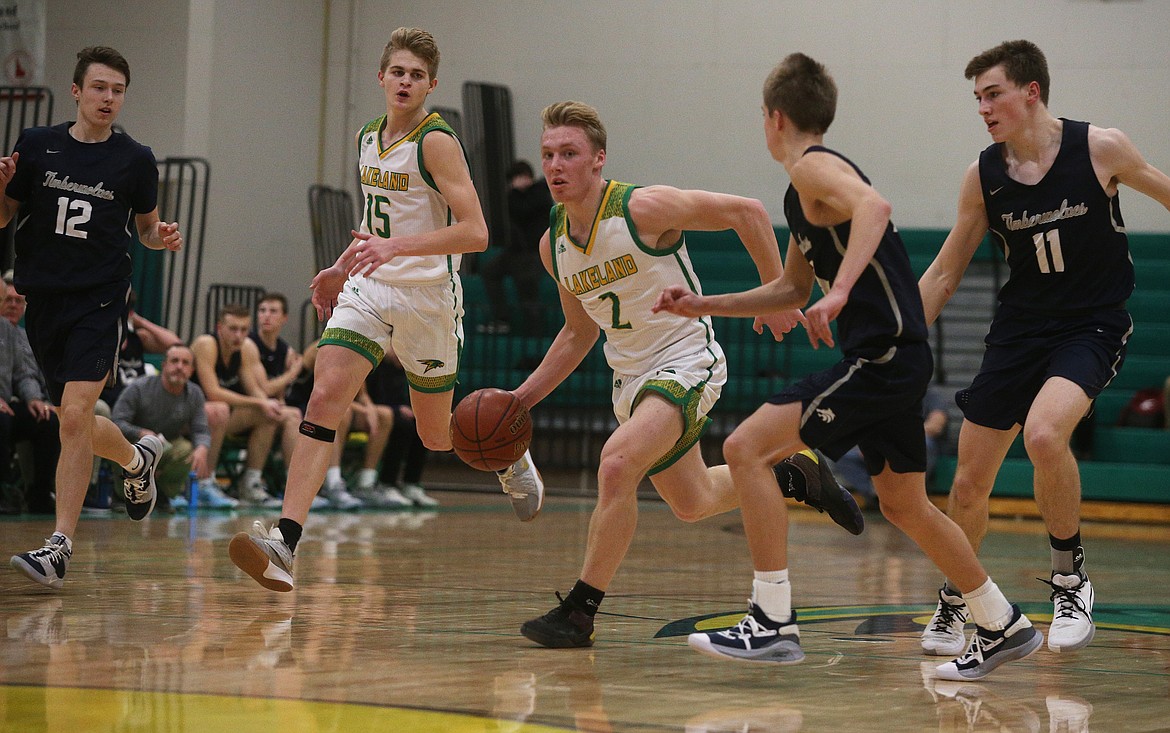
LOREN BENOIT/Press Ben Zubaly of 4A Lakeland dribbles the ball down the court in a game against 5A Lake City in a game Jan. 7 in Rathdrum.
Earlier this month Lake City, which plays in the 5A Inland Empire League, and Lakeland, which plays in the 4A Inland Empire League, played a thrilling high school boys basketball game in Rathdrum.
The game was decided by a 3-point basket by Lake City in the closing seconds.
Other than regional pride, the outcome meant nothing to either team in its respective league standings.
But next year, the game will indeed count toward seeding for each team to its respective regional tournaments.
How’s that?
If you’re a 5A school, why would a game against a 4A school affect your seeding when it comes time to qualify for state?
Likewise, if you’re a 4A school, playing a larger 5A school.
The answer, coaches and administrators say, lies somewhere among adding more meaningful games to the schedule for each team — a concession to the general remoteness of the two leagues, and maybe a teensy bit of making sure each team is able to fill its schedule.
The 5A IEL consists of Coeur d’Alene (an average of 1,371 students in two counts during the 2018-19 school year), Lake City (1,644.5), Post Falls (1,579.5) and Lewiston (1,333.5). The 5A classification is for schools with 1,280 or more students in grades 9-12.
The 4A IEL is made up of Lakeland (835.5), Sandpoint (991) and Moscow (763.5). The 4A classification is for schools with 640-1,279 students.
Starting the 2020-21 school year, in volleyball, boys and girls soccer, boys and girls basketball, baseball and softball the seven schools will face each other in one big league — twice each in volleyball, soccer and basketball, with baseball and softball still to be figured out.
One (IEL) league standings will be kept. At the end of the regular season, the 5A team with the best league record will be the No. 1 seed to the 5A regionals, and so on down the standings.
Ditto for 4A.
The seven schools in the league voted the plan into effect for just the next school year — though, with the new two-year scheduling cycle beginning this fall, it could also be this way it is in 2021-22.
Most — but not all — of the schools are happy with the idea.
“It started with the difficulty of scheduling,” Sandpoint High athletic director Kris Knowles said. “All of us struggle to build schedules in all sports, for different reasons. The discussion started with, ‘How do we help each other, because we’re kind of all we got.’ All of the North Idaho schools are dependent on the Washington schools ... it’s tough scheduling with them, because they seem to change (league/classification) every year. Let’s take care of ourselves a little bit. Are we a scheduling agreement, or are we a league?
“As the conversation progressed, we came to an agreement, as a conference, to say, ‘Yeah, let’s come back together as a league.’”
In fact, all seven schools meet together as an “IEL.” Go to any of the seven gyms, and you’ll see banners from all seven schools.
The only votes against the idea came from Post Falls — from its athletic director, and from its principal.
“To be honest with you, I don’t know why any 5A school would agree to it, because it doesn’t benefit the 5As at all. It benefits the 4As,” Post Falls athletic director Craig Christensen said. “And it’s like ‘Groundhog Day’. We do something, we find it doesn’t work, and wait a couple years and say ‘OK, let’s try it again.’ The issues we had before, some had to do with the freshman and JV programs, because basically the 4A freshmen and JV programs were getting devastated. You look at basketball, and half their season was against schools that were twice their size. And they were having trouble building programs.”
THIS HAS been done before, in the early 2000s.
In volleyball, it was done from 2000-08 in one form or another — for the first two years as a Border League, with Cheney, Colville, West Valley and Clarkston, the last seven years as an IEL. Lakeland moved up from 3A in 2004.
Everybody played everybody in league play, and the 5As and 4As went their separate ways for regionals.
In 2007-08, Lakeland pulled out of the IEL, and played as a 4A independent.
The following year, separate 5A and 4A IELs were formed, with Lakeland in the 4A league.
Basketball started as a nine-team Border League in 1997 (Moscow was still in the 3A Intermountain League at the time, and moved up to 4A and was part of the Border League beginning in 1998.).
The Border League lasted through 2002, then it was a six-team combined 5A and 4A IEL through the 2008-09 season. Then they split into separate leagues.
ONE BENEFIT to one big league, administrators say, is more meaningful basketball games in January. Now, girls teams play mostly nonleague games in November and December, and boys teams play pretty much all nonleague games in December. That is when other teams in North Idaho and Eastern Washington are available for nonleague games. That leaves January for 5As to play their six league games, and 4As to play their four league games. They are able to sprinkle in a nonleague game here and there during the month — oftentimes against each other. But it’s not uncommon for teams to go a week (or more) between games in January. And if it snows, the nonleague games are the first to be scrapped.
“The way we’re doing it now, if we’re playing Sandpoint and you’re banged up or sick or whatever, and you’re playing them at the end of the year, and you’re playing a 5A school a couple days later, you’re not going to play that game the same,” said Jim Winger, athletic director and boys basketball coach at Lake City High. “You’re going to rest kids; you’re probably going to do that if it’s another nonleague team, because league matters.
“In the big picture of it, I support (the combined league),” he added. “It’s not perfect for everybody, but as a whole, as a league, I think the positives outweigh the negatives. There will be some issues, in particular in some of the girls sports, where some of the scores have been a little lopsided. But the 4As want to compete and step up their game, and I think the majority of the 5As want games to matter, so now that we have 12 (basketball) games that matter.”
MOST 5A and 4A IEL teams have been playing each other anyway in recent years, in nonleague games — some once a season, some twice.
One exception is Post Falls boys basketball, which hasn’t played a 4A IEL team since playing Lakeland and Sandpoint once each in the 2017-18 season. The Trojans use their nonleague opportunities to schedule as many top Greater Spokane League schools as they can, and travel to play other teams elsewhere in Idaho and Washington.
Two seasons ago, Post Falls was invited to and played in the prestigious Tarkanian Classic in Las Vegas. The Tark Classic is interested in the Trojans returning; other tourneys (including one in Alaska) have also reached out to Post Falls.
“It’s hard to not take this as a personal attack on Post Falls boys basketball, because we’re not playing the 4As,” said Mike McLean, in his 13th season as Post Falls boys basketball coach. He has taken the Trojans to 10 state tournaments and won two state titles.
Despite just playing six league games per season, McLean said his program has no problem filling its nonleague schedule.
“If the state would allow it, we could play 35 games a year,” he said. “It’s not my job to make somebody else’s scheduling easier. It’s not good for anybody to get beat by 30 or 40. Do we want to do this because of convenience? I don’t think it’s the right thing, I think it’s the easy thing. We don’t play the 4As because it doesn’t help us, or them.
“Why are we fixing something that isn’t broken?”
WITH A few exceptions, in general, the 5A schools have had their way over the years with the 4As in most of the sports that will be part of the combined league.
Among the exceptions are Sandpoint boys and girls soccer and, years ago, Sandpoint volleyball.
In recent years, Lakeland volleyball and boys basketball, in particular, have been able to hold their own with the 5As.
According to research provided by Post Falls, the Trojan boys are 10-0 in their last 10 games vs. 4A IEL schools, with an average margin of victory of 33.6 points. Post Falls’ boys are 17-2 vs. the 4A IEL since 2012, the only losses to Moscow in 2012 and ’13.
The last five seasons (prior to the start of this season), 4A IEL girls basketball teams are a combined 8-55 against 5A IEL teams, and 4A IEL boys teams are a combined 12-65 against the 5A IEL. And the average margin of loss is well into double digits.
LAKELAND, UNDER second-year athletic director Mike Divilbiss, sent its football team to Pocatello to open its season last fall. And though the Hawks took a loss (47-32) to another 4A school (Blackfoot, which went on to reach the state title game), Divilbiss said traveling, and playing good nonleague competition, was beneficial. He said in the future the school is looking to schedule one long road trip for each of its teams, if they desire. Lakeland wrestling, for one, already travels to tournaments in Reno and Nampa (the Rollie Lane). And the Hawk baseball and softball teams also travel to the Boise area and/or Eastern Washington for early season games.
“Quiet frankly, from my experience, the tougher league you play in ... programs, teams evolve and look like the people they play with,” Divilbiss said. “If you’re consistently playing those teams, you find a way to get there.”
He pointed to Lakeland’s girls basketball team beating Coeur d’Alene earlier this season, for the first time since 2005. The Hawk boys have beaten Coeur d’Alene twice this season — most recently by 18 points at Coeur d’Alene. Though wrestling is not part of the combined IEL, Lakeland has been competitive with the local 5A schools for years.
“We’re there, with a lot of sports already,” Divilbiss said. “There’s a couple sports that have to grow and get better, but I think they will. Teams that bleed together, and struggle together, grow closer together. When you’ve really got to fight, and you have to invest more. You have to invest to play at a higher level.”
With the expansion of the Greater Spokane League to include 2A schools (joining 3A and 4A schools), some of the teams Lakeland has played in football — like East Valley, West Valley and Rogers — now won’t need to fill as many nonleague holes in their schedule, Divilbiss said. And the same could be true in the other sports as well.
DAVE STOCKWELL, in his ninth season coaching Lakeland’s boys basketball team, coached the Post Falls boys from 2000-07, taking the Trojans to state three times.
“In Post Falls when I coached in 4A, we won the league in 2005 and that’s with the 5As and 4As put together,” Stockwell said. “That was a neat deal for a 4A school to do that.
“Where everybody complains (about a combined league) the most is sub-varsity. The player pool is greater in the bigger schools ... when you get down to JV and C team, there’s not as many kids to pick from. Lakeland, we have four sophomores on varsity, and one starts. Typically, they would be a JV kid, and we would be more competitive on that team. That’s where the rub is. Mike (McLean) wants to play the best he can play. I get it, but to me, there’s tradition around here. Post Falls and Lakeland used to play. And now, we don’t play because we’re not good enough competition? I don’t know.”
MIKE RANDLES, now the Coeur d’Alene High athletic director, is a former wrestling coach at Sandpoint High, where he guided the Bulldogs to three state 4A titles.
“At least currently, I don’t see such a disparity in the affected programs (soccer, volleyball, basketball, softball, baseball) that any one program is profoundly playing up or down,” Randles said. “The general belief — or is it hope? — is that the programs that are down a bit will rise to the overall level of competition and that tougher programs will still have room on their calendars to schedule challenging nonleague competition. I believe this is true. Quality — real quality — seems to arrive in cycles. However, I think there will be some pressure, though, on those rare programs that tend to perennially struggle. Right down through the youth level, they will need to step up their game or you can expect a revolving door of coaches. These, though, are the exception and not the rule.”
KNOWLES, A Coeur d’Alene High grad who formerly coached boys basketball at Lake City, said the idea of having the 5A and 4A regional tournaments at the same site in the future has been floated, to create more of a tournament atmosphere.
These days, the regional tourney games are largely played at the home of the higher-seeded team.
“If you remember back in Border League days, every game counted,” Knowles said. “And it created kind of an elevated environment in the conference. That’s what I’m looking to do ... let’s make those games important again. Give kids a reason to get out and get after it every single night.”
AS SOME coaches and administrators note, high school sports are cyclical. Programs that are great now might not be in five years. Schools that are big now could split into two smaller schools. Other smaller schools could get bigger as more housing developments pop up in their communities.
“I think working with each other to have a great conference is better than working in silos, and working independently,” Knowles said. “Yeah, there was definitely a time, especially when I first got into being the AD here, where there was that sense of, ‘We don’t necessarily want to play the 5As all the time, because it’s not good for us.’ I think that mindset is changing a little bit (among the other 4A IEL schools); I know it’s changed here.
“As a high school school we decided about 6 years ago — we’re not going to run from the 5As, we’re chasing the 5As ... it’s going to make us better,” he said.
“It’s worth a shot,” Winger said, “for the sake of trying to pump a little energy into a pretty small, sparse league that relies on a lot of (nonleague) games.”
Post Falls doesn’t see it that way.
“A lot of it is they’re just looking at their varsity programs — ‘Our varsity’s not bad, we can compete with you,’” Christensen said, noting he was hearing JV and C squad coaches from 4A schools saying it was hard to build a program when they were playing mostly 5A schools — and losing. “In baseball, we’re going to go to Sandpoint for a single game in baseball and softball, and go down to Moscow for a single game in baseball and softball? We’re going to lose all those Tri-City games at the beginning of the year, where we can get four games in good weather.
“I don’t see why it would benefit us at all. And our coaches feel the same way. We’re going to lose a lot of GSL schools and (other schools) that we’ve established relationships with.”
IF, AS others are saying, combining the 5As and 4As into one big IEL was ‘good for the league,’ McLean recently pitched an idea to Christensen, his athletic director.
He noted that the more teams that are in a region, the more state berths they would get. Currently, 5A Region 1 usually gets 1 1/2 berths to state, every now and then two berths. 4A Region 1 usually gets just one berth.
“If we’re going to make this change, for the betterment of the league, have the 4As petition up to 5A,” McLean said. “Then we’d have more state berths (in 5A).”
Mark Nelke is sports editor of The Press. He can be reached at 664-8176, Ext. 2019, or via email at [email protected]. Follow him on Twitter@CdAPressSports.