
Like the x in TEDx, suicide is ubiquitous
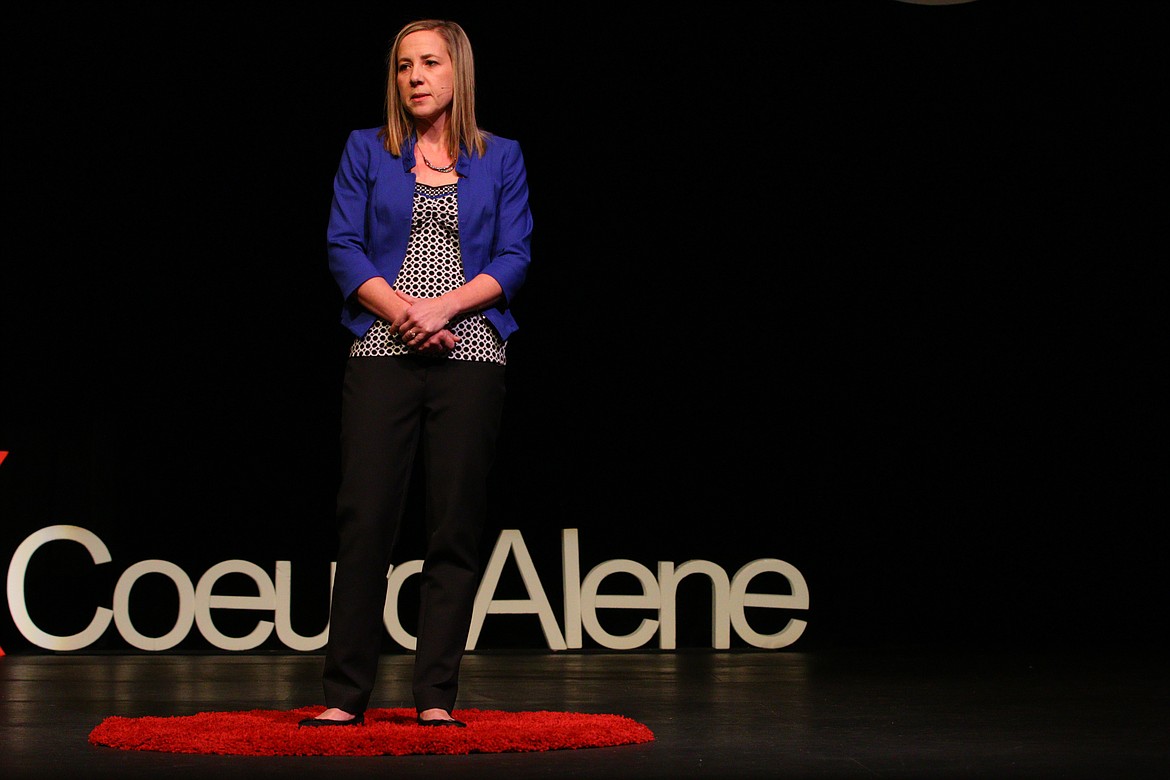
Coeur d’Alene teacher Saprina Schueller advocates for mental health reform in North Idaho at Saturday’s TEDx event at the Kroc Center. Photo courtesy of Mark Michaelis/TEDx Coeur d’Alene
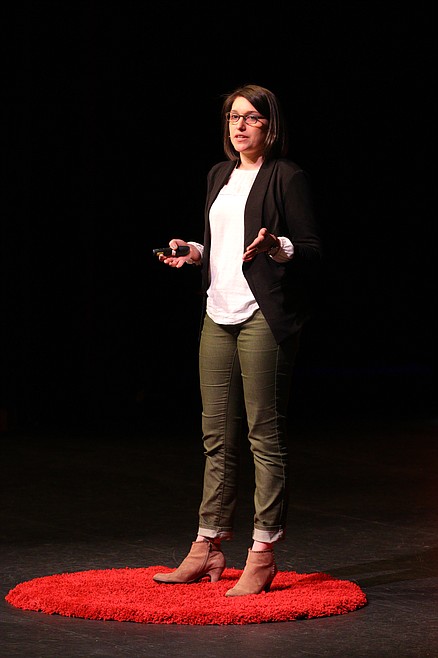
Dr. Melanie Bowden explains the burn-out, compassion-fatigue, and emotional exhaustion plaguing the veterinary industry. She lauched a relief veterinarian service to combat the problem in the Inland Northwest. (Photo courtesy of Mark Michaelis/TEDx Coeur d’Alene)
Editor’s note: Did you miss TEDx Coeur d’Alene? Fear not! This is the second installment of a three-part series highlighting the TEDx presentations Saturday.
By JENNIFER PASSARO
Staff Writer
COEUR d’ALENE — The x in TEDx stands for everywhere.
“Like the variable in math,” said Eric Edmonds, TEDx Coeur d’Alene organizer. “There are thousands of TEDx events around the world.”
It could also be said to stand for the universal, human stories presented Saturday by event speakers. Coeur d’Alene’s speakers all had ties to the Inland Northwest, but their stories informed and challenged a global society.
Teacher, writer, and mental health activist Saprina Schueller bravely told the story of her husband Troy Schueller’s suicide.
Schueller’s husband was a beloved Coeur d’Alene High School principal who unexpectedly took his own life on March 21, 2018.
Petite and blonde, wearing a crisp blazer with her hands folded delicately in front of her, Schueller stood on the round, red TEDx carpet in the very center of the simple stage and moved an entire audience to tears. She took the uncomfortable, unfathomable weight of suicide and gave the community a chance to stand up in her family’s story and advocate for mental health care reform.
“People have to be uncomfortable for change to occur,” Schueller said.
For a year and a half, Schueller’s devastation was overwhelming. Then she sat down to write. Six and half hours later she had written the story of Troy’s suicide. She created a blog and posted the essay to Troysstory.com. Since last October, 85,000 people have read the story.
Schueller outlined four things that need to happen to restructure the way society works to prevent suicide: research on CTE, alternatives to opioid pain management, reform of privacy laws regarding mental health, and more money for mental health care.
She told a personal story about the importance of continued research on concussions and chronic traumatic encephalopathy. CTE is a progressive degenerative brain disease found most notoriously in NFL football players and in people with a history of repetitive brain trauma, from which Schueller believed Troy suffered.
In 2001 Troy was traveling with his wrestling team when the bus driver suffered a massive heart attack. He leapt to the front of the bus to steer his team to safety, but the bus crashed. Troy suffered a broken jaw, knee, and an undiagnosed brain injury. After the accident, he quietly endured chronic pain and continuous headaches that became more severe with time.
"So how did my husband die?" Schueller asked. "Yes, as much as it still gets caught in my throat every time I say it, my husband died by suicide. But I also believe my husband was killed in a bus accident. It didn’t happen on Jan. 22, 2001; it killed him slowly over 17 years."
Schueller discovered after Troy's death that he managed his pain with opioids and a tough-it-out-mentality. She urges more progressive research to help people dealing with chronic pain find alternatives to opioids.
“Opioid use doesn’t work in the long term,” Schueller said. “For people managing pain while recovering from surgery, sure, but for people combating chronic pain, opioid use is addictive.”
The body’s tolerance heightens, and the drug becomes less effective, essentially causing pain to increase, Schueller explained.
She also wants to change privacy laws regarding mental health. Much like employers ask for an emergency contact person, employees could voluntarily list a mental health emergency contact person that could be contacted if they exhibit warning signs of depression or suicide. Schueller believes if the school district could have taken action regarding their concerns for Troy, he would still be here today.
Finally, Schueller thinks more money needs to be spent on mental health care. She said work needs to be done to remove the stigma that surrounds asking for mental health treatment throughout the country, but more specifically in North Idaho, where access to and the ability to ask for help remain thin.
“Removing the stigma opens the door to important conversations,” Schueller said, as she did just that.
TEDx Coeur d’Alene made space for these important conversations.
Schueller was not the only speaker to address suicide.
Dr. Melanie Bowden illuminated the devastating reality of being a veterinarian in America. One in 10 veterinarians who have died since 2010 have died by suicide. Burn-out, compassion-fatigue, and emotional exhaustion plague the industry, she said.
Bowden works throughout the Pacific Northwest and New England.
“I worry about your pets all the time,” Bowden said. “I can’t turn it off.”
That worry, compounded by unrelenting hours and a high industry-wide attrition rate, leaves veterinarians without the necessary support to thrive in their profession, according to Bowden.
“I believe veterinary medicine can be different,” Bowden said. “I believe the people who have the most impact on this process are all of you ... the biggest thing you can do is partner with your veterinarian to be an advocate for your pet. By partnering with your veterinarian we can get what we are both seeking. Both of us want Fluffy to live the longest, healthiest, and best life possible.”
This year Bowden will launch her new business, Vacation Vet, LLC, providing relief veterinarian services for clinics in Washington, Oregon, Idaho, New Hampshire and Maine. More information about her services can be found at drmelaniebowden.com. She hopes this service will provide the much-needed coverage for overworked veterinarians.
“A veterinary clinic can be a lot more than just a point of service for medical care,” Bowden said. “I think you have the opportunity to provide your employees with really fulfilling and meaningful work ... It’s a stressful environment and it needs to be a cohesive group that can rely on each other in times of turmoil and stress.
“Not only do I want to care for animals and for my clients, but I want to be able to provide the type of work environment for people where they feel that there’s a ‘why’ to doing what they do.”