
Hitting the mark
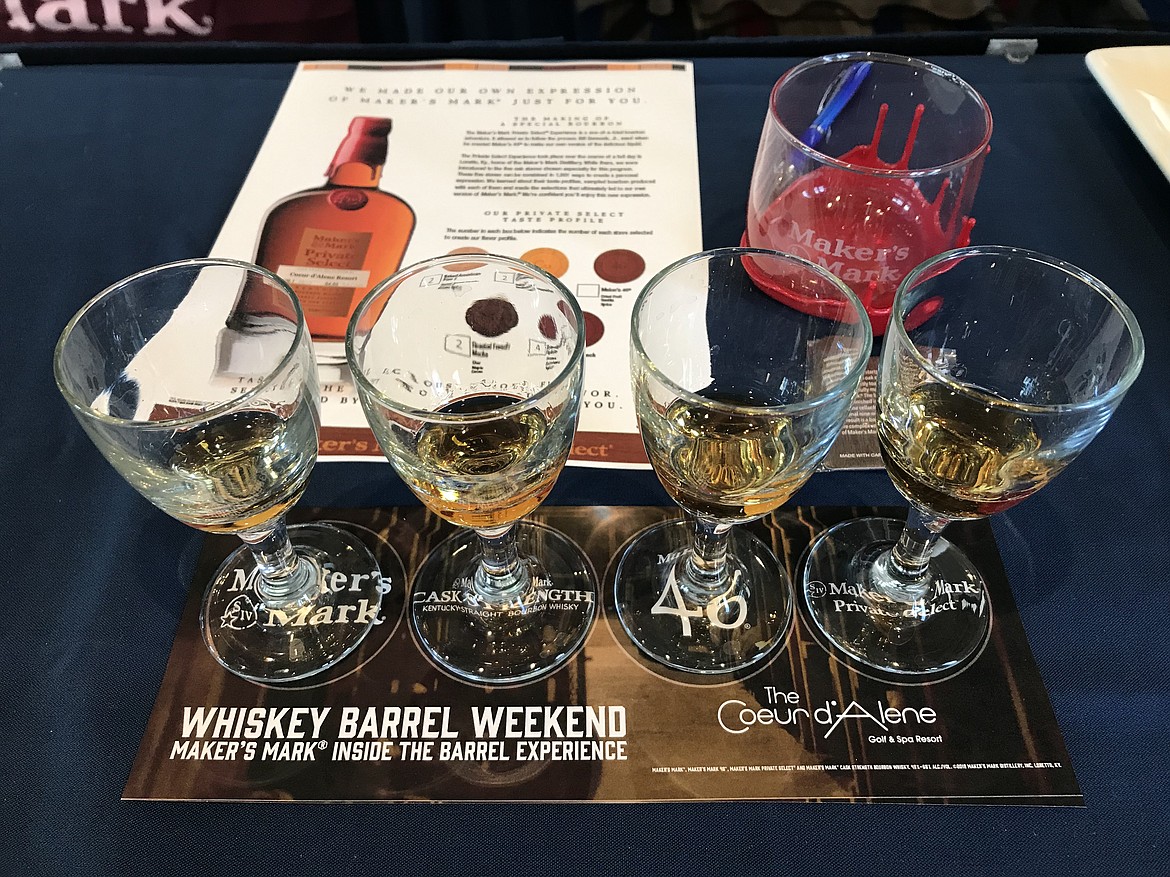
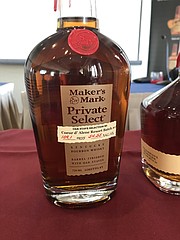
Press photo Guests at The Coeur d’Alene Resort’s “Inside the Barrel” experience had the chance to sample four types of whiskey, including a custom blend made just for The Resort by Maker’s Mark of Kentucky.
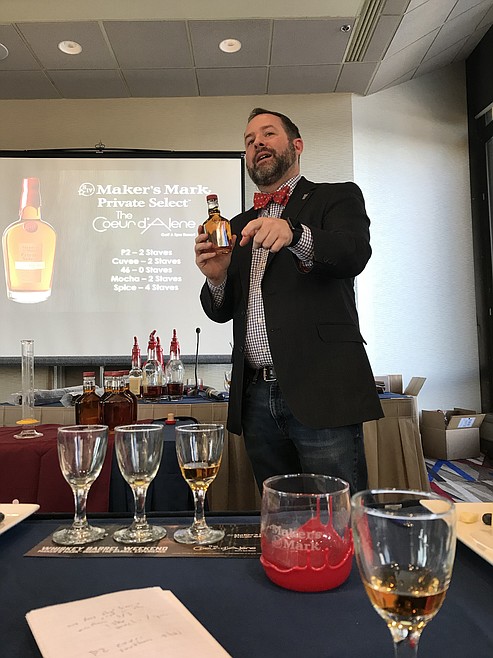
Ari Shapiro teaches class attendees about the art and science of whiskey-making at The Coeur d’Alene Resort on Saturday. The Resort plans to make the weekend, which also featured a dinner and a golf tournament, an annual event. (Press photo)
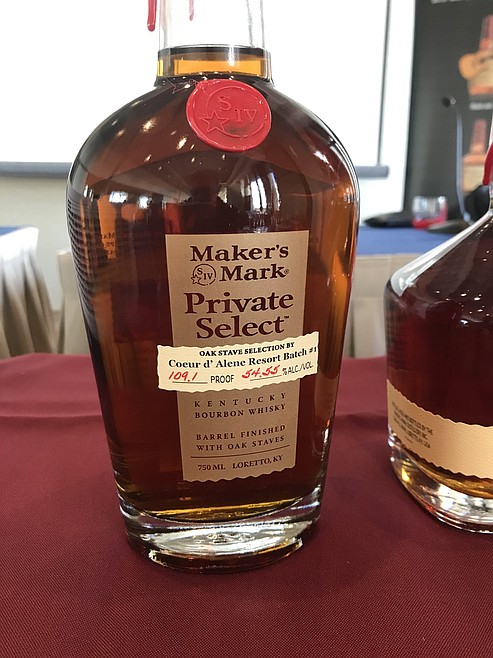
The custom blend made for The Resort has strong spice and mocha notes, flavors that tend to be popular in whiskies blended for the northern third of the country. (Press photo)
By ANDY OBERMUELLER
Staff Writer
George Bernard Shaw called it liquid sunshine.
Guests at The Coeur d’Alene Resort were all too happy to catch a few rays at this year’s inaugural Whiskey Barrel Weekend, which featured a limited edition created by The Resort’s tastemakers. The event featured tastings, a golf tournament, an afternoon class and a dinner followed by cigars and jazz by the lake.
Ari Shapiro is a 16-year spirits industry veteran, a Master of Whiskey and a certified spirits specialist. He’s been a part of nearly a dozen custom Maker’s Mark blends and was on hand to impart the storied history of the amber ambrosia to a couple of dozen whiskey lovers gathered in a seventh-floor boardroom.
Each custom blend comes from a special barrel engineered to deliver a handcrafted flavor profile. The oaken barrel contains 53 gallons of whiskey, enough for 240 to 252 bottles, a drop in the bucket, so to speak, of the company’s output of 2 milion cases a year.
The production of bourbon is governed by four main rules. First, it must be made in the United States — anywhere will do, even Idaho. The notion that bourbon must come from Kentucky is a misconception. Bourbon, secondly, must be made from a mash containing at least 51% corn. The rest can be any cereal grain. Bourbon must be stored in new, charred oak containers and, finally, it can have no added flavor or color.
Maker’s Mark began in 1951, when Bill Samuels, a fourth-generation distiller of Scottish descent, bought a storied distillery and began to tinker with his idea of the perfect recipe. His lab was his kitchen, where he and his wife, Margie, experimented with bread recipes in a bid to find the perfect flavor profile. Bill’s family distillery had recently gone out of business. He wasn’t too upset: He thought it was bitter and tasted burnt. Soon, he and Margie hit upon a solution: A mix of 70% corn, 16% soft red winter wheat and 14% malted barley. Removing rye removed whiskey’s bite, giving it a sweet rather than a bitter flavor.
But before Bill, an engineer by training, could figure out the perfect process for a consistent product, he had to make a deal with his wife. She laid out the terms: For every dollar Bill spent building the distillery, she got to spend a dollar building the brand.
It was Margie who came up with the bottle’s distinctive shape, which she cribbed from fancy French spirits, as well as the hand-torn label that featured her own calligraphy (and still does). She embossed the glass of each bottle with a logo she designed. It was made up of an “S” for Samuels, IV for fourth generation, a star and a circle. The circle is broken three times. Once for World War I, once for World War II and a third time for Prohibition, the only three times Maker’s Mark hasn’t been distilled since its founding. She spelled whisky with no “e,” a nod to the family’s roots in Scotland, where the spelling is governed by law. The term “maker’s mark” referred to the symbols jewelers stamped into their work to identify who crafted it. She hand-dipped each bottle into a special mixture of signature red wax using her electric fryer. A marketing icon was born, though her fried chicken never tasted quite the same.
Bill ensured the water supply would be consistent by buying a nearby lake (and, later, another) to feed the distillery. The grains were ordered from local farms to exact specifications, and each batch of the three deliveries of corn Maker’s Mark receives each day is tested. Its proprietary blend of yeasts is carefully stored at the distillery, which only uses wood from Independent Stave of Kentucky, a company with its own century-long heritage. Each barrel is inspected before use, and, once full, is moved around the warehouse as it ages. That’s because each floor’s temperature varies slightly, which can affect taste. “We care about the taste of our whiskey,” Shapiro said. That means going to great lengths to ensure consistency. Each batch is small, only about 25 barrels, which is a tiny fraction of the production scale of Shapiro’s larger brands like Jim Beam.
While Scotch is aged for a certain number of years, Maker’s Mark is not labeled with an age statement. That’s because it’s aged to taste, Shapiro said, a process that takes between five years 10 months and seven years.
All of the custom blends Maker’s Mark creates start out as “cask strength,” a robust variety with a slightly higher alcohol content. “It’s a bigger whiskey,” Shapiro said. To customize it, 10 wooden staves are added to the barrel. Each stave adds its own flavors, and the five kinds of staves allow for more than 1,000 blends.
Like every part of the process, the wood has to be just right. Oak is the best choice, Shapiro said, because it is durable, widely available and it can breathe while still holding the liquid well. Oak also reacts well to charring. The wood for Maker’s Mark is seasoned — that is, cut into staves and left outside to interact with the elements, bugs and plant life. After a year, it’s lost a lot of water and, with it, chemicals known as tannins that can add the bitterness Samuels labored so hard to keep out. The staves for the custom blends come in five varieties. P2 is an American stave, cooked to perfection in a convection oven; Shapiro compared it to the stock of a good soup, a base layer that can be built upon. Cuvee is a bright, fresh stave that has a dominating flavor, the result of being seared in an infrared oven, where it is cooked and flipped once. The “46” stave is heated long and slow in infrared heat. The final two are mocha and spice, named for the flavors they impart. The recipe for The Resort’s blend is two staves of P2, two of Cuvee, two of mocha and four spice. Spice and mocha, Shapiro said, are popular in the northern third of the country. The southern third tends to prefer P2 and Cuvee.
Cally King, Marketing and Public Relations manager for The Resort, said guests loved the weekend festivities, the brainchild of CEO Bill Reagan, a whiskey aficionado, and which will be an annual event each October from now on. “A lot of guests have been really interactive,” she said. “It’s been fun.” They’ve probed the experts on everything from the difference between Scotch and bourbon to how to best make ice for their cocktails. “Thank goodness our staff knows the answers,” she said.
Of all the bourbon in all the gin joints of all the world, which is Shapiro’s favorite?
“The next one,” he said. “Cheers.”