

Duncan on Vikings, state of golf in Idaho
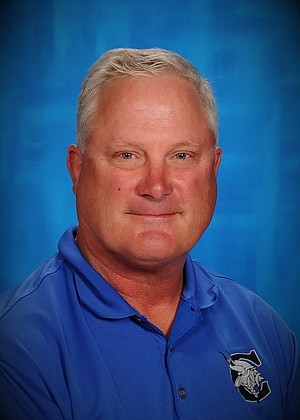
Duncan
When Bryan Duncan joined the Coeur d’Alene High boys golf program in 2004, as co-coach, the Vikings won the state title his first year.
It was Coeur d’Alene’s fifth state title in nine seasons, under the coaching guidance of Steve Cook, and then Darrell Hull, who handed the reins to Duncan after the ’04 season.
“It’s been a good run,” Duncan said of his tenure, which has included “nine or 10” trophies brought home from state since 2004.
The key to that run?
“In 2004 when I took over, nobody had any JV programs,” Duncan recalled. “They kept five or six kids, or seven kids (on the team). I said, ‘Well, that’s not going to work.’ So we kept 15, 20 kids, and it works.”
That depth has created competition for varsity spots. It wasn’t unusual for Coeur d’Alene’s No. 2 boys team to beat other schools’ No. 1 squads at tournaments.
“The other thing is, we’ve had great parents, and great kids,” Duncan said. “They all have to play the junior leagues in the summer. That’s what’s worked for us, and it will continue to work for a long time — because you can’t just pick up golf at the start of the season, and put down the clubs at the end of the season and be successful.”
More and more players from other schools are also playing junior golf in the summer, and high school golf in North Idaho in general is better for it.
AND THOUGH Coeur d’Alene hasn’t won a state title since, the Vikings have been in the hunt nearly every year, with numerous second-place finishes, including one last year.
This season, the Vikings were the top boys’ team in North Idaho, but finished second at regionals to Lake City, which won its first regional title since 2001.
Coeur d’Alene is hoping to bounce back on Monday and Tuesday, when the state tournament unfolds at Highland Golf Course in Pocatello.
“I’ve been there three times,” Duncan said. “None of my kids have been there. I think the equalizer on that course, it’s a pretty sedate course, but the greens are the equalizer. They’re very undulating, they’re very raised. If you miss a green, you pay a price.”
All but one player is back from last year’s state runner-up team — Brayden Ogle, Jackson Davenport, Wyatt Williams and Sam Johnson.
“If we shoot well, we should be able to trophy,” Duncan said.
THE RUN by Coeur d’Alene is even more impressive because, as Duncan says, “We’re kind of behind the eight-ball on (the Boise-area schools), because they get to play longer.”
While the southern schools are out on their courses in March, the northern schools are still hitting into a net for most of the month, at least in recent years. Most years, they could at least get on the Lewiston-area courses in March, but even that hasn’t always been the case in recent years — expecially this year, following February’s record snowfall.
Duncan started playing golf when he was in his 20s, at one time was a 5-handicapper, and won some tournaments in Wyoming and Montana.
He’s been a biology teacher for nearly 40 years, and an administrator for a few years. He’s coached football and track and field, then took over the boys golf program. A few years later, he took over the girls golf program as well.
Duncan and Craig Leaf, an assistant golf coach and longtime freshman football coach at Coeur d’Alene High, are both planning to retire from teaching at the end of the school year.
As for coaching ...
“The candle’s still out on the coaching,” Duncan said.
DUNCAN HAS been an advocate for change in high school golf in Idaho.
He pushed for golf to be a fall sport, but it got voted down narrowly, he said, by most of the smaller schools in southern Idaho not wanting to lose some of their football players to golf.
He’s also in favor of making golf a two-season sport — have a few tournaments in the fall, and finish up in the spring. And start the spring portion of the season later, like after spring break, and have the state tournament a week or two later than it is now, so the spring season is played in better weather.
“That’s what the colleges do, and that’s what the high schools should do,” he said.
His other suggestion — change the qualifying format for state. Now, it totally comes down to how you play on that one day, at the regional tournament.
“It puts a lot of pressure on the kids,” Duncan said. “If you play really really bad, you’re done.”
If that doesn’t fly, he said, at least make the state-qualifying tournament a two-day affair.
“A lot of states do that,” Duncan said. “If you have a two-day tournament at state, you should have a two-day qualifier to get to state. Let’s do what’s best for the kids.”
Mark Nelke is sports editor of The Press. He can be reached at 664-8176, Ext. 2019, or via email at [email protected]. Follow him on Twitter@CdAPressSports.