
So you want to study big mammals, do you?

University of Idaho Department of Fish and Wildlife Services Professor Ryan Long’s work takes him to Africa, where he studies elephants, buffalo and antelope. He spoke to seventh-grade students Tuesday at Woodland Middle School in Coeur d’Alene. Courtesy photo
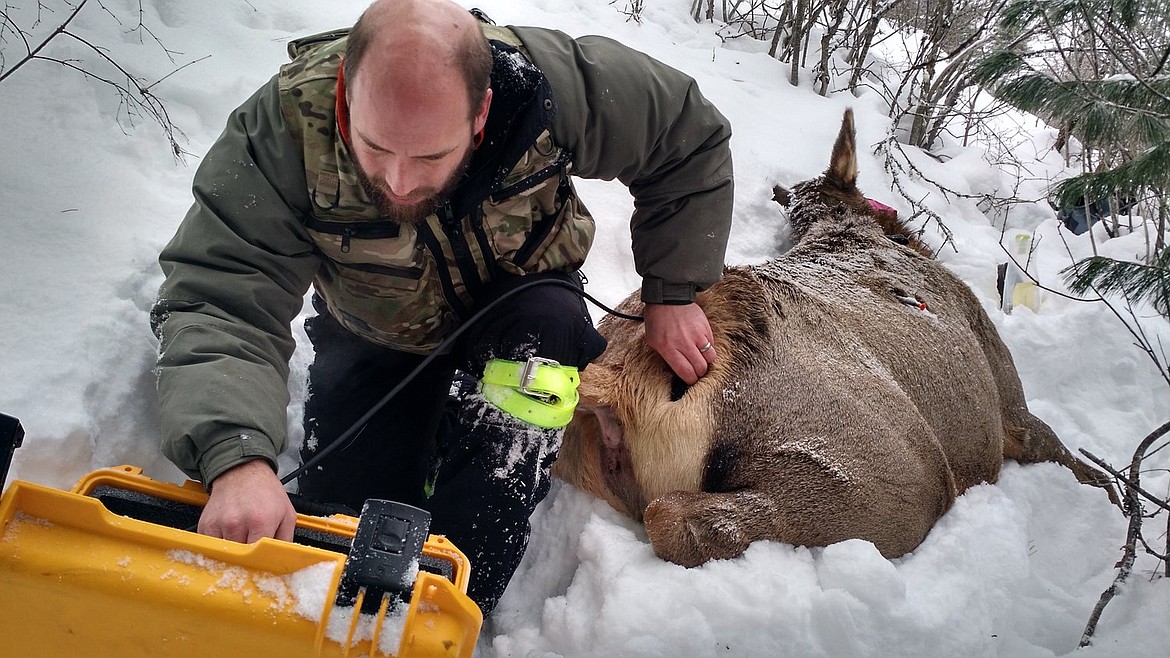
UI professor Ryan Long gathers data from a cow elk as part of a study that compares populations of woodland elk with southern Idaho's desert elk. Long was at Woodland Middle School Tuesday to interest students in biology. (Courtesy photo)

By RALPH BARTHOLDT
Staff Writer
COEUR d’ALENE — When Ryan Long was a kid growing up in small-town Oregon, he didn’t know elephants were afraid of bees.
His mom was a waitress and his dad was a firefighter. Neither had attended college, and Long was just a normal kid with normal ambitions until the day everything changed.
“I had no idea I could do this for a living,” Long, a big mammal ecologist and University of Idaho professor, told seventh-graders Tuesday at Woodland Middle School.
Like most kids, he watched National Geographic television and the Discovery Channel, but it wasn’t until college that he realized studying animals was a thing.
“That!” he said. “I have to do that!”
And he adopted it as his thing.
These days, Long spends his time between elk and wild sheep studies in Idaho, teaching at the university and flying to Mozambique to learn about antelope and elephants in Africa.
As dozens of life science students shuffled into the Woodland school cafeteria Tuesday afternoon — making themselves comfortable on the floor while Long set up a slideshow of blindfolded and hobbled wild rams and ewes, and orange-backed wapiti caught in nets that biologists fitted with radio collars — science instructor Gretchen Bell explained her method:
Inviting Long to Woodland, Bell said, is one step in the progression of helping students understand that life science is real.
It’s a way to connect with the community, and a way for students to understand that science isn’t confined to dog-eared pages between the covers of an outdated book, or inside classrooms.
“We want to create a vision for the students,” Bell said.
Part of Tuesday’s visuals were created with a GoPro.
In a short GoPro video, Long showed a biologist shooting a dart from a gun while leaning from a helicopter over a kudu running across the African savannah.
The animal sped wildly, its hooves pounding as the shadow of the helicopter, its rotors spinning, crept into the frame — and then the dart flared out toward the running kudu.
“Did you see that? The dart struck him in the left flank,” Long said excitedly as the students leaned toward the screen where the helicopter’s shadow now drifted across the frame, rotors pumping as the kudu galloped away, making its own shadow on the yellow earth.
Long answered questions from students as he clicked through slides and explained how he and his graduate students conduct elk studies in Idaho and northeastern Oregon, along with wild sheep studies. Desert elk are caught with nets shot from helicopters and equipped with radio collars, while elk in the wooded mountains are often lured into pens and darted before they’re fitted with collars and their vital signs checked and documented.
In Africa, he has studied three types of antelope — kudus, bushbucks and nyala; as well as lions and elephants.
“It’s hard to beat working with elephants,” he said.
While looking for ways to keep elephants inside the boundaries of Gorongosa National Park instead of sneaking out and raiding farmers’ crops, Long learned a couple things: Bees frighten elephants, and Mozambique grows darned hot chilis.
He has successfully employed both along park fences to either scare elephants back into the park, or to repel them from leaving the park.
“We learned to build beehive fences,” Long said. “It works really well.”
His message to seventh-graders was simple.
“If you work hard and want to do it bad enough, the opportunity exists,” he said. “Anyone can do these things.”
Student Emma Whetstone, who spent a few moments thanking Long for dropping by her class, said she plans to study science, and wants to do what Long does. Long’s presentation was inspirational, the seventh-grader said.
“It was fantastic.”