
Capital contribution
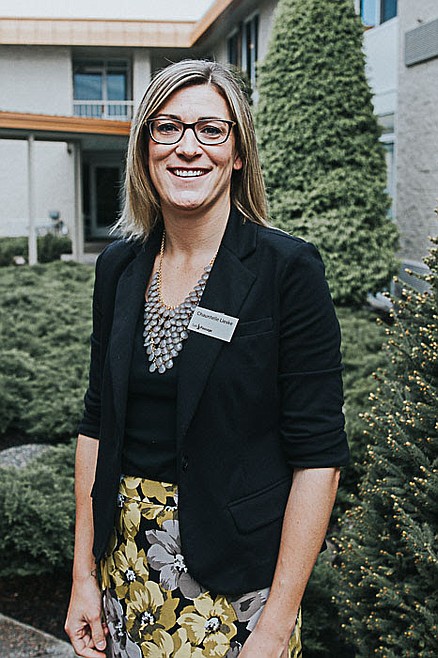
Lieske
By RALPH BARTHOLDT
Staff Writer
COEUR d’ALENE — As program director at Coeur d’Alene’s Safe Passage women’s shelter, Chauntelle Lieske had concerns not addressed in the center’s mission statement.
They were nuts and bolts naggings.
She stewed over the safety of the structures where clients were housed.
Now, as the agency’s executive director, Lieske rests easy in part because of funding provided by the city of Coeur d’Alene that helps nonprofits pay, among other things, for capital improvements.
The city awarded Safe Passage $25,028 last week as part of its Community Development Block Grant funded by the U.S. Housing and Urban Development Agency, or HUD.
The money will be used to refurbish a roof and upgrade its electrical system.
“It is an older house,” Lieske said. “It needed the upgrades.”
The money was part of $88,524 awarded to four entities including Trinity Group Homes, Inc. which received $21,333 for flooring improvements at a 16-unit group home. Children’s Village, Inc. received $24,253 for two part-time employees at its on-site youth and family counseling program, and Commonwealth Agency, Inc. was awarded $17,856 to support low-to-moderate income seniors.
The city is a conduit for the cash meant to serve its nonprofit community, but also its business and low-income community by providing money for neighborhood revitalization, economic development and affordable housing.
“While the city of Coeur d’Alene’s annual funding from HUD is modest, we’re very proud to be able to provide support for programs and services that assist some of our most vulnerable residents,” Mayor Steve Widmyer said.
The vulnerable residents that Lieske worked with daily were women and children, abused, battered, and fearing for their well-being.
A few years ago, as the agency’s program director, Lieske feared that the old, brittle wiring of the electrical system in the safe house was unsafe.
And there was the issue of a questionable roof.
“We averaged 180 to 200 people through there a year,” Lieske said. “And they had kiddos.”
Providing a shelter, Lieske felt, was one thing. Providing a shelter that was structurally safe was another.
Recently she was apprised that the roof at the safe house had sprung a leak.
“Guess what?” She happily replied. “We’re getting a new one.”
Council member Dan English, who is active in the local nonprofits, said the city’s recent allocations are a rock-solid investment in the community.
“It’s not very sexy to go out and raise money for ... patching the roof and putting in new flooring,” English said. “Those capital funds can be hard to come by and I do believe this is exactly what these Community Development Block Grants are for.”
Michelle Cushing, the city’s block grant administrator, said the city received $1,496,245 through the block grant program over the past five years. The money, allocated incrementally year by year, is based on a five-year plan the city submits to the federal government that outlines where it plans to focus resources.
The latest allotments were part of the 2017 distribution, and public comments are being considered for a draft plan for the next five years. The City Council will review the plan (which is published on the city’s website) at next week’s council meeting.
A public hearing on the five-year plan is also set for the council meeting. And the council will review an action plan for 2018 funding.
“We have to have this plan in place to guide funding,” Cushing said. “It’s where we suggest funding should go based on the assessment of need.”
To Lieske, the block grant money is integral because most of the funding her group seeks cannot be used for capital improvements.
“It’s a huge relief,” she said. “It’s really hard for us to raise that kind of money.”