
It's T-time for Commerce leader
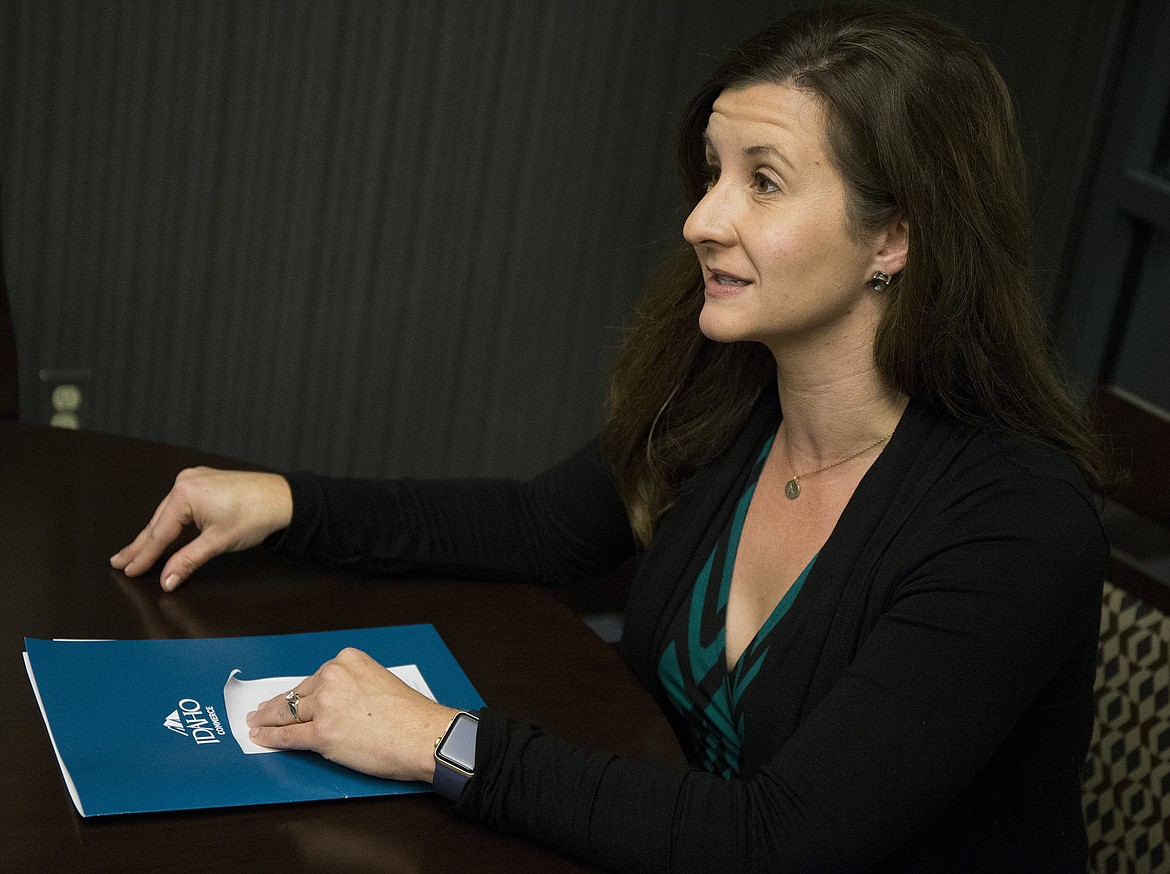
LOREN BENOIT/Press Megan Ronk, director of the Idaho Department of Commerce, speaks with the Press about tourism, taxes and legislation.
COEUR d’ALENE — Tourism, trade missions and tax policy form a trifecta of opportunities for Idaho growth, according to the state’s commerce boss, Megan Ronk.
Ronk, who was appointed director of the Idaho Department of Commerce by Gov. Butch Otter in January 2016, is in Coeur d’Alene for the annual Idaho Conference on Recreation and Tourism. In a visit Tuesday with The Press editorial board, Ronk touted the state’s burgeoning tourism industry, but also chatted about other important programs and priorities.
TOURISM
A subject that’s intimately familiar to Kootenai County residents, it’s a little less so in other parts of the state. Hence the annual convention, which continues at The Coeur d’Alene Resort through Thursday.
“Tourism is Idaho’s third largest industry in terms of impact to GDP, and it’s often forgotten,” Ronk said. “But tourism is a significant driver in many communities throughout Idaho in places like Coeur d’Alene, which is well known, but also smaller communities like up in the Silver Valley, where tourism has become a really important industry.”
Using the state’s 2 percent lodging tax as a measuring stick, Ronk said tourism is tracking about 14 percent year-over-year growth statewide — and that’s not an aberration.
“That [growth] has continued over the past several years — 12, 13, 14 percent growth,” she said. “Tourism is extremely strong, and we’re just looking for new ways to market to those likely targets that can make it in a day’s travel to Idaho.”
In the friendly crosshairs are families, particularly families who can drive here in a day or catch a direct flight to somewhere like Boise or Spokane. And the state’s marketing efforts are working. In Ronk’s view, they’re working wonders.
She lauded the state’s recent tourism campaign called “18 Summers,” which just won a prestigious award in Florida, beating out 350 competitors nationwide. That’s especially rewarding because Idaho doesn’t throw money at marketing.
“Compared to even Montana and Wyoming, we have a pretty limited budget for tourism promotion,” she said. “We’re really getting a lot of bang for our buck.”
Ronk said she’s looking forward to increasing focus in an area called culinary tourism, which is gaining momentum in Idaho.
“That’s obviously an area where we have great strength with our history and heritage in agriculture,” she said. “There’s a lot of curiosity about ag and where food comes from, and we’ve had a lot of growth in our wine and craft beer industry, as well.”
TAXES and LEGISLATION
Looking forward to the next legislative session, Ronk said there are two key commerce-related targets involving taxes.
One is the Idaho Small Employer Incentive Act, which has been around since the early 2000s.
“It provides a series of tax incentives [including property tax and sales tax exemptions] for companies that create 10 or more jobs, so it makes it very applicable to companies in smaller communities,” she said.
Ronk said that program expires in 2019, so she’s hopeful the Legislature will extend it an additional 10 years.
The other tax incentive proposal involves huge farms, but not the agricultural variety.
“We’ve had a significant amount of interest from large-scale data centers interested in locating in Idaho,” she said of the massive data storage “farms” owned by tech giants like Apple, Google, Amazon and Facebook. “We have pretty much the perfect environment: competitive power rates, really low environmental risks (like hurricanes and tornadoes), and our climate is generally pretty ideal to be able to take advantage of the free cooling in the summer months, where they pull in ambient air in the evening to help lower their power costs.”
Ronk said some legislators opposed the proposed bill last session — it cleared the House but died in the Senate — because data centers aren’t necessarily huge job creators. Ronk argues that the companies provide substantial capital investment — Iowa just landed a $1.2 billion Apple project — and while they might create “only” 75 to 100 jobs, “they’re really good-paying jobs, like $75,000-plus. My argument is that as we continue to diversify Idaho’s economy... I think it’s a smart move to bring in industry that’s going to have a great impact on our state and local economy without being a significant drain on our existing workforce.”
The problem is, Ronk said, that about 30 other states offer a sales tax exemption, rebate or have no sales tax on the equipment these data centers use.
“We’ve had a lot of interest, but when they start running the numbers, we’re not competitive,” she said. “So we’re bringing forward legislation to provide a rebate on the sales tax for equipment within a data center.”
Ronk said North Idaho could benefit.
“I think North Idaho is definitely a part of the state that could recruit some of these companies to be part of the local economy, especially with close proximity to Spokane and a major airport,” she said.
TRADE MISSIONS
The optimistic Ronk is also a passionate advocate of trade missions that send Idaho government and business leaders to targeted partners outside the U.S. Next month, Ronk and Scott Bedke, speaker of the Idaho House, will lead a trade mission including 17 Idaho companies to Taiwan and Vietnam.
In June, Gov. Otter and Ronk led a delegation of 11 Idaho aerospace companies to an industry-specific international trade show in Paris. Several North Idaho companies participated, Ronk said, and the state-sponsored pavilion there made the venture more affordable for the whole group.
“It allowed us to market Idaho as a place where there’s a lot of exciting things happening in the aerospace industry,” Ronk said.
She said trade missions are excellent opportunities for established and even new businesses with products or services to export to reach new markets. Some grants are available to help businesses offset their costs.
Information: https://commerce.idaho.gov/