
BECOMING HUMAN
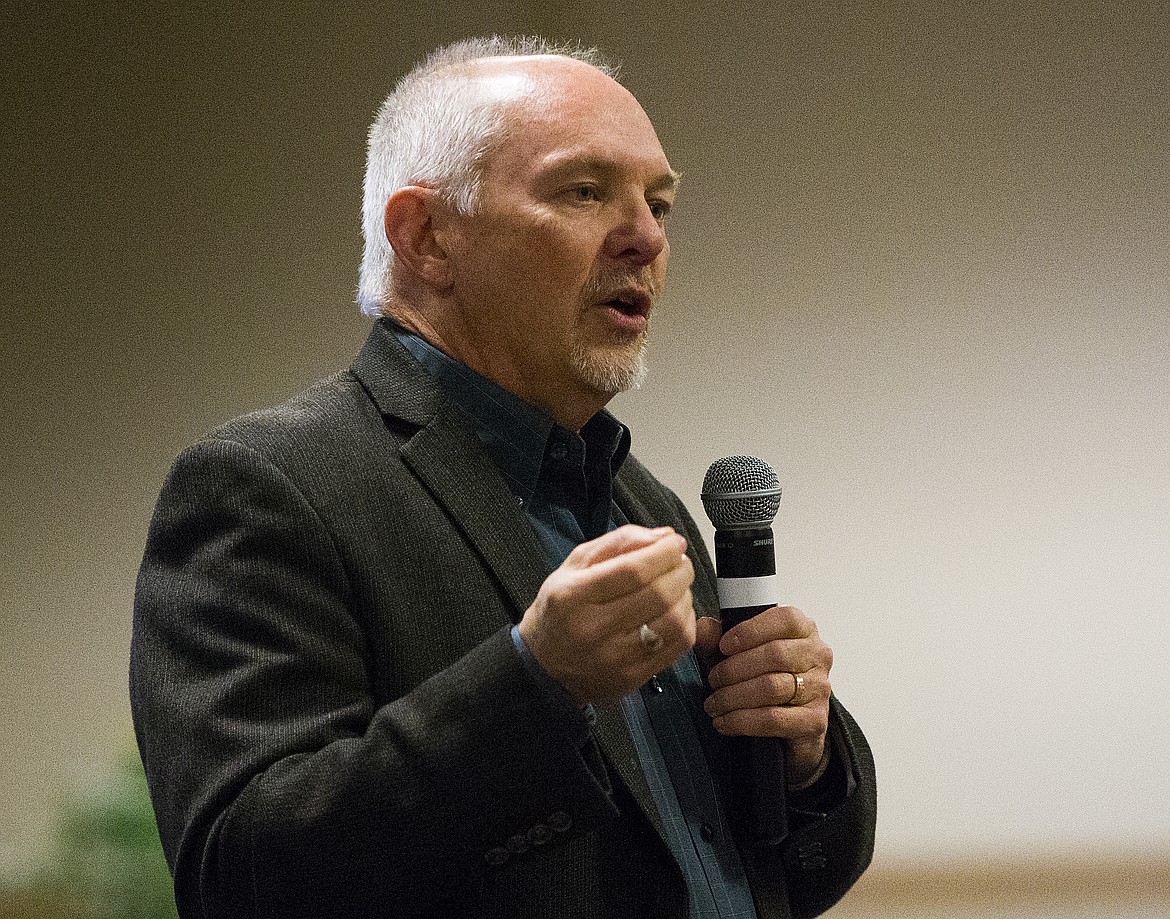
LOREN BENOIT/Press Author Paul Young, who wrote “The Shack,” speaks about integrity, both in the workplace and in relationships, at the State Financial Officers Foundation national fall meeting Wednesday morning at The Coeur d’Alene Resort.
By DEVIN HEILMAN
Staff Writer
COEUR d’ALENE — In the world of numbers and finances, it's easy to slip into an isolated mentality.
"We get so siloed in dealing with all of the numbers and tax policy and budgets," said Derek Kreifels, president of the State Financial Officers Foundation.
That’s why SFOF officials brought in William Paul Young, author of "The Shack: Where Tragedy Confronts Eternity," to speak to about 80 of its members during the SFOF's annual fall convention in The Coeur d'Alene Resort during a morning session Wednesday.
Young's best-selling book explores religion in a world filled with pain, mirroring Young's own soul-shattering struggles, deep questions and enlightening insights. His presentation, titled "Higher Level of Integrity in the Workplace," delivered a powerful message of what it means to be human.
"Integrity is basically when your inside world and your outside world are coherent," he said. "Wholeness, being fully human and alive, being a whole person, is when the way of your being matches the truth of your being."
Young, a Canadian, grew up as a missionary kid in the highlands of New Guinea. It was a beautiful experience and it had a wonder to it, he said, but his unique childhood experience contributed to his lack of sense of belonging.
His relationship with his father was never as close as it could have been. His father experienced a lot of hurt in his own life, which had "broken his capacity for being a father before I even showed up," Young said.
Young opened up to even deeper, darker places in his past. He spoke of sexual abuse he suffered as a little boy, which began at a very young age and continued when he was sent to missionary school at the age of 6.
“If we’re talking about integrity, if we’re talking about things that break our capacity to actually live what is the truth of our being, what sexual abuse will tell you about the truth of your being, it will tell you is all you are is a piece of s***, that you’re worthless, and then you’ve got theology that comes along and says God thinks the same thing about you," he said, adding that his relationship with Jesus helped because he viewed Jesus as the bridge between a God he felt didn't like him and his desperation to escape eternal fury.
Later in his life, after hiding his shame and dark secrets behind a façade, Young shared that he had an affair that took 11 years of healing for he and his wife to finally be OK.
"My whole world came crashing down," he said, describing the moment she called him to let him know she knew. "At that point I had to make a decision whether to face her or kill myself. Killing yourself is the last way to run away before you hit the bottom. It’s not hitting the bottom; it’s the last way to run.”
He said they spent four hours in his office while she tore him apart.
“I couldn’t look up. Actually, I couldn’t look up for over a year," he said. "One thing shame does to you, you can see it in people where they just can’t see you or look you in the face."
All of the shame, the secrets, those painful human experiences, led Young to write "The Shack" as a story for his children to help them understand what was going on in his mind and heart.
"I had to work through a lot of things. (Protagonist) Mackenzie’s weekend in the shack represents 11 years of deconstructing and rebuilding for me," Young said. "The shack is the house on the inside that people help us build."
He said for some, their "shack" has been built by loving, encouraging people.
"But a lot of us, we did not get good help building the house on the inside, and it becomes a shack, a place you can't even live inside and you definitely don’t want to invite anybody there," he said. "That’s where you store your addictions, you hide all your secrets. That’s where everything gets covered up. It’s a place of shame, a place of lies, and you learn to spin the truth to cover up the fact that the inside is all broken down."
Young sincerely shared all of this without hesitation, demonstrating that "the cost for authenticity feels monumental, but the cost for hiddenness and aloneness is multiple times more devastating."
"This is my encouragement to you,” he said, looking around the room. "You’re in a place where people look to control because finances and money are the way we control when we don’t want to take the risk of relationship. You’re in the spotlight, you’re right there. I'm saying, do the work to be people of integrity, and God will show up in the middle of all of your humanity to love you, to love those around you, to love the world."
SFOF’s mission is to promote fiscally responsible public policy, partner with key stakeholders and educate the public about the role of finance in a free market economy. Kreifels said Young's speech is an encouragement to its officers to "humanize the financial industry" and remind them to have meaningful relationships with people in the private sector and other officials who might not always agree with them.
"We’re a divided nation right now. The pendulum swing is drastic, and so our hope is that we can impress on this group that through relationships and the blame, that’s how we’re going to solve some of the state’s biggest financial issues," he said. "There's an application for allowing people to get to know you, and his point that we’re not created to be alone, we’re created to be relational, transcends whether you believe in God or not.
"The point is, we all need each other," Kreifels said. "In this time when the world feels like it’s falling apart, it’s really nice to have a friend.”