
March Madness, missed work - and money
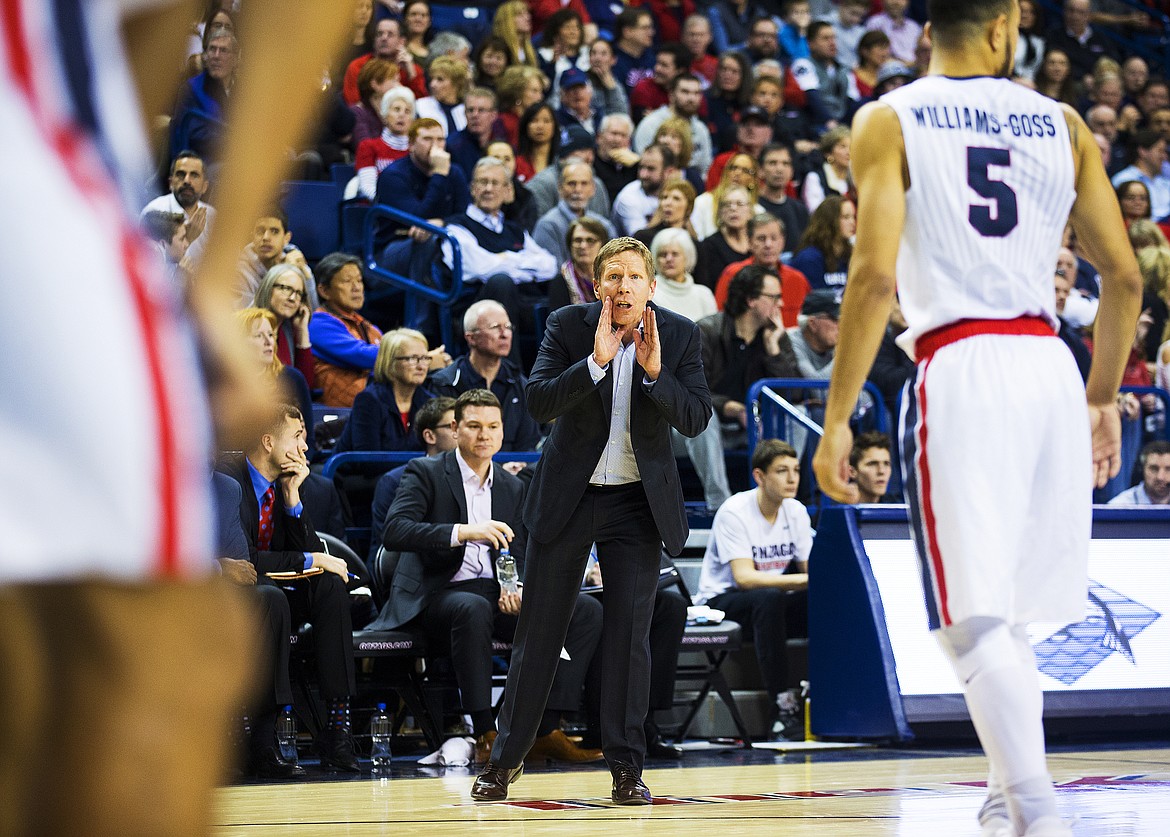
Gonzaga coach Mark Few shouts instructions to his players during a game against Saint Mary’s on Jan. 14. Gonzaga faces South Dakota State, Thursday, in the first round of the NCAA Tournament. LOREN BENOIT/Press
By STEVE CAMERON
Staff Writer
It’s not your imagination, nor just a wild guess.
March Madness, the artist formerly known as the NCAA men’s basketball tournament, will cost American businesses a bundle of money in lost productivity.
Chicago-based Challenger, Gray & Christmas, Inc., the world’s oldest employment outsourcing firm, recently conducted a study to see how much potential income actually could disappear between now and the end of the tournament on April 3.
The conclusion: $1.3 billion.
Not so bad, you say, in this age of gigantic numbers in corporate profits and massive government spending.
Well...
The report is referring to $1.3 billion PER HOUR in employee distraction.
As the late Sen. Everett Dirksen of Illinois once said: “A billion here, a billion there. Pretty soon we’ll be talking about real money.”
In fact, this loss of productivity during the NCAA basketball tournament is very, very real.
So is there any silver lining to this national obsession?
Maybe.
But let’s start with the big numbers: The American Gaming Association estimates 40 million people will fill out 70 million tournament brackets, with an average wager of $29 per bracket.
Then there are the 51 million office pools that Challenger, Gray & Christmas suggest will be entered and faithfully followed during the tournament.
“Let’s conservatively assume that workers will spend at least one hour putting together their office pool brackets, and then at least two more hours streaming games during the workday on Thursday and Friday,” said Andrew M. Challenger, the firm’s vice president, in a statement accompanying the findings.
“That’s about $3.9 billion in lost wages paid to unproductive workers — just in the first week of the tournament.”
Needless to say, multiple streams on various video devices have made it easy for workers to watch all or part of several games.
“March Madness Live,” available on the NCAA and its various partners’ websites, grants subscribers access to the action over 12 platforms — a service that last year generated 80 million video streams and nearly 18 million hours of video consumption.
Those are the NCAA’s own figures, so there’s no telling what the actual streaming time might be when other services, blogs, tweets and personal interactions are toted up.
Surprisingly, perhaps, Challenger suggests employers should not fight the trend, but simply go with the flow — noting that office competitions can boost camaraderie and employee happiness.
That might seem surprising, considering the billions in lost productivity.
But Morag Barrett, CEO of Denver-based SkyeTeam — a group of employment and workforce consultants — agrees with Challenger that employers can use events like March Madness for long-term gain.
“Allowing these brackets, and embracing them, can be a major mood booster for many organizations,” Barrett told The Press. “Creating an emotional connection among team members is essential.
“It’s the secret glue that keeps people engaged and connected to their work.”
Barrett conceded she doesn’t follow basketball — she’s a soccer fan with a background living in Great Britain — but she insists a communal activity that bonds workers is obvious when she sees one.
“This is a great activity connecting people,” she said. “But it doesn’t have to be basketball like March Madness, or even a sports event.
“It could be almost anything that produces the same result as a bonding exercise — a company potluck meal, community service as a group, almost anything.”
Barrett insisted it’s clear employers are getting a message.
“You can see it now in newer office designs, where people are meant to be more engaged together,” she said. “You even notice things like ping-pong tables or other types of recreation. The last thing you want is to put people in a cubicle farm.”
Challenger seconded Barrett’s theory, adding a hint of the hard-core business decision in his statement.
“Labor markets are getting tighter and tighter,” he said, “(so) employers are better off just embracing March Madness.”
So let the hoops begin, then.
Even American business seems to be suiting up.