
Forensic artist fashions novelist career
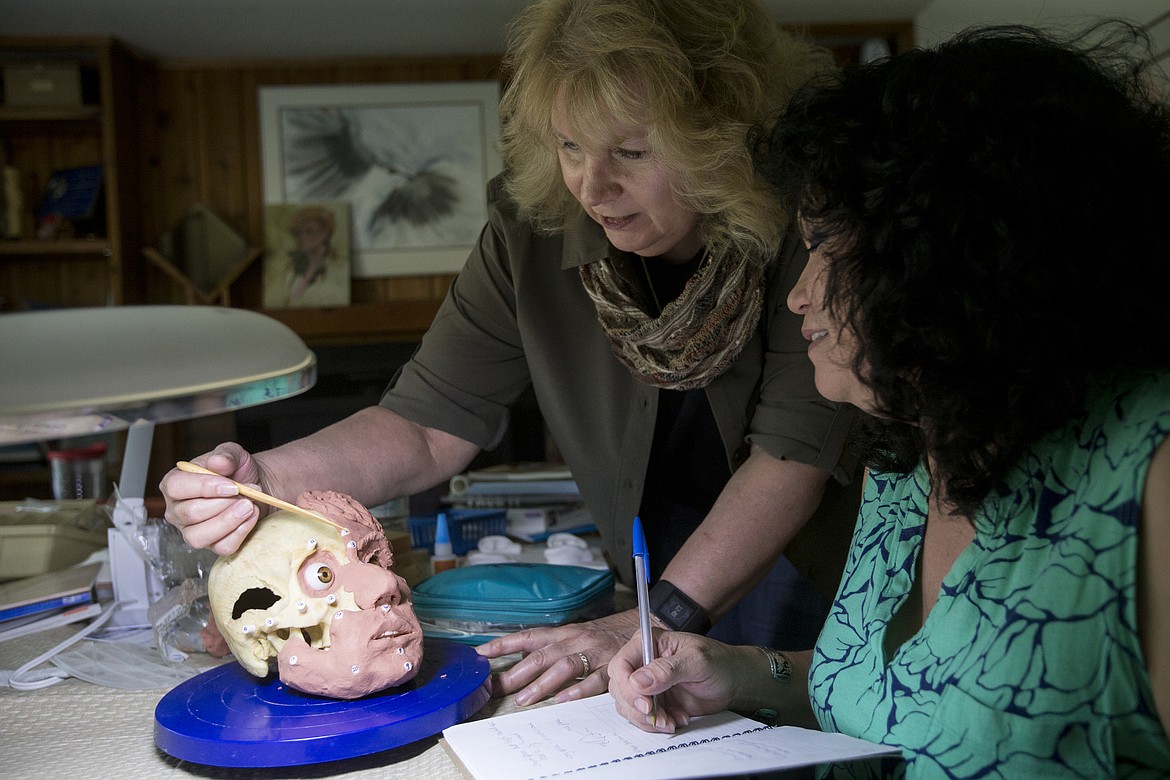
LOREN BENOIT/Press Carrie Parks helps walk through 3D face reconstruction with Dr. Sharon Moses during a law enforcement workshop held at her house Wednesday morning in Cataldo.
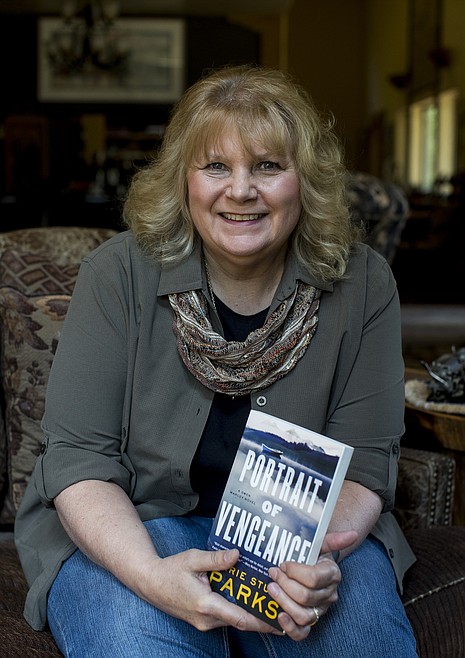
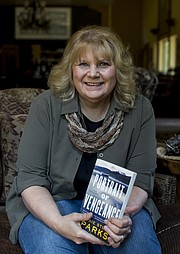
LOREN BENOIT/PressCarrie Stuart Parks’s newest pulse-pounding novel, Portrait of Vengeance, is inspired by at least four different cases she recently worked on as a forensic sketch artist. A resident of Cataldo, Idaho, she also teaches workshops to FBI agents, Secret Service agents and law enforcement offices across the county.
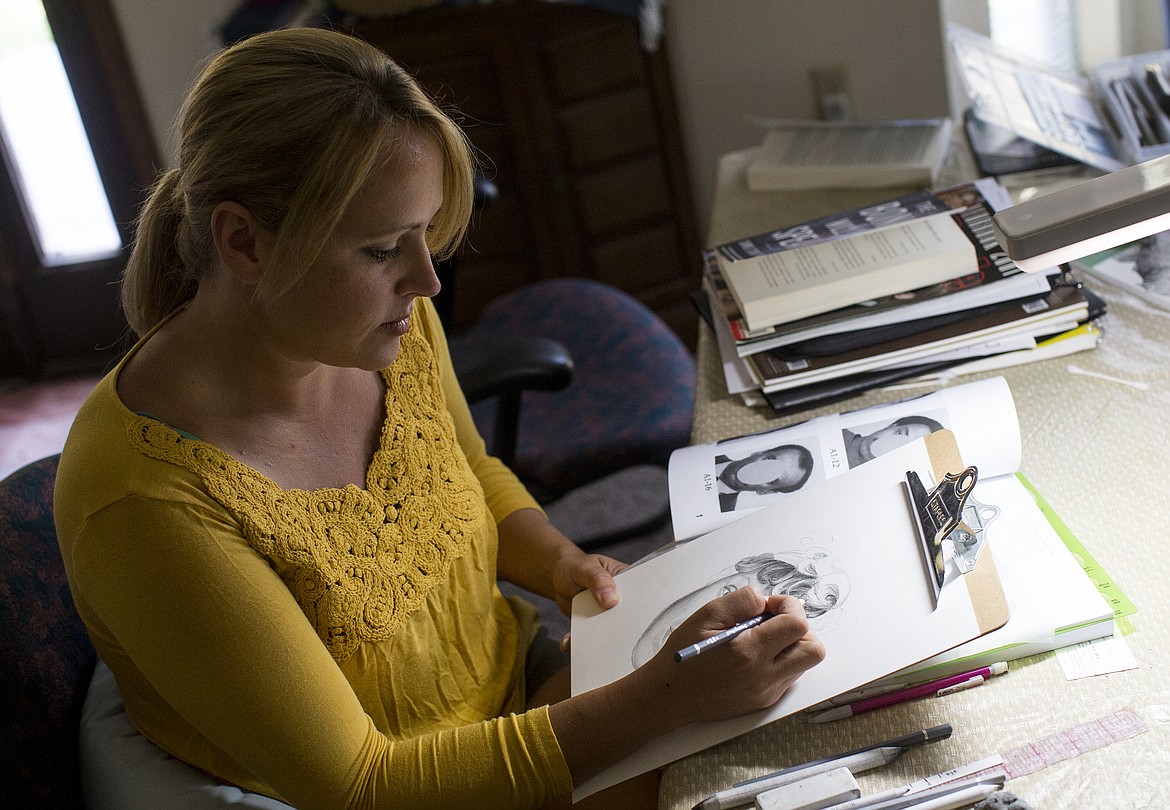
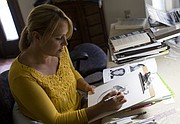
LOREN BENOIT/PressAmanda Jay, a detective with the DeSoto Police Department in DeSoto, Texas draws a practice sketch during a law enforcement workshop at Carrie Parks' home Wednesday morning in Cataldo.
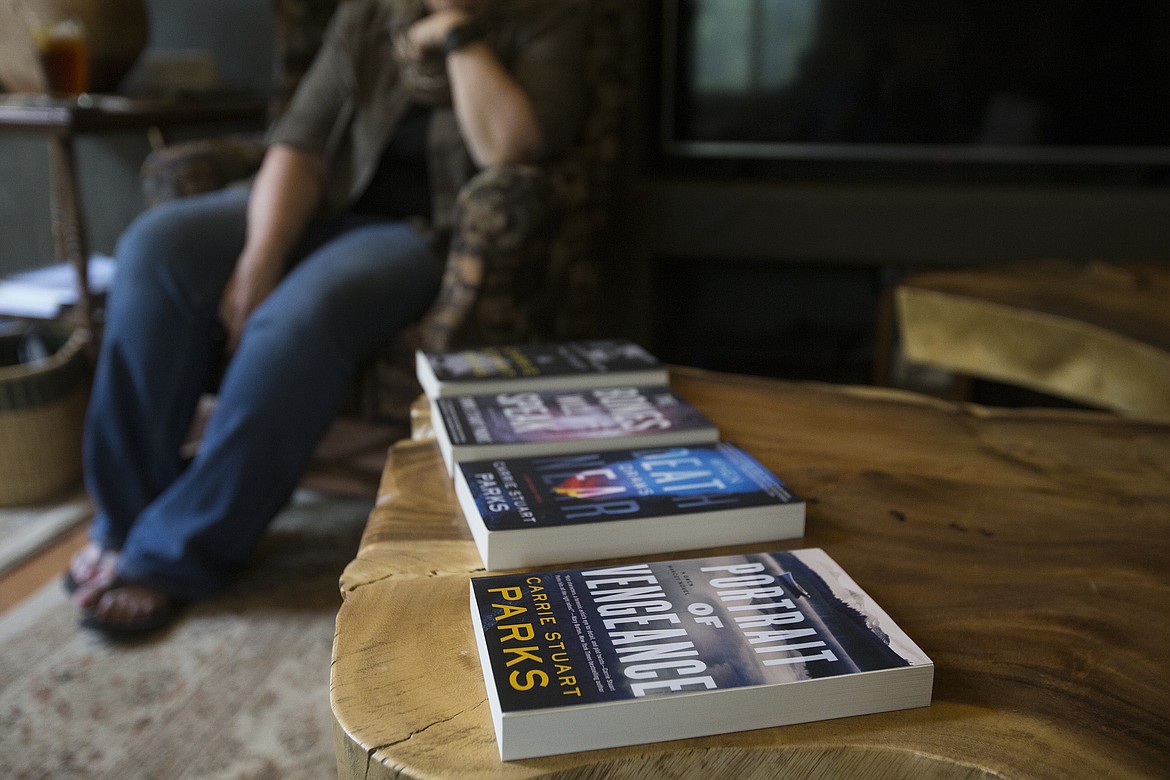
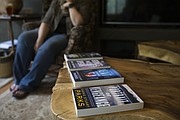
LOREN BENOIT/PressParks loosely uses the cases she works on to create the high-intensity stories in her Gwen Marcey series. ”Portrait of Vengeance” is the fourth book in the series.
By DEVIN HEILMAN
Staff Writer
CATALDO — Plaster skulls half-covered in clay lie among sketch books, paintbrushes and other art supplies on a table in Carrie Stuart Parks' studio.
One skull has an empty socket and a lifeless replica eyeball staring from the other, waiting for its face to be completed.
From skeletons and missing persons to catching bad guys, it's all part of Parks' work as a forensic artist, a career in which she thrives.
"I definitely fell in love with it," she said Wednesday, seated next to her Great Pyrenees, Elphie, in her Cataldo home.
Parks, 65, has spent more than 35 years in the field of forensic art. She has assisted with some major cases, including when a Spokane County Sheriff's deputy killed his wife in 1997 over insurance money and when the white supremacy group known as the "Phineas Priesthood" bombed and robbed places in Spokane in ’96.
"I’d drawn them so many times, I was just dying to see what they looked like by this time," Parks said, describing what it was like to be in the courtroom when a few of the Phineas priests were arraigned.
“The first guy that walked in, I looked at him and I literally went, ‘YES!’” she said. “But normally, you don’t get that kind of feeling of, ‘Oh wow, it looks like him, yay!' When it’s close it’s a rush, but a lot of times you don’t even know how (the sketches) are used.”
Composite sketches, facial reconstruction, courtroom exhibits and measuring crime scenes are some of the tasks of a forensic artist. Parks got into the field when her dad, Ned Stuart, was the director of the North Idaho Regional Crime Lab.
"Around 1980, he wanted to teach his students this really new thing called 'forensics,'" Parks said, smiling. "He asked if I would help prepare trial charts, initially. His idea was to take Elmer's Glue-All and a hunk of cardboard, so I prepared them correctly."
Parks, a Kellogg High School and Lewis-Clark State College graduate, trained at the FBI Academy. That's where she met her husband, Rick, a top artist for the FBI, as her own forensic art skills were refined.
"It was very exciting," she said. "I took that class and it was actually only the second one they'd ever taught."
And now, the student has become the teacher.
"I actually taught the FBI," Parks said. "Ten years after I took their class I taught them, and the Secret Service."
Parks and her husband travel across the United States and Canada teaching forensic art to law enforcement agencies. Parks said many times, sketching and other forensic tasks are conducted by detectives or those who already have law enforcement or court jobs, but she is one of very few freelancers.
"There are probably less than 20 forensic artists across the U.S.," she said.
In 1987, a detective who was an artist approached her to teach him what she knew about her craft.
“I thought, ‘Well, if you do what I’m doing, I’m not going to do what I’m doing because you’re doing it,’” she said with a chuckle. “Then I thought, ‘Well, maybe I would be more effective teaching it,’ because there are only so many cases I could work.”
That year she went to North Idaho College to offer a two-week forensic art course.
"I was hooked on teaching it," she said.
This fascinating career comes after a lifetime of being an artist. Parks said she has been artistic since she was a child and the talent runs in her family.
"My great-grandmother was an artist, my grandmother, my great-uncle," she said. "My dad couldn’t draw blood with a knife and my mother couldn’t draw her own conclusions, but I got the art."
Her artistic talent and experiences have also led her to another skill — writing. Parks has authored several "how-to" books about drawing and watercolor. And she recently delved into the world of fiction, using cases she worked on in her forensic art experiences to create award-winning mystery suspense novels. She was also mentored by New York Times best-selling author Frank Peretti.
Her fourth novel, "Portrait of Vengeance," will be released Tuesday.
"'Portrait of Vengeance' is about a double-homicide in Lapwai on the Nez Perce Reservation," she said. "It goes into the American Indian Movement from the 1970s."
Parks is published through HarperCollins Christian Publishing, so her books don't contain gratuitous sex or foul language. Although "Portrait of Vengeance" is the fourth in a series that follows protagonist Gwen Marcey, a forensic artist, Parks said the books can be read out of order or as standalones.
Her novels are about strong belief systems; her first book, "A Cry from the Dust," is about "fundamentalist Mormons and their end-times scenario," she said.
Her second book, "The Bones Will Speak," involves the Phineas Priesthood. Book three, "When Death Draws Near," explores the dark side of eastern Kentucky Pentecostal Appalachian snake-handlers.
Each book includes Parks' extensive and diligent research, from historical information to modern times. She even visited a snake-handling church to ensure her details were accurate for "When Death Draws Near."
"I like the strong belief system and how that comes into conflict with other things," she said. "I try to present things from (the subject's) standpoint, then I let the reader decide if that's sane or logical. There's not a judgment from my character. The reader forms their own decision."
Parks is already writing more books in her head and has one more she just submitted Tuesday. She'll be going to South Carolina and Calgary to teach forensic art to more police officers and just this week had students sketching and reconstructing faces in her studio at home.
"I can teach anyone to draw, unless they’re dyslexic. Then it’s really hard for them. But you have to practice, because it’s a perishable skill,” she said. "You really have to devote your time to it."
Parks' books are available at The Well-Read Moose in Coeur d’Alene and through companies such as Amazon and Barnes and Noble.
Info: www.carriestuartparks.com