

Looking back on training Iraqi Army
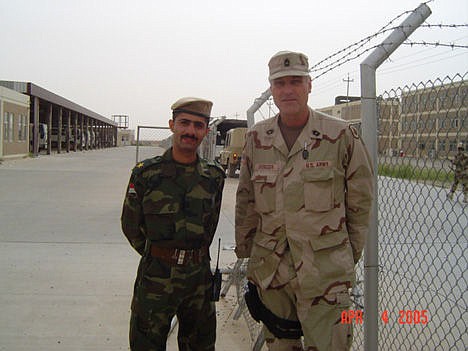
<p>Master Sgt. Jack Evensizer with Second Lt. Ali of the Iraqi Army.</p>
This September marks the 10th anniversary of my return from Iraq in 2004 to 2005. Being deployed as a cross level soldier to the 98th Division, now headquartered at Fort Benning, Ga., we were tasked with a historic mission to train the Iraqi Army.
Training of a foreign army is the mission of Army Special Forces, and since the teams were engaged in Afghanistan, the Philippines, Iraq and other unnamed locations around the world, the Army created a training mission to meet the deadline of combat training for the final three Iraqi Battalions to complete the new Iraqi Army. The Army tasked the 98th, which provided cadre for West Point Military Academy, to assemble a force of some 700 senior officer and senior enlisted combat arms soldiers to deploy in 10-man adviser teams to align with battalion, brigade, and division level officers.
I call us the "old dogs," and as an infantry Master Sergeant, I was assigned as an adviser to an Iraqi infantry company, commanded by Second Lieutenant Ali, a recent Iraqi Military Academy graduate. We were part of Iraq's 3rd Division at Al Kisik, a northwest Iraqi Army base near the Rabiah border crossing with Syria. I think the hardest part of the mission was teaching the Iraqi soldiers to fire single, well-placed shots with their AK-47, and not shoot in full auto, which burns 30 rounds in less than 5 seconds. If you run out of ammo in a firefight you will be in deep doo-doo!
Concurrently, and on its own mission, Idaho's 116th Cavalry Brigade deployed in 2004-2005 to the oil-rich northern city of Kirkuk and conducted combat operations in a very dangerous area. The soldiers conducted a "full spectrum of operations" in the area, to include training for the Iraqi Army and police, and stabilizing the region for national elections held in late January 2005. My friend Tom Irby, a combat engineer, deployed with the brigade and told me they were tasked with route clearance, arguably one of the most dangerous missions in any theater of war. The brigade redeployed to the United States in November 2005, and was redesignated as the 116th Cavalry Brigade Combat Team. They deployed again on another combat rotation for a "Force Protection" mission in Iraq for "Operation New Dawn" in 2010-2011.
Staff Sgt. Tom Irby was stationed at FOB (Forward Operating Base) McHenry, whose higher HQ was FOB Warrior. One of our Humvees went down and was towed to Warrior so Tom may have been the guy to get us back in the war. Irby took on a lot of first sergeant responsibilities and was the mayor of the FOB, responsible for maintenance and supplies. I asked him if he saw action, and being a humble man of few words, he said: "Not really. Just incoming arty (artillery), IEDs, and small arms fire." In my experience, he and his troops were in a pretty dangerous situation. Tom retired in 2007, spending 22 years in the Idaho Guard since 1985.
Our 116 CAV and Hayden's 455th Engineers have each deployed twice. Now, the tempo of deployments has slowed due to withdrawal of troops from Iraq and Afghanistan, but the military mission is not over. There are thousands of troops deployed around the world and all have families and friends here at home who support them.
The military fully supports family readiness groups, and families know that deployment is truly a team effort and that they are in it as much as those in combat. With peace of mind that your family is cared for, those in harm's way can concentrate on the mission. So I say THANK YOU to the families, friends, neighbors, employers, and all that support those on deployment. Please give our troopers the support they deserve so they can "get 'er done" and come home safely.
Jack Evensizer is a resident of Dalton Gardens.