
Opinion: Respect for our prey
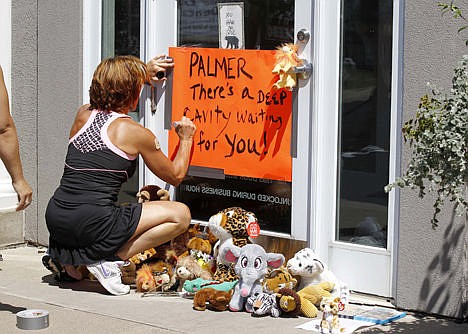
<p>A woman writes on a sign outside Dr. Walter James Palmer's dental office in Bloomington, Minn., July 29. Palmer reportedly paid $50,000 to track and kill a black-maned lion, just outside Hwange National Park in Zimbabwe.</p>
The recent outrage against Dr. Walter Palmer, the lion assassin, was followed by titillating media focus on Sabrina Corgatelli, the big game hunter from Idaho.
Ms. Corgatelli was pictured with a dead giraffe, kudu, and warthog in South Africa. She is reportedly an excellent shot with her Winchester; and there seems to be nothing unlawful about her recent African excursion.
Who's next in the crosshairs? A jackrabbit hunter from Arco? A squirrel killer from Ammon? Dr. Palmer has gone to ground. Ms. Corgatelli has unapologetically pushed back.
We need perspective. This can't be about killing animals as such. We humans are the alpha predators on planet Earth (anthropologists use the term "apex predator"). Farm animals are our former prey, tamed into a symbiotic relationship with us. We kill animals all the time. Why this outrage?
Our fellow mammals, especially the furry ones, are almost universally perceived as cute, unless, of course, you are running from one. Cuteness confers a survival advantage for young mammals. It is one thing to kill a dog. But a puppy?
What about our innocent water-dwelling friends? When was the last time anyone went ballistic about a cruel dentist abusing a fish? The message seems to be: Fish all you want, but don't mistreat furry mammals! Our sympathy for whales is thin. Fur matters.
Something essential is missing from this discussion: the ancient traditions of predator reverence for and conservation of prey. That tradition is alive, well and relevant.
Wyoming poet and writer Gretel Ehrlich ("The Solace of Open Spaces," "This Cold Heaven: Seven Seasons in Greenland") lived with an Inuit tribe in Greenland and wrote movingly about the tribe's respect, sorrow and gratitude when they needed to sacrifice a large mammal to feed and clothe themselves.
Almost nothing was left to waste. Deep respect (even reverence) for prey remains a common thread among Native American spiritual practices, and is prevalent among the older natural hunting traditions.
We still hear versions of that ethos expressed among the better hunters here in the West ... although with a bit less sentimentality. We can even hear the echo of the prey-conservation spirit among the hog packers of early Chicago: "We use everything except the squeal."
When the wolf population gets out of scale, hunters are enlisted to bring the numbers back in balance. Elk hunters tend to go for the older males, a practice that does not threaten the herd's survival.
It seems we intelligent predators have an important function: keeping the prey-predator ecological relationship in balance. I personally believe that the biblical injunction that we humans have dominion over the animal kingdom means the dominion of a caretaker, not of a serial sport-killer.
I'm not repelled by hunters, whether African big game hunters or Idaho deer hunters. But I am offended by the cavalier hunting practices of some of the wealthy trophy hunters. Their profound disconnection from the honorable and ancient hunting traditions is shameful; and it unfairly tarnishes the reputation of honorable hunters everywhere.
Send your thoughts about this or any other issue related to outdoor sports in North Idaho to [email protected].