

World/Nation
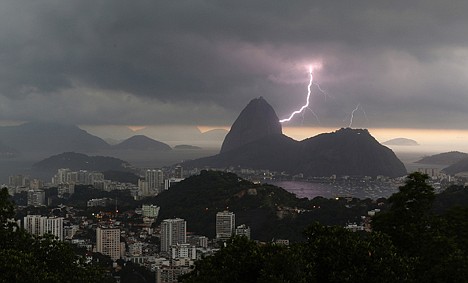
<p>Lightning lights up the the sky over Sugar Loaf mountain in Rio de Janeiro, Brazil, Thursday. An alert was called by Rio authorities due to heavy rains and the possibilty of floods in the city.</p>
• Senate passes $1.1 trillion spending bill
WASHINGTON - Congress sent President Barack Obama a $1.1 trillion government-wide spending bill Thursday, easing the harshest effects of last year's automatic budget cuts after tea party critics chastened by October's partial shutdown mounted only a faint protest.
The Senate voted 72-26 for the measure, which cleared the House a little more than 24 hours earlier on a similarly lopsided vote. Obama's signature on the bill was expected in time to prevent any interruption in government funding Saturday at midnight.
The huge bill funds every agency of government, pairing increases for NASA and Army Corps of Engineers construction projects with cuts to the Internal Revenue Service and foreign aid. It pays for implementation of Obama's health care law, a fight over implementing "Obamacare" sparked tea party Republicans to partially shut the government down for 16 days last October.
Also included is funding for tighter regulations on financial markets, but at levels lower than the president wanted.
• Supreme Court considers right to search cellphone
WASHINGTON - The Supreme Court decided 40 years ago that police don't need a search warrant to look through anything a person is carrying when arrested. But that was long before smartphones gave people the ability to take with them the equivalent of millions of pages of documents or thousands of photographs.
In a new clash over technology and privacy, the court is being asked to resolve divisions among federal and state courts over whether the old rules should still apply in the digital age.
The justices could say as early as today whether they will hear appeals involving warrantless cellphone searches that led to criminal convictions and lengthy prison terms.
There are parallels to other cases making their way through the federal courts, including the much-publicized ones that challenge the massive collection without warrants of telephone records by the National Security Agency. Though the details and scale are far different - searching a single phone for evidence that could send someone to jail versus gathering huge amounts of data, almost all of which will never be used - In both situations the government is relying on Supreme Court decisions from the 1970s, when most households still had rotary-dial telephones.
• Execution by lethal injection takes 25 minutes
LUCASVILLE, Ohio - A condemned man appeared to gasp several times and took an unusually long time to die - almost 25 minutes - in an execution carried out Thursday with a combination of drugs never before tried in the U.S.
Dennis McGuire's attorney Allen Bohnert called the convicted killer's death "a failed, agonizing experiment" and added: "The people of the state of Ohio should be appalled at what was done here today in their names."
An attorney for McGuire's family said it plans to sue the state over what happened.
McGuire's lawyers had attempted last week to block his execution, arguing that the untried method could lead to a medical phenomenon known as "air hunger" and could cause him to suffer "agony and terror" while struggling to catch his breath.
McGuire, 53, made loud snorting noises during one of the longest executions since Ohio resumed capital punishment in 1999. Nearly 25 minutes passed between the time the lethal drugs began flowing and McGuire was pronounced dead at 10:53 a.m.
Vatican grilled by UN rights panel over abuse cases
• GENEVA - After decades of accusations that its culture of secrecy contributed to priest sex abuse, the Vatican was forced for the first time Thursday to defend its record in public and at length.
In a stuffy U.N. conference room before an obscure human rights committee, the Holy See was interrogated for eight hours about the scale of abuse and what it was doing to prevent it.
The Vatican was compelled to appear before the committee as a signatory to the U.N. Convention for the Rights of the Child, which requires governments to take all adequate measures to protect children from harm and ensure their interests are placed above all else.
The Holy See was one of the first states to ratify the treaty in 1990, eager to contribute the church's experience in caring for children in Catholic schools, hospitals, orphanages and refugee centers. It submitted a first implementation report in 1994, but didn't provide progress assessments for nearly two decades, until 2012.
• Manager prays, is spared in store shooting
ELKHART, Ind. - The manager of an Indiana grocery store where a shopper and employee had just been fatally shot was on his knees in front of the gunman and appeared to be praying when police entered, catching the shooter's eye and giving the manager enough time to run.
That split-second diversion likely saved the manager's life and enabled police to chase down Shawn Walter Bair and kill him Wednesday night before anyone else in the Martin's Super Market was harmed.
With the gunman distracted, the manager ran down a store aisle.
• Google's contact lens glucose monitor prototype could end finger pricks for diabetics
MOUNTAIN VIEW, Calif. (AP) - Google unveiled Thursday a contact lens that monitors glucose levels in tears, a potential reprieve for millions of diabetics who have to jab their fingers to draw their own blood as many as 10 times a day.
The prototype, which Google says will take at least five years to reach consumers, is one of several medical devices being designed by companies to make glucose monitoring for diabetic patients more convenient and less invasive than the traditional finger pricks.
The lenses use a minuscule glucose sensor and a wireless transmitter to help those among the world's 382 million diabetics who need insulin keep a close watch on their blood sugar and adjust their dose.
The contact lenses were developed during the past 18 months in the clandestine Google X lab that also came up with a driverless car, Google's Web-surfing eyeglasses and Project Loon, a network of large balloons designed to beam the Internet to unwired places.
But research on the contact lenses began several years earlier at the University of Washington, where scientists worked under National Science Foundation funding. Until Thursday, when Google shared the project with The Associated Press, their work had been kept under wraps.