
Conservative in the courtroom
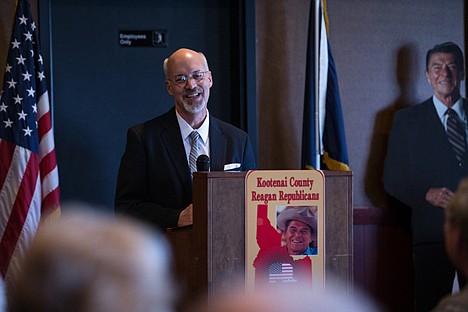
<p>Lansing Haynes speaks about being a republican judge during a Kootenai County Reagan Republicans meeting Thursday.</p>
COEUR d'ALENE - What is it to be a conservative judge?
First District Judge Lansing Haynes made that question the title of his speech Thursday at a meeting of the Kootenai County Reagan Republicans at Fedora Pub and Grille.
"I can tell you that I have intentionally and volitionally have set out to be a conservative judge," Haynes said.
To the people who know him well, he said, there has never been a mystery where he stands.
"I'm conservative personally, conservative religiously, (and) conservative socially," Haynes said. "As chief deputy prosecutor for 18 years, I had somewhat of a reputation for being a so-called tough prosecutor."
He is also a former public defender, and was appointed to the bench by former Idaho Gov. Jim Risch, who is now one of the U.S. Senate's most conservative members. Haynes became the 1st District's administrative judge in April.
Haynes said he has strived to be a fair judge, being tough or lenient when needed, but always conservative.
"If you don't know who you are as a judge, you're not likely to know where you're going, and to know why you're going there, and what it takes to get there," Haynes said.
What it means to be a conservative judge is encapsulated in three words: ownership, intervention, and authority, he said.
As for ownership, he means judges must not take ownership of their courtroom, but must understand that it's the people's courtroom.
"It's the people's business that is being conducted in that courtroom," Haynes said. "All I do is call the balls and strikes over the process that goes on in that courtroom and make the decisions I'm called on to make."
He said it's not a principle of a conservative judge to deny requests for continuances made by parties in a case just to make it proceed through the courts faster. He also doesn't think it's a principle of conservative judging to make parties engage in mediation.
"In terms of the ownership of the case, it's their case," Haynes said. "It's not for me to tell them how they're best to reach justice."
As for intervention, he said, it's important for judges to make sure the government doesn't violate the rights of citizens. And it's important to protect the community - through their government officials - when one party's "liberty is being expressed to an excess" and causes damage or loss of dignity to another party.
As a conservative judge he maintains the perspective that an intervention into the liberties of citizens - in instances such as search warrants - should never become routine.
"It needs to be the extraordinary act, and not the ordinary act," he said.
Finally, he said his authority is limited by state law.
"So I guess I'm going to coin the phrase and call myself a 'statuteist,'" he said. "By that I mean I can only do those things that the Legislature authorized me to do."