
Freeze frame
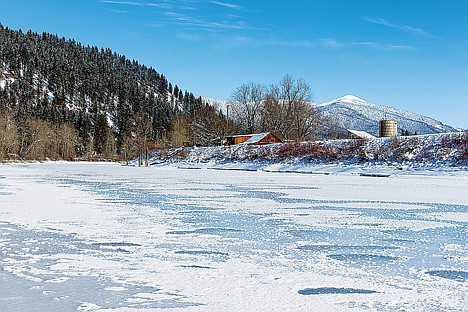
<p>Low temperatures have caused some rivers in the region to freeze over, including the St. Joe River near St. Maries.</p>
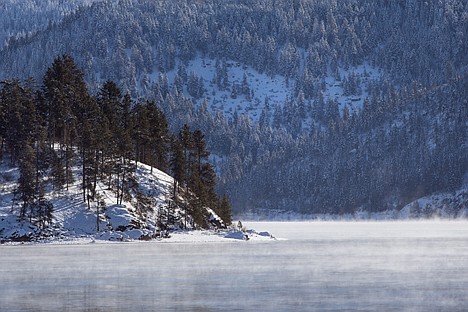
<p>A frigid scene from mid Thursday morning as steam rises from Lake Coeur d’Alene around Higgins Point.</p>
<p>A frigid scene from mid Thursday morning as steam rises from Lake Coeur d’Alene around Higgins Point.</p>
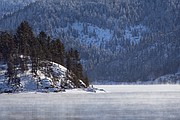
COEUR d'ALENE - You know it's frigid when Lake Coeur d'Alene shows obvious signs of freezing.
This week's bone-chilling temperatures have made the lake's shores turn to ice, but don't bother breaking out your skates.
"It won't be cold long enough for the lake to freeze over," said climatologist Cliff Harris.
Thursday's low of minus 8 degrees tied the record for Feb. 6 set in 1929. The temperature was as cold as it has been since Nov. 24, 2010, when it was minus 9.
With the wind chill factor, Thursday's temperature reached minus 11, Harris said.
Harris said the last time Lake Coeur d'Alene froze over was 2000.
His records indicate the ice became so thick during the winter of 1936 that vehicles were driven on the lake.
Thursday, Harris said, was the peak of the arctic front, as temperatures are now expected to rise and snow is coming.
Harris said as much as 10 inches of snow could fall between today and the middle of next week.
"We'll have a white Valentine's Day (Feb. 14 for guys who need a nudge) - even though it will warm up," he said.
Today and Saturday, temperatures are expected to reach near 20 degrees and may even get above freezing on Tuesday, Harris said.
The freezing St. Joe and St. Maries rivers, where ice dams have caused flooding during some years, has Benewah County Emergency Manager Norm Suenkel monitoring the situation closely. Both rivers are frozen over in some stretches and, when warmer weather breaks up the ice, dams can form.
Suenkel said low river levels - the St. Joe at St. Maries is nearly 7 feet below the normal summer level - and lower-than-normal mountain snowpack have prevented flooding concerns for now.
"The water level is so low that there's room for water to come in," he said.
But conditions can change in a hurry, Suenkel said.
"A week ago, the snowpack was 73 percent of normal," he said. "It's now at 83 percent. It all depends on how warm it gets and how fast it melts."
In some years, tugboats have been used to break up the ice to alleviate flood concerns. But Suenkel said it's too early to tell if that will happen this year.
"Long-range forecasts are difficult to make," he said.
Pat Maher of Avista Utilities, which has hydroelectric projects on rivers in the region, said his firm's biggest concern is ice dam buildup on the Clark Fork River that flows from Montana into Lake Pend Oreille.
"We can get some inconsistent (water) inflow," he said, adding that the Clark Fork projects produce 60 percent of Avista's hydroelectricity.