
Transplanting Oregon bighorns helps their recovery
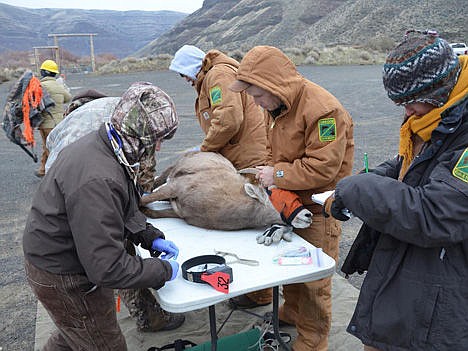
<p>A California bighorn is prepared for a tracking collar at the John Day River Canyon in Oregon in December.</p>
BEND, Ore. (AP) - It's not easy to catch bighorn sheep in canyon country.
The Oregon Department of Fish and Wildlife uses a helicopter and four-barrel net gun to capture the animals annually around Oregon, including earlier this month in the Deschutes and John Day river canyons.
"Kind of like the name implies, it's a gun that shoots a net," said Corey Heath, Deschutes district wildlife biologist for Fish and Wildlife in Bend.
In recent years, the two river canyons have been the main source of California bighorn sheep that are transplanted around the state. Wiped out of Oregon in the 1940s by unregulated hunting and disease brought by the introduction of domestic sheep, bighorn sheep are recovering.
The state's effort to restore bighorn sheep started in 1954 when 20 bighorns were moved from British Columbia to the Hart Mountain National Antelope Refuge in Lake County, according to Fish and Wildlife. Statewide, scientists today count about 3,500 to 3,700 animals.
Of those, about 500 to 550 roam the Deschutes River Canyon, and another 400 to 600 live in the John Day River Canyon, said Don Whittaker, ODFW ungulate species coordinator. Ungulates are animals with split hooves, such as deer, elk and sheep.
"They are in pretty good shape," he said.
Fish and Wildlife has two main reasons for relocating bighorn sheep, a nearly annual event at this time of year. One is to create genetic diversity in a given location, and the second is to improve populations around the state. Each year, the department generally relocates 20 to 80 bighorn sheep.
"Research conducted in Oregon shows we need to mix up the genetics of the herds," Whittaker said in a news release. "Higher genetic diversity leads to better population performance and we hope to see population increases, too."
Scientists do not want bighorns that are already doing well, such as those in the Deschutes and John Day river canyons, to grow overpopulated and become prone to disease.
"We don't want them to get too dense in any one area just because of the disease issue," said Heath, who was among the team of Fish and Wildlife workers who collected and relocated bighorn sheep in the two canyons.
The helicopter used in the capture of the sheep was not just a platform for the net gun. The team used the helicopter to find the animals, which Heath said frequent rocky canyon sides, and then carry them out of the canyons once ensnared in a net. Depending upon the success of the search, the line of bighorn sheep dangling beneath the helicopter sometimes reached six or seven animals.
In all, Fish and Wildlife captured 15 sheep in the Deschutes River Canyon and transported them to the Alvord Peaks in Harney County, and 20 sheep in John Day River Canyon went to the McClellan area in Grant County. Another 26 bighorn sheep captured near Branson Creek in Grant County went to the Klamath River Canyon near Klamath Falls.
Some of the sheep released into new terrain carry GPS transmitters, which will aid wildlife managers monitoring their location. Fish and Wildlife also plans to conduct periodic aerial and ground surveys of the bighorns.
Bighorn sheep are one of the rarest game mammals in Oregon, with Fish and Wildlife issuing fewer than 100 tags for them last year, according to the agency.
"Those tags are a once-in-a-lifetime tag," Heath said. "Thousands of people apply."