
Cloud seeding used to boost snowpack

IDAHO FALLS (AP) - A warm and dry Idaho winter might be on the way, weather experts say.
That means some state water managers will be turning to the decades-old technology of cloud seeding to squeeze every last snowflake out of the storms that do appear.
Idaho Power officials said last week they are ramping up cloud-seeding operations in the upper Snake River Valley, as well as the Payette River basin near Boise. Another eastern Idaho cloud-seeding effort, operated by the High Country Resource Conservation and Development Council, also is up and running for the winter.
"The goal is more water in the Snake River basin," Idaho Power meteorologist Derek Blestrud said.
Why cloud seeding?
Idaho Power has determined cloud seeding can increase snowpack levels by as much as 14 percent, Blestrud said, though measured benefits in some areas have been less than half that amount.
More snow equals more runoff. That translates into more water for plants, animals and irrigation later into the summer. For Idaho Power, it also means more power generated by downstream hydroelectric dams, which are the company's primary source of generation capacity.
Idaho Power coordinates its cloud-seeding efforts with the High Country Resource Conservation and Development Council, based in St. Anthony.
The nonprofit's board includes elected leaders from nine counties. Cloud seeding first came to eastern Idaho more than two decades ago, though it was not until 2008 that a more organized, large-scale seeding effort occurred.
Despite one big snowstorm last month and an unusual deluge of rain in August, Idaho meteorologists predict precipitation and temperature trends could reverse heading into winter. Snowfall totals were below average for Idaho Falls and Pocatello in November, National Weather Service meteorologist Alex Desmet said.
A warmer and drier winter could happen because of a tropical weather pattern known as an El Nino, said Weather Service climatologist Troy Lindquist, in a recent webinar hosted by the Idaho Barley Commission. The occasional ocean-atmospheric phenomenon affects weather patterns around the globe.
But forecasting for a phenomenon such as El Nino, particularly in Idaho, is "not a perfect science," Blestrud said. "It's an educated guess, at most."
What is becoming more exact, however, is the science behind cloud seeding. While it can't make a storm appear, the technology can help wring just a little more precipitation out of clouds that do pass through.
"We're starting to get some real hard data now," said Lee Miller, a Fremont County commissioner who serves on the High Country Resource Conservation and Development board. "For us, it's good for the irrigation and the recreation and the fisheries - those are our main interests."
Blestrud and Shaun Parkinson, Idaho Power's water resources leader, said they are becoming more confident of the positive effect cloud seeding has on water levels, too.
In the Upper Snake region, for example, the scientists have determined an average of 270,000 acre-feet of additional water per year can be attributed to seeding, through modeling and river measurements.
Still, some argue the benefits of cloud seeding remain opaque.
"Although the principles behind it are well established, it is difficult to prove that a given round of cloud seeding produced a particular effect because it is difficult to know what would have happened otherwise due to natural variability," a fact sheet from the University Corporation for Atmospheric Research said.
Cloud seeding 101
Blestrud and three other Idaho Power meteorologists already are keeping an eye out for storms with a perfect cloud-seeding combination of temperature and wind direction.
They use weather balloons, surface gauges and other instruments to hunt for the ideal storm, always looking at least three days ahead.
When the right storm appears, they remotely switch on 20 generator towers that are spread out along high-elevation ridges, reaching from Island Park to Soda Springs. Some of the generators already have seen about 10 hours of use since Nov. 1, Blestrud said.
High Country Resource Conservation and Development Council operates another 25 generator towers in eastern Idaho, however they must be turned on manually, and are mostly at lower elevations.
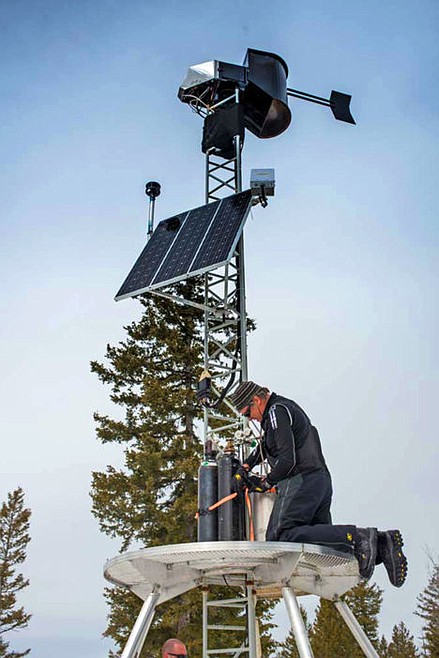
Generators are equipped with a propane torch mounted to 30-foot tower. The torch burns silver iodide, which drifts up in tiny particles to seed the clouds. The particles attract water droplets in the cloud and effectively "teaches" them how to freeze and turn into precipitation, Blestrud said.
"We're trying to target the seeding agent into an area of the cloud that has below-freezing water," he said. "Once the (silver iodide) particles come into contact with the water, it starts the process of growing a snowflake."
The generator towers must be upwind of where the "target" clouds are located, Blestrud said. Eventually, snowflakes fall out of the cloud, usually about five to 15 miles downwind from the generator towers.
Growing trend
Outside the Upper Snake region, Idaho Power's other primary seeding operation is around the Payette Basin, where it operates 23 generator towers and two airplanes. Airplanes can release silver iodide deeper inside a cloud, where the coldest water often is hiding.
Each generator tower costs about $35,000, Parkinson said. They are portable and can be moved with a pickup truck. The company employs four meteorologists and five technicians who work on the project.
Idaho Power's seeding program budget stands at about $1.6 million per year, Parkinson said, but he expects that to grow considerably over the next few winters. More research is coming out, including a report by the state of Wyoming, which should give better long-term evidence of cloud-seeding's benefits.
Eventually, Parkinson said there could be from 30 to 40 generator towers operated by Idaho Power in eastern Idaho, and perhaps as many as 80 throughout the state.