

Matt Handelman: 'The noblest profession'
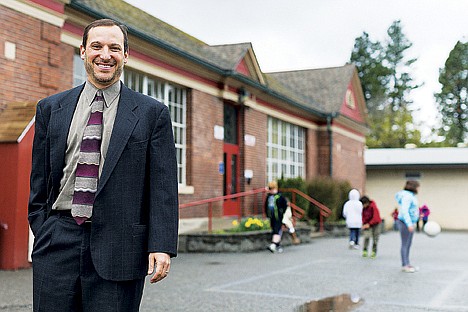
<p>Matt Handelman was named superintendent of Coeur d’Alene School District last fall.</p>
COEUR d'ALENE - Growing up, Matt Handelman's career path pointed toward a profession involving law books, not school books.
But Handelman, who is completing his first year as superintendent of the Coeur d'Alene School District, decided against following in the footsteps of his father and grandfather, both lawyers. Instead, he took a path blazed, as he says, by his grandmothers, and decided to become an educator.
There was a brief flirtation with a career in professional baseball management, but Handelman stayed true to teaching.
Before his hire by the Coeur d'Alene School District in 2010, Handelman was a school principal in Spokane.
In Coeur d'Alene, he served as associate superintendent under Hazel Bauman until the end of last year, when Bauman resigned from the superintendent's position. Handelman stepped into the role of interim superintendent July 1.
Last fall, the school board decided to forgo a superintendent search, and moved Handelman into the permanent superintendent's position.
In this email interview completed this week, Handelman shares with The Press a little of his personal journey into teaching, and what it's like to be the superintendent of schools in Coeur d'Alene.
How long have you lived in the Pacific Northwest? What brought you here?
I've lived here since 1990. After living and teaching at an Episcopal school in New York City for two years after college, I decided to seek greener pastures, literally and figuratively. I had two great friends - one from high school and one from college - who had grown up in Portland (Oregon). One of my brothers also was living there at the time, and still is. I chose Lewis & Clark College to pursue my Master's in Teaching and have been in the Pacific Northwest ever since. I was in Portland for about a year, Seattle for 10, Spokane for nine, and now beautiful Coeur d'Alene for almost four years.
When did you decide to become an educator? What led you to that career choice?
Growing up, I always thought I wanted to follow in my father's footsteps and become a lawyer - he had followed in his father's footsteps, and they practiced law together. However, when I was in college and met so many people who wanted to become lawyers, bankers, management consultants, I thought I'd pursue something different. I took one class in college, "The Sociology of Education," which really was most influential in my decision and direction to become an educator. I read a book called "Horace's Compromise," written from the perspective of a high school teacher, which I think sealed it for me. Why not "the noblest profession," and follow in the footsteps of my grandmothers instead?
If you hadn't gone into education, would you have become a lawyer?
Actually, I mentioned the law and I still have a passion for it. However, the one other job I pursued out of college was through an executive internship program that Major League Baseball was offering at the time. After accepting my first teaching job, I was offered an interview with the Boston Red Sox through this program. Interestingly, several MLB general managers went to my small college in Western Massachusetts, including the current GMs of the Red Sox and the Pittsburgh Pirates.
How many hours would you say you work each week, and what keeps you going when things become challenging?
Well, I'm writing the answers to these questions at 10:45 at night, if that gives you any idea. My average work day is 10 hours, Monday to Friday, but I usually have one or two night meetings a week in addition to that, plus I'm catching up on emails and other paperwork for at least a couple of hours each night and on weekends.
What keeps me going when things become challenging? My wife, my kids, a good bike ride and the knowledge that the work I'm doing is so important for all of our kids and for the entire community.
What's your favorite day in the school year? Why?
As a teacher, the anticipation of the first day of school was always, of course, the favorite - meeting the kids, getting a sense of what the year would be like.
As a principal, that anticipation shifted to the first day the staff was back at work for similar reasons.
Now, as superintendent, that shifts to the first day that principals are back in August. However, the Back to School Breakfast, when all staff is together the week before school, is incredibly energizing.
What's the most frustrating thing you deal with regularly, as a superintendent, beyond finance-related issues?
I'd say it's my schedule. My meetings are so often back-to-back-to-back that I don't feel like I give ample attention to every person and issue, even if I try my best. It is always "the next thing" that needs my attention. I would like to have more time to both reflect and be more proactive, rather than reactive.
What is the most significant change you've seen in education during your career?
Though there are a lot of factors that have led to this (brain research, standards, No Child Left Behind, to name a few), I'd say that it's the increased understanding and focus on each student's growth. When I was teaching, it was before the standards movement, and there was a lot less clarity about what needed to be taught and what the best methods were to teach it. Now, teachers are so focused and skilled not just at building relationships with their kids, but also at understanding how to meet their needs.
If a magic genie gave you the power to make three wishes come true for the school district, what would they be?
First, I'd make sure that every student was coming to kindergarten with adequate and ample pre-kindergarten skills - and never coming to school hungry or traumatized by their environment.
Second, I'd make sure we had enough financial resources to provide the support and innovation necessary to meet every student's needs and create more individualized learning paths throughout a child's K-12 experience. Having the funding to not only attract but also retain the best of the best educators from around the country to come live, work and play in North Idaho would also be a wonderful dream.
Third, I'd enhance the ways all community members have the opportunity to see and understand what we do every day for our students. Many people haven't set foot in a public school in 20, 30 years or 40 years. Practices have changed; needs have changed. To fully appreciate and assist in supporting what we do requires hands-on observation.